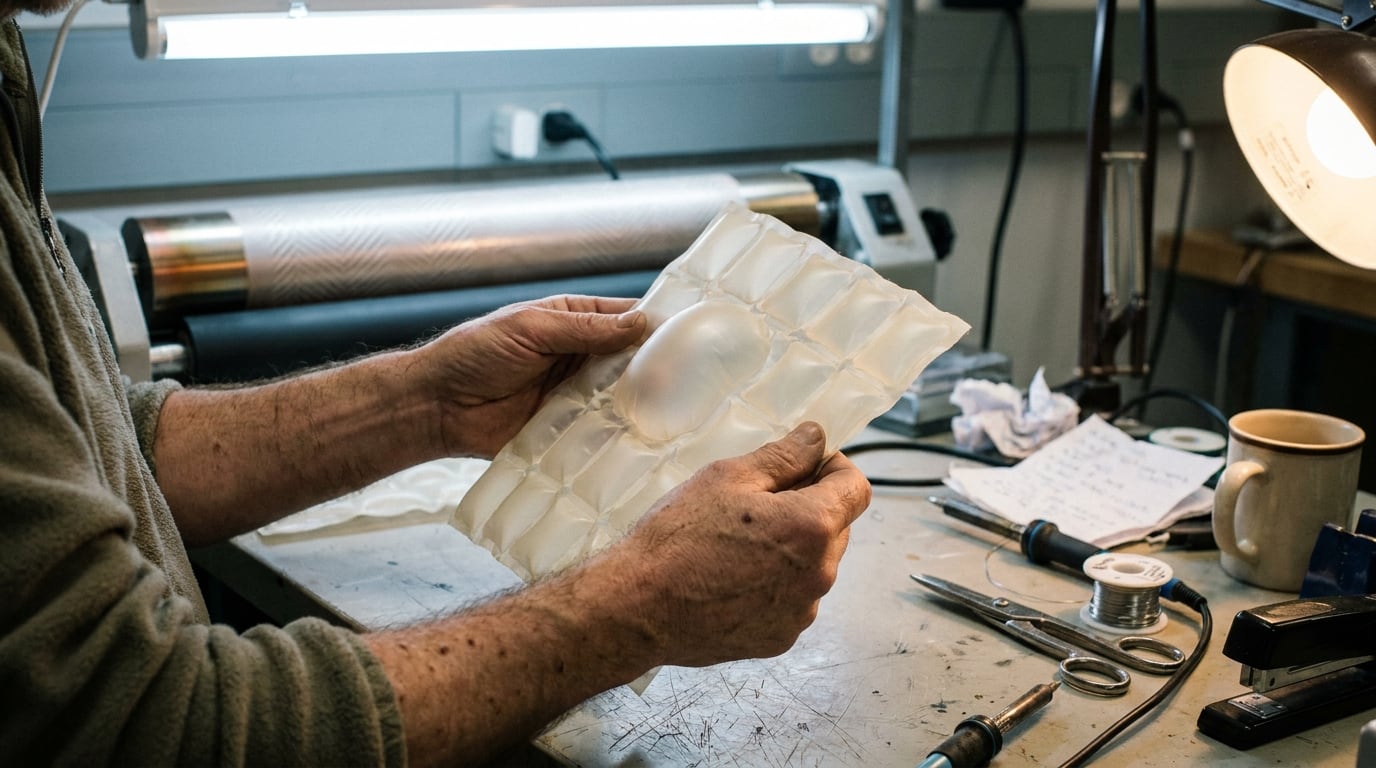
What was built
Researchers at the University of Michigan College of Engineering have developed FaBrick, a pneumatically actuated fabric embedded with a grid of inflatable pouches. The design drew inspiration from modular building blocks such as LEGO bricks, according to the university's press release. The work is published in Science Advances as a peer-reviewed study led by Mingyuan Li, a doctoral student of mechanical engineering, with Daniel Bruder, an assistant professor of mechanical engineering, as senior author.
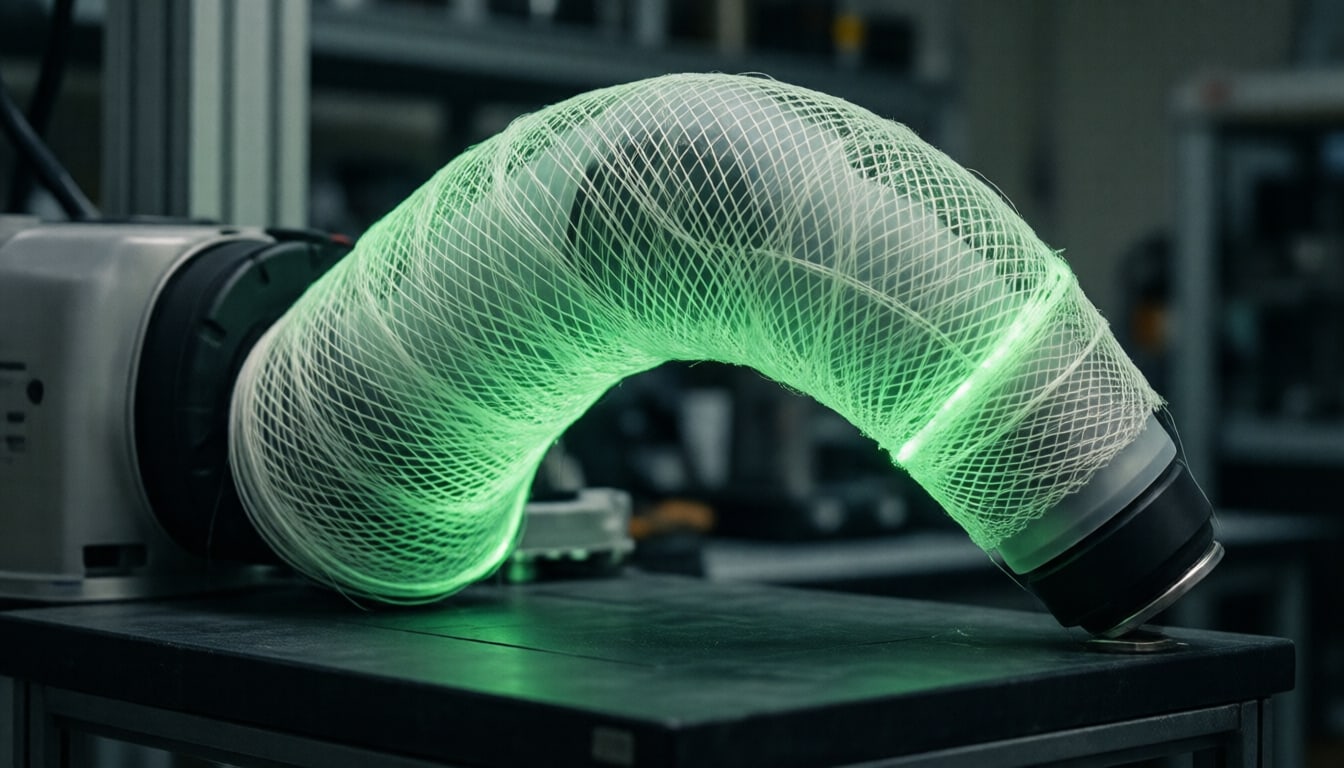
According to the study abstract, the same material can be configured through folding, cutting, sealing and stapling to reproduce the contractile, twisting, rotational and bending motions of other soft pneumatic actuators. The researchers integrated the actuators into wearable robotic limbs, a one-piece adaptive gripper, an elephant trunk-inspired manipulator and a quadruped-like locomotion robot.
How it works
A roll of two TPU-coated fabric layers passes through a patterned, heated roller on top and a rubber roller below. Heat and pressure laminate the material only at the raised regions, forming sealed pouches while leaving connecting channels open, according to the press release. The process is roll-to-roll, and the researchers say FaBrick could be mass-produced in sheets of any size; the paper describes production at arbitrary lengths.
A finished sheet resembles a chocolate bar, with rectangular inflatable motor cells arranged in columns and rows. Connected to an air inlet, each airtight pouch inflates into a bulged shape, shortening its length and generating force, similar to a muscle flexing. Sheets start with open channels between neighbouring cells, so a single air inlet can inflate the whole sheet. Strategically closing off connecting channels produces actuators that contract, twist, bend, rotate and stiffen.
Li said the same roll of fabric can give a muscle that contracts, a finger that bends and a wrist that twists, using scissors, a soldering iron and a stapler as post-processing tools. Bruder said the approach pushes fabrication difficulty upstream into a heat-rolling process that happens once.
How it was tested
The study abstract states that each actuator type was fabricated, modelled and experimentally validated. The press release describes a series of demonstrations: a gripper cut from a single FaBrick sheet that conforms to whatever item it holds; a FaBrick sleeve that assists elbow, shoulder and wrist motion without adding bulk; and a soft robot with four legs, each made of a FaBrick cylinder, that walked by contracting different sides of each leg to make it bend and step.
What is not yet proven
The press release frames wearable assistance and rehabilitation as future possibilities: in future devices, the assisted motions could support physical therapy for stroke recovery, Parkinson's disease and postsurgical rehabilitation.
Build details
The build uses two TPU-coated fabric layers, a patterned heated roller and a rubber roller, with scissors, a soldering iron and a stapler for post-processing.
Build sheet
- Material: two TPU-coated fabric layers, heat-laminated
- Production: roll-to-roll, sheets of arbitrary length
- Cells: rectangular inflatable pouches in columns and rows
- Post-processing tools: scissors, soldering iron, stapler
- Actuation modes: contraction, bending, twisting, rotation, stiffening
- Demonstrations: gripper, wearable sleeve, elephant trunk-inspired manipulator, quadruped robot
- Validation: each actuator type modelled and experimentally validated (study abstract)
Sources
- FaBrick: An actuated fabric building platform for constructing scalable and versatile soft robots — Science Advances — Mingyuan Li, Russell Dickerson, Runze Zuo et al.
- Inflatable FaBrick enables soft robots to contract, bend and twist — TechXplore (Robotics)
Discussion
Technical questions and corrections are welcome. Comments are signed and checked before they appear.
No comments yet.
Sign in to add a typed review comment. Reviews are signed with your name.