What was built
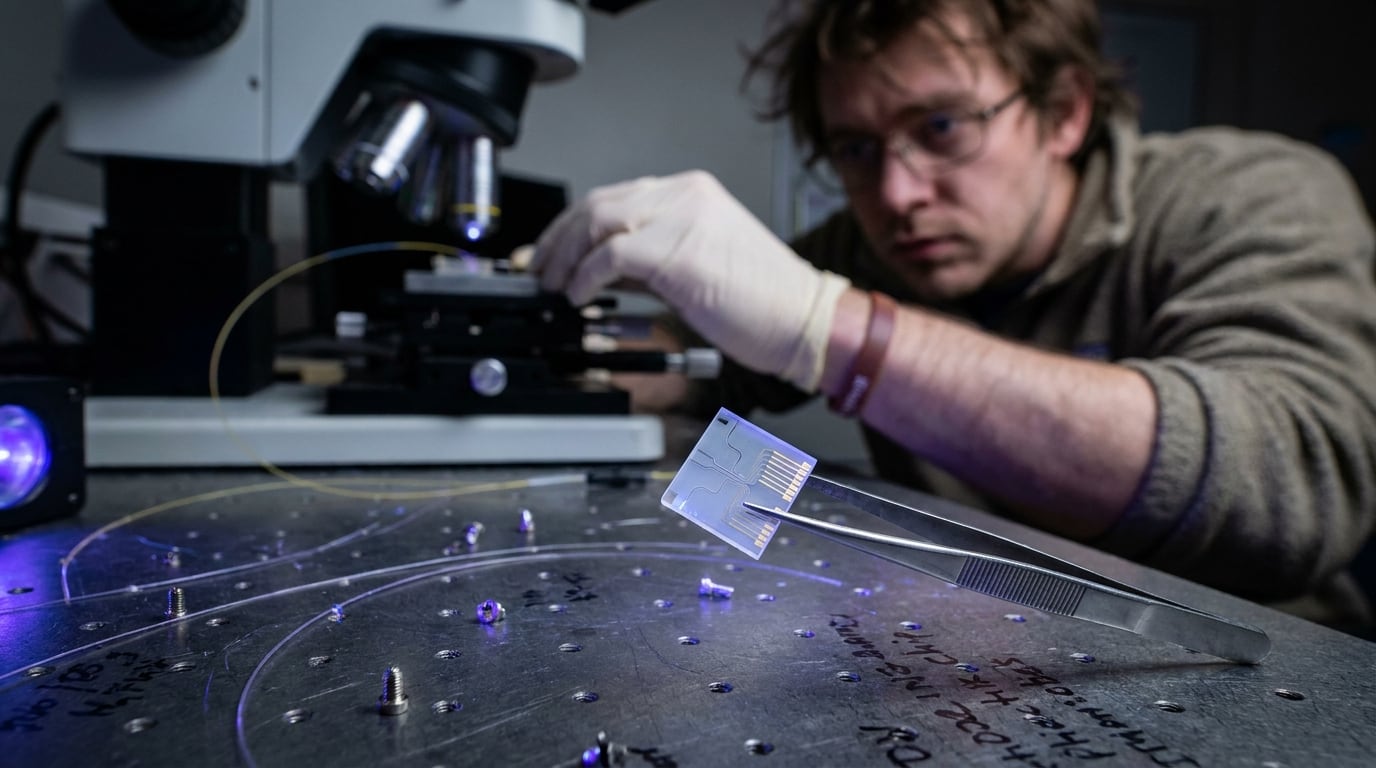
A Harvard-led research team in the laboratory of Marko Lončar, the Tiantsai Lin Professor of Electrical Engineering, has demonstrated a microscopic photonic device that generates ultraviolet light on a chip. The work is published in Nature Communications as "Milliwatt-level UV generation using sidewall poled lithium niobate".
The device is intended as a compact on-chip UV source for applications the researchers name: trapped-ion quantum computers, ultra-precise atomic clocks and compact sensors for greenhouse gases and other atmospheric pollutants. According to the researchers, many of the atomic energy transitions needed to operate trapped-ion quantum computers involve light in the near-ultraviolet part of the spectrum.
How it works
The device is built on thin-film lithium niobate. Rather than delivering ultraviolet light through microscopic channels, it generates UV light from red light inside the chip through frequency upconversion: two photons of red light combine inside the lithium niobate crystal to produce a single ultraviolet photon with higher energy.
Light is carried in optical waveguides, microscopic channels etched into the lithium niobate film. For efficient conversion, the orientation of regions within the crystal must be reversed at precisely controlled intervals along the waveguide, a manufacturing process called poling.
The team's technique, which they call sidewall poling, places precisely patterned metal structures resembling tiny fingers directly alongside the etched waveguide instead of exclusively above the lithium niobate film. A small voltage is applied during fabrication to permanently reverse the orientation of the crystal domains in a controlled pattern. According to co-first author and former graduate student Soumya Ghosh, positioning the electrodes required about 50-nanometer accuracy.
The arrangement reversed the crystal domains throughout the entire cross section of the waveguide. The team also fine-tuned the spacing of the reversed crystal regions along the device, incorporating adapted poling techniques previously developed in Lončar's laboratory and elsewhere, to compensate for variations in the lithium niobate film thickness and waveguide shape.
How it was tested
The researchers report that the device generated 4.2 milliwatts of ultraviolet power directly on the chip at a wavelength of 390 nanometers. That is approximately 120 times the output power achieved by the best previous thin-film lithium niobate devices operating in this wavelength range, which generated only tens of microwatts of UV power.
The paper reports record-low propagation losses of 2.3 dB/cm, complete domain inversion across the waveguide cross-section, an optimum 50% duty cycle and a record-high normalized conversion efficiency of 5050 % W−1 cm−2.
What is not yet proven
Co-first author Kees Franken, a former research fellow in the Lončar lab, said the team also shows that some other nonlinear effects are happening that they do not fully understand yet.
Build sheet
- 4.2 mW — on-chip UV output power at 390 nm wavelength
- ~120× — output power versus the best previous thin-film lithium niobate devices in this wavelength range
- 2.3 dB/cm — propagation loss reported for the sidewall poled waveguides
- 5050 % W−1 cm−2 — normalized conversion efficiency reported
- 50 % — optimum poling duty cycle reported
- ~50 nm — positioning accuracy required for the electrodes
- Tens of µW — UV power of earlier experiments with the material
Sources
- Milliwatt-level UV generation using sidewall poled lithium niobate — Nature Communications — C. A. A. Franken, S. S. Ghosh, C. C. Rodrigues et al.
- Harvard’s tiny UV light chip could help shrink quantum computers — ScienceDaily (Engineering)
Discussion
Technical questions and corrections are welcome. Comments are signed and checked before they appear.
No comments yet.
Sign in to add a typed review comment. Reviews are signed with your name.