What was built
A research team led by Professor Soon Moon Jeong of the Department of Advanced Technology at the Graduate School of Engineering Practice at DGIST has developed a tubular mechanoluminescent fibre and used it as a battery-free optical sensor for soft robots. The work is published in the peer-reviewed journal Small Structures.
The fibre is designed to address a known problem in soft robotics: soft robots made from flexible materials such as rubber or silicone move like octopus arms or human muscles, but detecting their subtle movements traditionally requires attaching numerous rigid electronic sensors and wires, which the DGIST release says poses a major challenge to keeping the robot flexible. The paper describes the mechanical mismatch between conventional sensors and highly compliant actuators as the specific difficulty for pneumatic soft robots.
How it works
The fibre relies on mechanoluminescence, in which a material emits light on its own when subjected to external mechanical forces such as stretching, bending or pressure, according to the release.
The researchers made the fibre by encapsulating a self-recoverable zinc sulphide–copper–PDMS composite (ZnS:Cu–PDMS) inside an elastic silicone tube, as described in the paper's abstract. The release states that luminescent zinc sulphide particles were mixed with a flexible polymer material and that this mixture filled an elastic silicone tube.
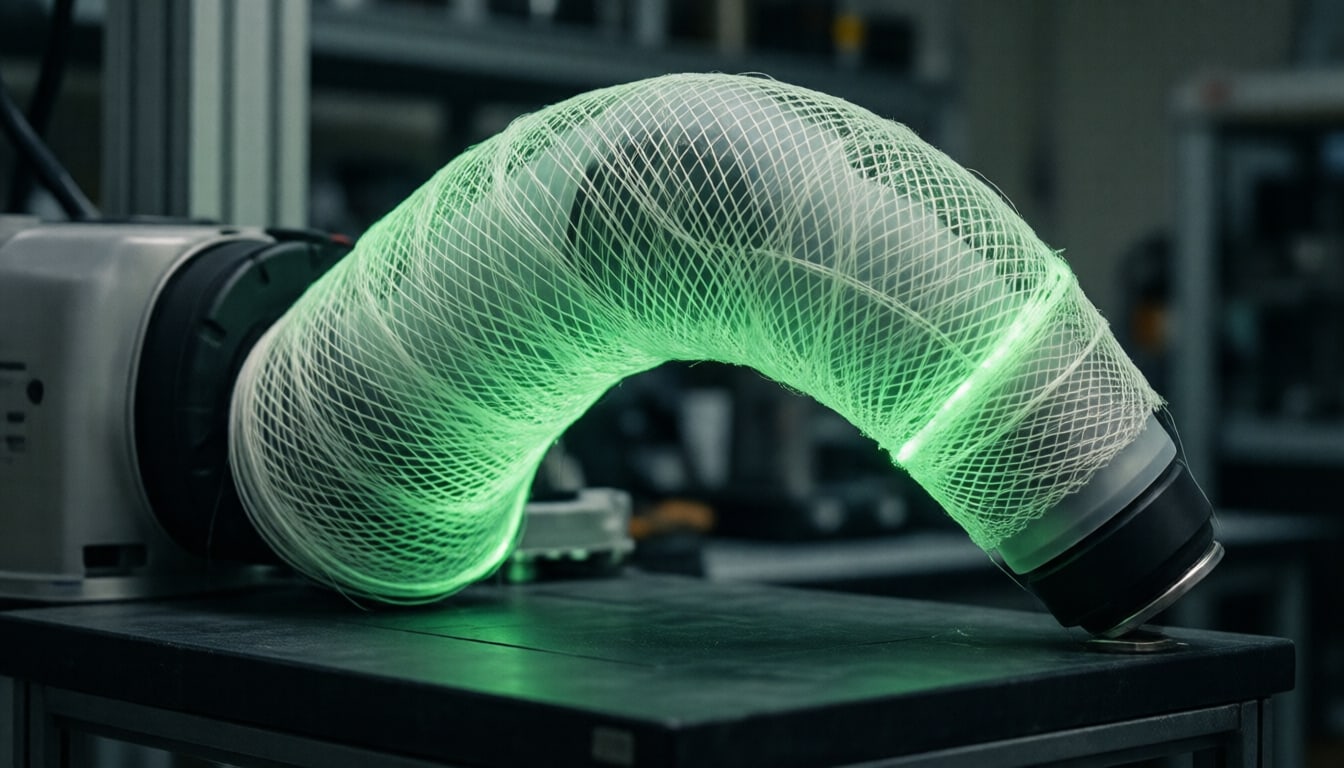
In the robot demonstration, the team covered the surface of a soft robot with a mesh-like, woven network of the fibres and then operated it. Green light was emitted immediately from the areas undergoing deformation whenever the robot moved, which the team describes as a battery-free optical sensor that lets bending and stretching be observed directly without an external power supply or attached sensors. The paper calls the result qualitative visual monitoring of robotic motion, achieved without wiring, signal-processing circuits or external power sources for sensing.
How it was tested
The release reports that the fibre withstood stretching to more than twice its original length (200%) and reliably maintained its initial light-emitting performance after more than 1,000 stretching–release cycles. The paper's abstract states that the fibre sustains tensile strains exceeding 200% and maintains stable mechanoluminescent responses under repeated deformation.
The robot test consisted of covering a soft robot with the fibre network and operating it; the reported observation is that green light appeared from deforming regions as the robot moved. The sources describe this as qualitative visual monitoring rather than a calibrated measurement of deformation.
What is not yet proven
The paper characterises the light emission as enabling qualitative visual monitoring of motion, and the sources do not describe quantitative mapping of light output to specific strain values.
Jeong states that the team plans to further improve the light-emitting performance and durability of the fibres and to expand their applications to wearable devices and artificial skin for human–robot interaction, indicating that these uses lie ahead rather than being demonstrated in this work.
Build details
The sources name the key materials — zinc sulphide (ZnS:Cu) particles, a PDMS composite and an elastic silicone tube — and describe the fibre network as woven over the robot.
Build sheet
- Stretchability: tensile strains exceeding 200% (more than twice original length)
- Durability: initial light-emitting performance maintained after more than 1,000 stretching–release cycles
- Emission colour in robot test: green light from deforming regions
- Materials: ZnS:Cu–PDMS composite inside an elastic silicone tube
- Integration: woven mesh-like network covering the soft robot surface
- Power for sensing: none — no battery, wiring or signal-processing circuit
Sources
- Motion‐Driven Self‐Visualizing Soft Robots Enabled by Mechanoluminescent Tubular Fibers — Small Structures — Minseok Lee, Seongkyu Song, Soon Moon Jeong
- Self-illuminating fibers reveal soft robot movements without batteries or complex electronic circuits — TechXplore (Robotics)
Discussion
Technical questions and corrections are welcome. Comments are signed and checked before they appear.
No comments yet.
Sign in to add a typed review comment. Reviews are signed with your name.