What was built
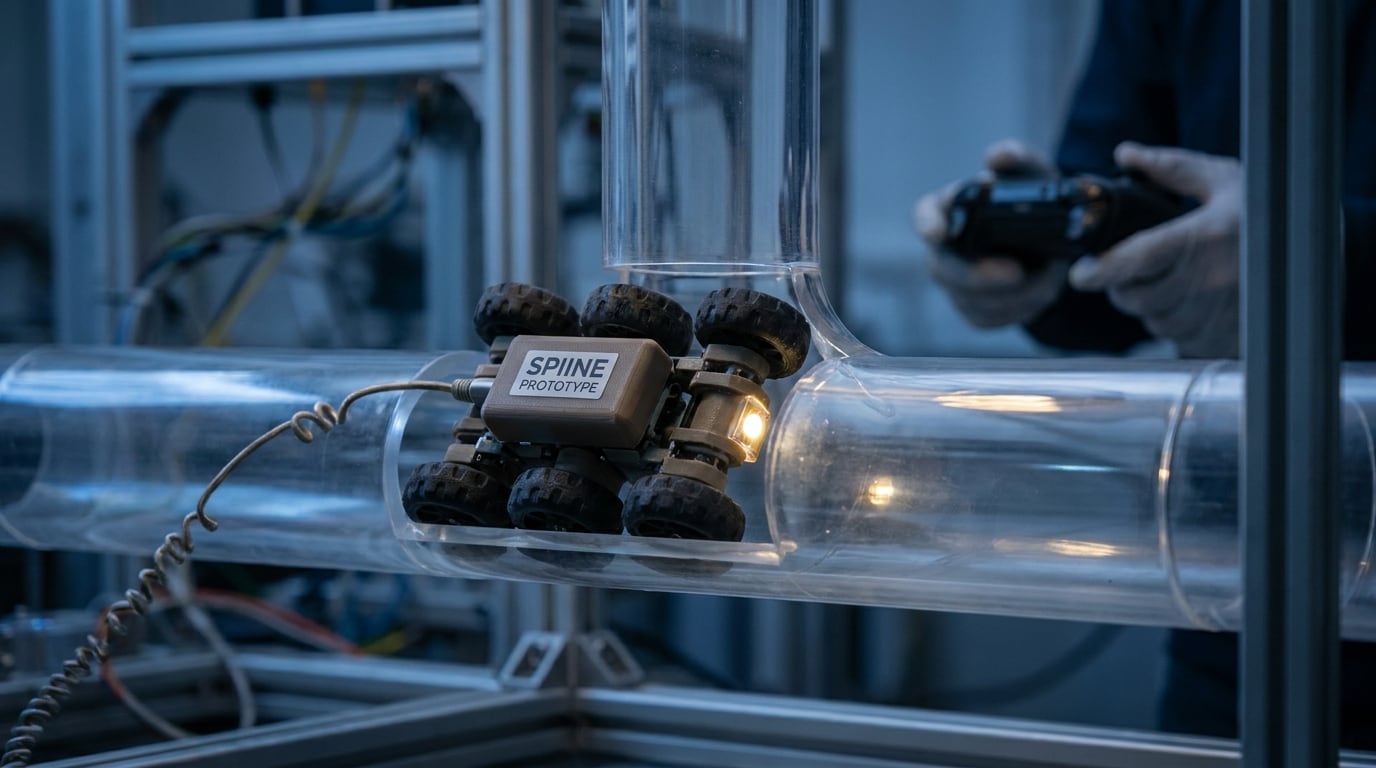
A team at Sandia National Laboratories led by mechanical engineer Steve Buerger, with Daniel McArthur, Derya Tansel, Clint Hobart and Josh Ortiz, has designed a robot called SPIINE — Self-Propelled Interior Inspector for Non-destructive-testing Examination — to inspect the underground waste-transfer pipes at the Hanford Site in Washington state, a decommissioned nuclear production complex managed by the US Department of Energy. According to the researchers, the pipes are double-walled, run hundreds of feet in various directions and measure as little as 2 inches (5.1 centimetres) in diameter.
The robot measures 2 inches (5.1 centimetres) by 6 inches (15.2 centimetres). It has a multi-axis body, adaptive wheels, steering capability and a high-resolution camera with adjustable LED lighting, and is controlled with a standard video game controller. Its motors are intended to carry a payload such as an ultrasonic or electromagnetic field probe to measure pipe thickness. The design is described in the peer-reviewed journal Robotics.
How it works
SPIINE is a compliant six-wheeled robot intended to navigate 53 mm (2 in) inner-diameter pipes with tight 90° elbows, including elbows with a curvature radius as small as 76 mm (3 in), while transmitting power and high-resolution video over long tethers verified to 110 m. Buerger describes the aim as a flexible body that lets the pipe guide the robot: "It's really designed to conform to those pipe walls, roll in the pipe and steer and reorient itself if needed."
The robot is designed to use a single cable that transmits power and data while bearing mechanical loads, and to allow multiple robots or propulsion modules to be tied together in series with additional payloads attached. The team says this addresses the capstan effect, in which the force needed to drag a cable grows with the number of bends it passes around; propelling the cable at several points along its length reduces that effect. Buerger says the team had to experiment with different elastomeric compounds for the wheels to find what interfaced best with pipe walls, and to transmit power efficiently from small motors with limited force.
How it was tested
The paper reports prototype hardware tests that evaluate the accuracy of the team's analytical models for robot stiffness and normal-force generation. Across the tested displacement range, the vertical reaction-force model achieved a root-mean-square error of 0.21 N, and pull-force estimates for two tested pipe configurations were within 7–13 % of measured values.
In hardware experiments, SPIINE traversed a tight 90° elbow in forward and reverse at eight tested entry roll orientations spanning 360°, generated 16.5 N of pull force in straight steel pipe, and traversed more than 60 m of mixed horizontal and vertical pipe with measured power consumption of approximately 2–3.5 W across representative test segments. In straight steel pipe the robot can generate more than eight times its weight in pull force to support towing of NDT sensor payloads, according to the paper.
What is not yet proven
The tests described are laboratory tests at Sandia. The next step is to test the robot in the real world; the team states that tests at Sandia have been successful but that seeing SPIINE at work at the Hanford Site could reveal new challenges.
The team already knows of issues to tackle: a self-cleaning function so the robot can wipe its camera lens or clean a dirty pipe wall, and a built-in fail-safe recovery system in case the robot becomes stuck or disabled. Researchers are also exploring microscale ultrasonic sensors that would fit on the robot, because conventional sensors do not fit through a 90° turn. Earlier inspection attempts are cited as limited: traditional push cameras travelled only about 10 feet (3 metres) at a time and could not manoeuvre tight 90° bends, and conventional ultrasound probes were often too bulky for smaller pipes with tight bends.
Build sheet
- Size: 2 in (5.1 cm) by 6 in (15.2 cm)
- Pipe size: 53 mm (2 in) inner diameter, 90° elbows down to 76 mm (3 in) curvature radius
- Pull force: 16.5 N in straight steel pipe; more than eight times its weight
- Tether: power and high-resolution video verified to 110 m
- Traversal: more than 60 m of mixed horizontal and vertical pipe
- Power: approximately 2–3.5 W across representative test segments
- Model accuracy: vertical reaction-force RMSE 0.21 N; pull-force estimates within 7–13 % of measured
- Elbow test: forward and reverse at eight entry roll orientations spanning 360°
Sources
- Design of a Compliant Six-Wheeled Robot for In-Pipe Inspection with Geometry Constraints — Robotics — Daniel R. McArthur, Derya Z. Tansel, Clint Hobart et al.
- Six-inch robot could inspect nuclear waste pipes beyond reach of conventional cameras — TechXplore (Robotics)
Discussion
Technical questions and corrections are welcome. Comments are signed and checked before they appear.
No comments yet.
Sign in to add a typed review comment. Reviews are signed with your name.