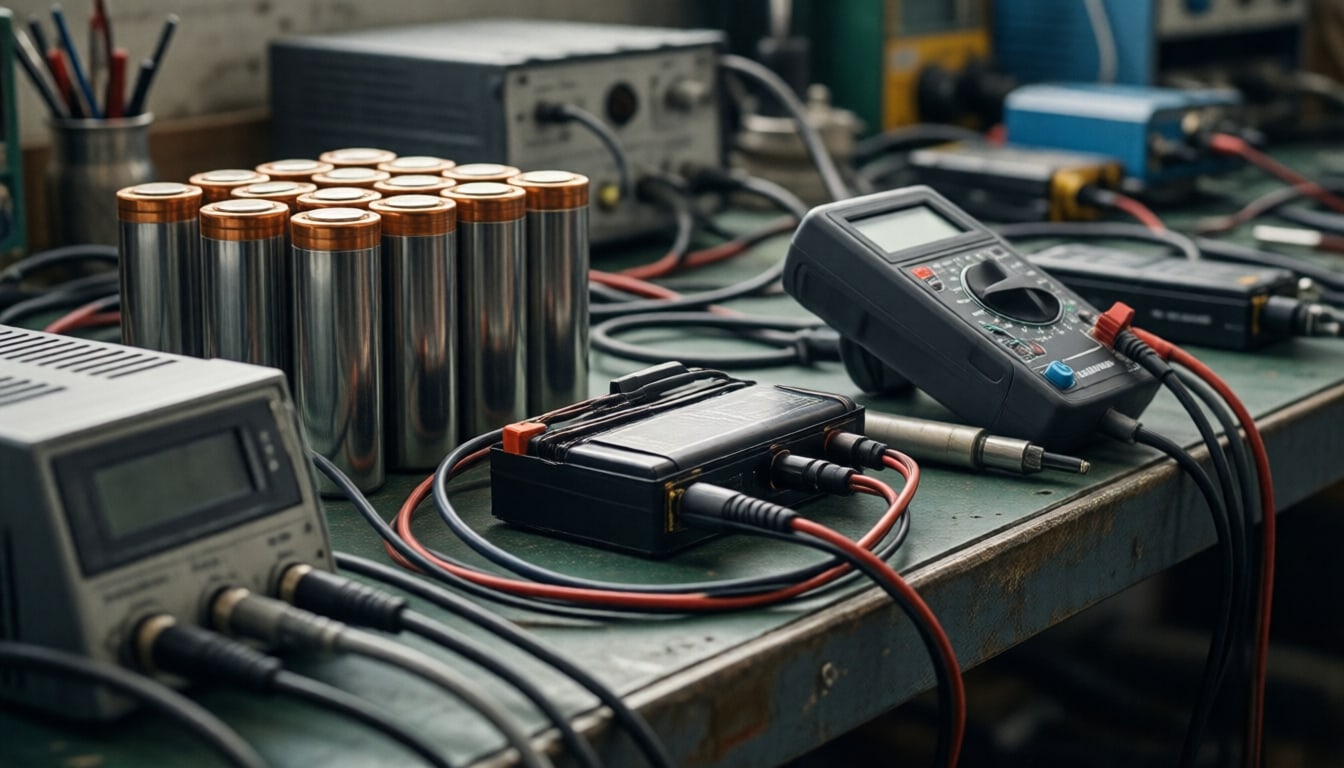
Two batteries both say "100 Ah". One is a 12.8 V LiFePO₄ pack, the other a 3.7 V cell. They are not remotely the same size. Ampere-hours measure charge; to compare energy you need watt-hours:
12.8 V × 100 Ah = 1,280 Wh, while 3.7 V × 100 Ah = 370 Wh.
Runtime
Divide the usable energy by the load's power. Usable, because you shouldn't drain most chemistries to zero: LiFePO₄ tolerates 80–90 % depth of discharge; lead-acid prefers about 50 %.
C-rate
The C-rate is current relative to capacity. 1C empties the battery in about an hour; 0.5C in two hours; 3C in twenty minutes. High C-rates cost usable capacity (voltage sags under load) and make heat — the losses scale with I²R inside the cell. That is why fast-charging cells need serious thermal design; see how a first-order thermal model handles that in our technical paper on cell temperature.
Series and parallel
Cells in series add voltage; strings in parallel add capacity. A "4S2P" pack of 3.2 V, 50 Ah cells is 12.8 V and 100 Ah. Energy is the same however you arrange them — only voltage and current change.
Use it
Discussion
Technical questions and corrections are welcome. Comments are signed and checked before they appear.
No comments yet.
Sign in to add a typed review comment. Reviews are signed with your name.