What was built
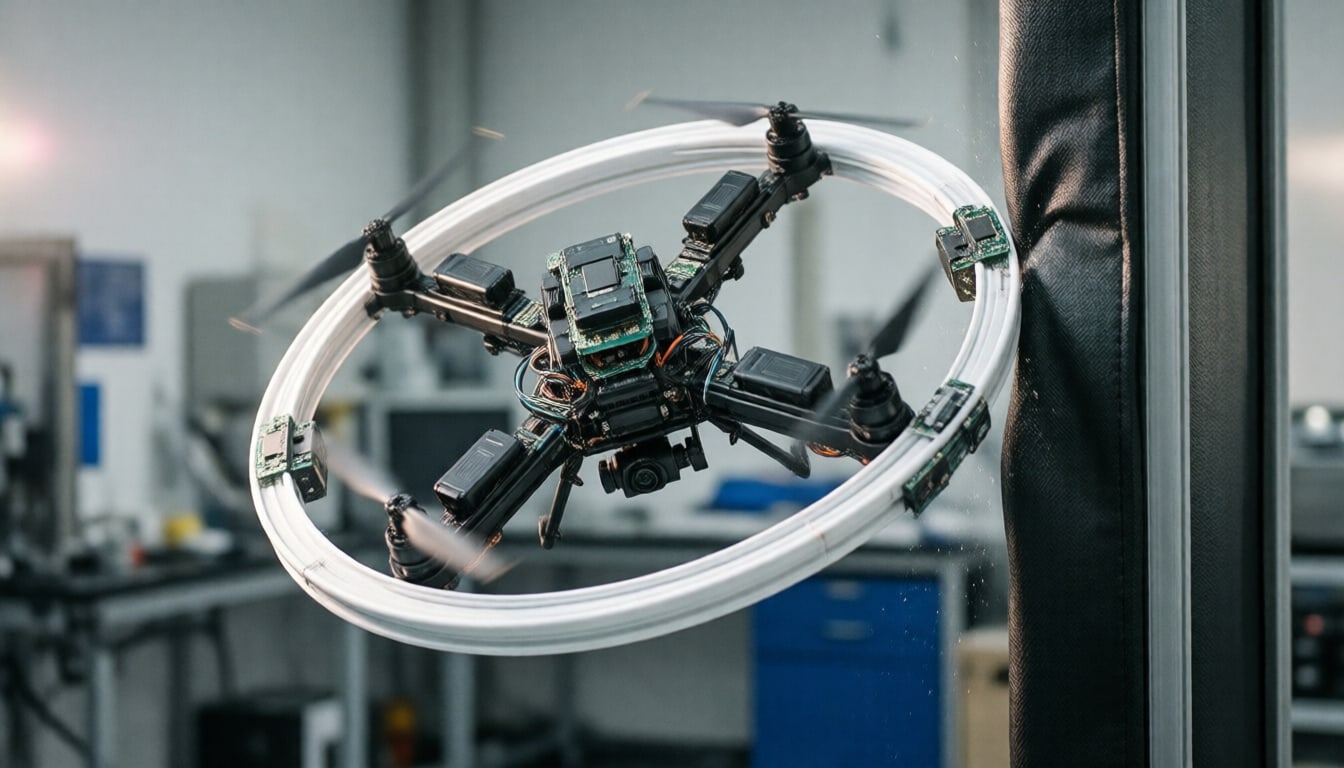
Researchers at ETH Zurich have built a quadcopter called FlexiQuad. Its frame is a soft, ring-shaped structure without a central body. The rotors, batteries and control module are evenly distributed along the frame, according to the researchers.
Luca Girardi and Stefano Mintchev developed FlexiQuad at the Environmental Robotics Lab. Mintchev was then a professor at ETH Zurich; he has since taken up a professorship in agricultural robotics at the University of Bonn. Girardi is now conducting research at the Mobile Robotics Lab at ETH Zurich. The pair has filed a patent application for FlexiQuad, and the invention has been nominated for this year's Spark Award.
The design addresses a weakness of conventional quadcopters. The researchers describe those drones as highly sensitive to unexpected contact with their surroundings and liable to become destabilised or break apart on impact.
How it works
The frame is not equally flexible in all directions. The researchers drew inspiration from birds and insects. In Girardi's account: "We were interested in how stiff their wings are and how they bend them—or don't bend them—in different directions." Following this principle, the frame flexes laterally, where deformation is desired, while vertically it is stiffer, allowing the rotors to transmit the forces needed for flight.
On impact the flexible frame briefly deforms. The researchers say this reduces the forces acting on the drone and allows it to continue flying. The same flexibility can be used to grasp and carry objects.
The design is modular. When the ring is opened, the flat frame elements can be stowed compactly; Girardi has transported a prototype this way in a medium-sized suitcase. With quick-release fasteners and slide-in batteries, the drone could in the future be assembled on site in a short time, the researcher explains.
How it was tested
In collision tests, the researchers flew FlexiQuad into obstacles at speeds of up to around 25 km/h (16 miles per hour). The flexible frame briefly deformed on impact and the drone continued flying. According to Girardi, the test speed was limited mainly by the space needed to accelerate the drone before impact.
In flight the drone is described as agile, reaching speeds of up to 80 km/h (50 miles per hour) and linear and angular accelerations comparable to those of rigid drones. "Soft doesn't automatically mean slow," Girardi says.
In tests, FlexiQuad has grasped, carried and set down a soft first-aid kit, and lifted a payload heavier than the drone itself.
The researchers have also used reinforcement learning to teach FlexiQuad to stabilise itself after an impact using its onboard motion sensors and then return to autonomous flight, work they describe as their latest.
What is not yet proven
Before FlexiQuad can be deployed outside the laboratory, it needs to be able to perceive its surroundings reliably and navigate autonomously, according to the source. After a collision, oscillations in the flexible frame can blur camera images and make navigation more difficult.
The team is investigating whether measurements of how the frame bends and vibrates could one day provide additional feedback for flight control, inspired by how insects sense deformations in their wings.
The patent envisions applications in cluttered environments, including inspecting ships' ballast tanks, supporting search-and-rescue operations in collapsed buildings and taking environmental measurements in dense forests. Girardi also foresees fitting a net within the drone's hollow centre to capture rogue or unwanted drones.
Build details
The airframe materials cost less than 15 Swiss francs, with what the source describes as ample margin for further reductions.
Build sheet
- Top flight speed: up to 80 km/h (50 miles per hour)
- Collision test speed: up to around 25 km/h (16 miles per hour), drone continued flying
- Airframe materials cost: less than 15 Swiss francs
- Payload: lifted a payload heavier than the drone itself in tests
- Frame: soft ring shape without a central body; flexes laterally, stiffer vertically
- Transport: prototype carried in a medium-sized suitcase with the ring opened
Sources
- New flexible drone can withstand collisions without sacrificing speed or agility — TechXplore (Robotics)
Discussion
Technical questions and corrections are welcome. Comments are signed and checked before they appear.
No comments yet.
Sign in to add a typed review comment. Reviews are signed with your name.