What was built
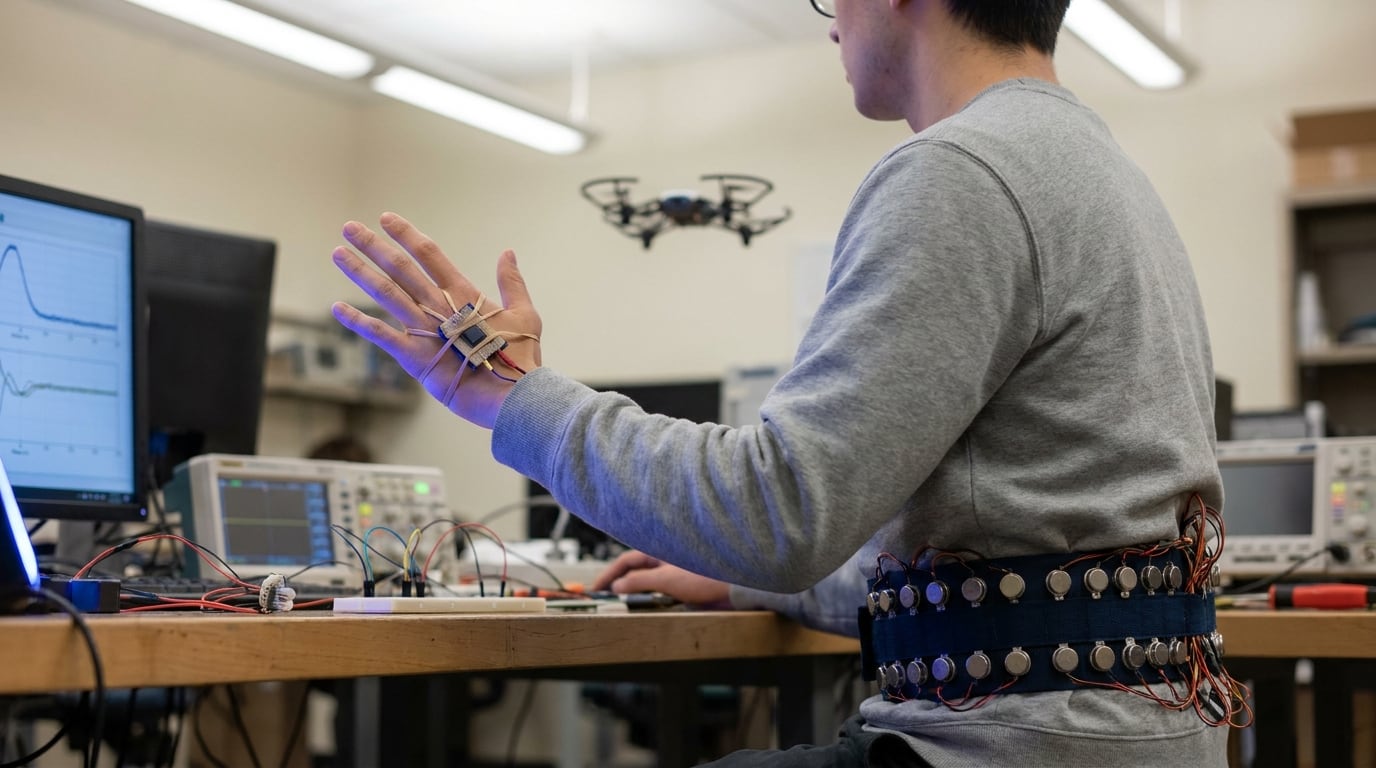
A research team at Jeonbuk National University in the Republic of Korea has built a wearable interface for controlling a drone. Professor Kee-Ho Yu of the Department of Aerospace Engineering led the team, with researcher Myeong-Ho Shin and Dr Giancarlo Eder Guerra Padilla from the same institute.
The interface pairs a sensor worn on the back of the hand with a belt containing 36 vibration motors. Hand gestures send commands to the drone, while vibrations on the abdomen indicate the drone's position relative to the user. The work was published in the journal IEEE Robotics and Automation Letters.
How it works
The hand-worn sensor feeds a computer that interprets 12 gestures as drone commands. Drone telemetry is translated into vibration patterns on the belt that indicate direction, relative height and distance.
According to Yu, the two halves are designed to work together: the hand sensor lets the user issue commands through familiar movements, while the waist-worn device communicates spatial information through touch. The stated aim was to connect the user's intention with clear information about the drone's position, rather than improving commands or feedback in isolation.
How it was tested
The system was assessed through gesture-recognition tests, simulated flying, an indoor tactile-perception study and two real-drone tasks.
The gesture-recognition model identified gestures with 97.58 % accuracy and a macro F1 score of 0.9773. In a simulated waypoint task involving 12 novice users, average completion time fell from 263 seconds in the first trial to 186 seconds in the fifth.
In the indoor study, 12 participants completed 1,200 trials using the belt without visual guidance. They correctly identified direction, height and distance together in 82.75 % of trials, with an average response time of 3.1 seconds. Direction was recognised more reliably than distance, which the researchers report as the most confusing cue.
In real-drone point-to-point trials, one novice participant used the gesture controller with either visual or tactile-only feedback. Visual operation reached the target in all nine trials, averaging 31.4 seconds. Tactile-only operation succeeded in eight of nine trials and took an average of 45.1 seconds. In a separate task, the participant returned the drone to its target zone after all eight boundary exits while vision and hearing were blocked.
What is not yet proven
The researchers describe the findings as indicating feasibility, not field readiness. The real-drone evaluation involved only one participant.
Yu says touch-based feedback is promising but that the results also show where the system needs improvement, especially in communicating distance and reducing response delays.
The sources state that larger studies in varied outdoor conditions are needed, alongside improvements to distance cues, response speed, comfort and safety, before practical deployment can be assessed. Potential future applications cited by the team include infrastructure inspection, search-and-rescue support and training; these uses were not tested in the study.
Build sheet
- 36 vibration motors in the abdominal belt
- 12 hand gestures mapped to drone commands
- 97.58 % gesture-recognition accuracy; macro F1 score 0.9773
- 82.75 % of 1,200 indoor belt trials identified direction, height and distance together
- 3.1 seconds average response time in indoor belt trials
- 8 of 9 real-drone tactile-only trials reached the target, averaging 45.1 seconds
- 9 of 9 visual real-drone trials reached the target, averaging 31.4 seconds
- 1 participant in the real-drone evaluation
Sources
- Wearable Human–Drone Interface: Gesture-Based Control and Vibrotactile Spatial Awareness — IEEE Robotics and Automation Letters — Myeong-Ho Shin, Giancarlo Eder Guerra Padilla, Kee-Ho Yu
- Hand gestures and vibrating belt enable drone control without visual feedback in early tests — TechXplore (Robotics)
Discussion
Technical questions and corrections are welcome. Comments are signed and checked before they appear.
No comments yet.
Sign in to add a typed review comment. Reviews are signed with your name.