What the UCL-led team changed
A UCL-led research team has developed a new electrolyte chemistry for aqueous (water-based) batteries that increases the energy-storing capacity of iodine, the main energy-storing material in iodine batteries. The work was published in Nature on 11 November 2026 as a peer-reviewed paper, 'Non-halogen aqueous electrolytes for four-electron iodine conversion', with Ruwei Chen as first author and Guanjie He, a professor at UCL Chemistry, as corresponding author.
According to the researchers, the advance addresses a known limitation of aqueous batteries: they are safer and more sustainable than lithium-ion batteries but have a relatively low energy density, which limits their practical use. The press release accompanying the paper describes large-scale battery farms as a need in the transition to net zero, to store excess energy from renewables, and notes that such facilities use lithium-ion batteries, which can carry a fire risk and require mining of scarce resources such as cobalt.
How the electrolyte works
The study's central result is enabling iodine to transfer four, rather than two, electrons during charging and discharging, which the researchers say effectively increases the energy that can be stored.
One form the iodine takes, hypervalent iodine cations (I⁺), is highly reactive in water. Previous experimental efforts prevented unwanted chemical reactions by using highly concentrated halogen-containing electrolytes, the liquid in which the electrochemical reactions occur, but the press release describes these electrolytes as corrosive, costly and unlikely to be manufactured easily.
The team designed an entirely new electrolyte chemistry to prevent those unwanted reactions without corrosive material. According to the press release, this was done through molecular-level design of the iodine's local environment, with some molecules preventing water from reaching the iodine and others binding to iodine's reactive forms.
The paper describes the approach as a kosmotropic anion–polar anion–nucleophilic species (Nuc) electrolyte framework. In the abstract, the authors state that polar anions establish a water-deficient, anion-enriched interfacial microenvironment, while kosmotropic anions regulate water–Nuc interactions to increase the availability of Nuc for stabilising hypervalent iodine cations through Nuc–I⁺–Nuc halogen bonds.
What the tests measured
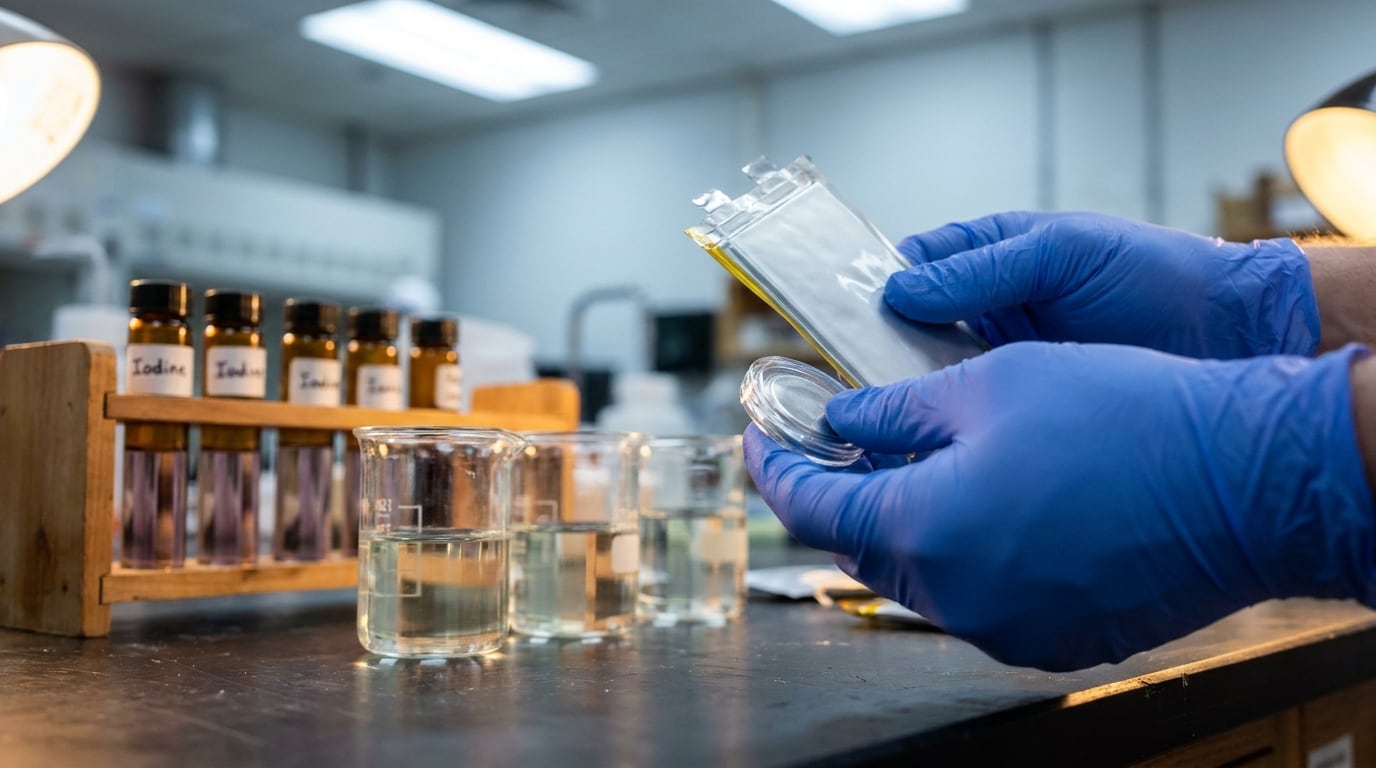
The researchers report that they showed their battery design worked reliably in different cell configurations, including pouch cells, the type used in laptops and mobile phones, and coin cells, disk-shaped batteries used in devices with low energy demands.
They also tested the design's durability and found that, when used in zinc-iodine batteries, it retained almost all of its storage capacity even after thousands of charge-discharge cycles. The paper reports validation of the electrolyte framework across diverse Nuc and in both aqueous Zn–I₂ and Al–I₂ batteries.
Limits and next steps
The press release states that the approach could also be adapted for aluminium-iodine batteries, suggesting it may be useful across a range of future energy-storage technologies.
He is quoted as saying that next steps include testing the technology at a larger scale and improving its performance under realistic operating conditions.
Chen is quoted as saying that moving beyond conventional, highly concentrated electrolytes opens new possibilities for developing more practical, affordable and sustainable aqueous batteries, and that making iodine batteries rechargeable requires understanding how the key chemicals interact with the water-based electrolyte and how those interactions change as the battery charges and discharges.
Context the sources give
The press release frames the work against lithium-ion batteries, which it says power laptops, e-bikes and electric cars and are used in battery farms, and which it says can carry a fire risk and require mining of scarce resources such as cobalt, incurring an environmental cost.
The paper's abstract describes the findings as establishing a distinct electrolyte chemistry framework and a mechanistic shift for reversible multi-electron iodine chemistry in aqueous environments, moving beyond conventional interhalogen stabilisation.
Technical fact box
- Electrons transferred per iodine: four, rather than two, during charging and discharging
- Zinc–iodine cells: retained almost all storage capacity after thousands of charge-discharge cycles
- Cell formats tested: pouch cells and coin cells
- Electrolyte: halogen-free, kosmotropic anion–polar anion–nucleophilic species (Nuc) framework
- Battery chemistries validated: aqueous Zn–I₂ and Al–I₂
- Publication: Nature, 11 November 2026, DOI 10.1038/s41586-026-11282-0, peer reviewed
Sources
- Non-halogen aqueous electrolytes for four-electron iodine conversion — Nature — Ruwei Chen, Haobo Dong, Yuhang Dai et al.
- Water-based batteries store more energy in iodine with new electrolyte design — Phys.org (Technology)
Discussion
Technical questions and corrections are welcome. Comments are signed and checked before they appear.
No comments yet.
Sign in to add a typed review comment. Reviews are signed with your name.