What the team built and measured
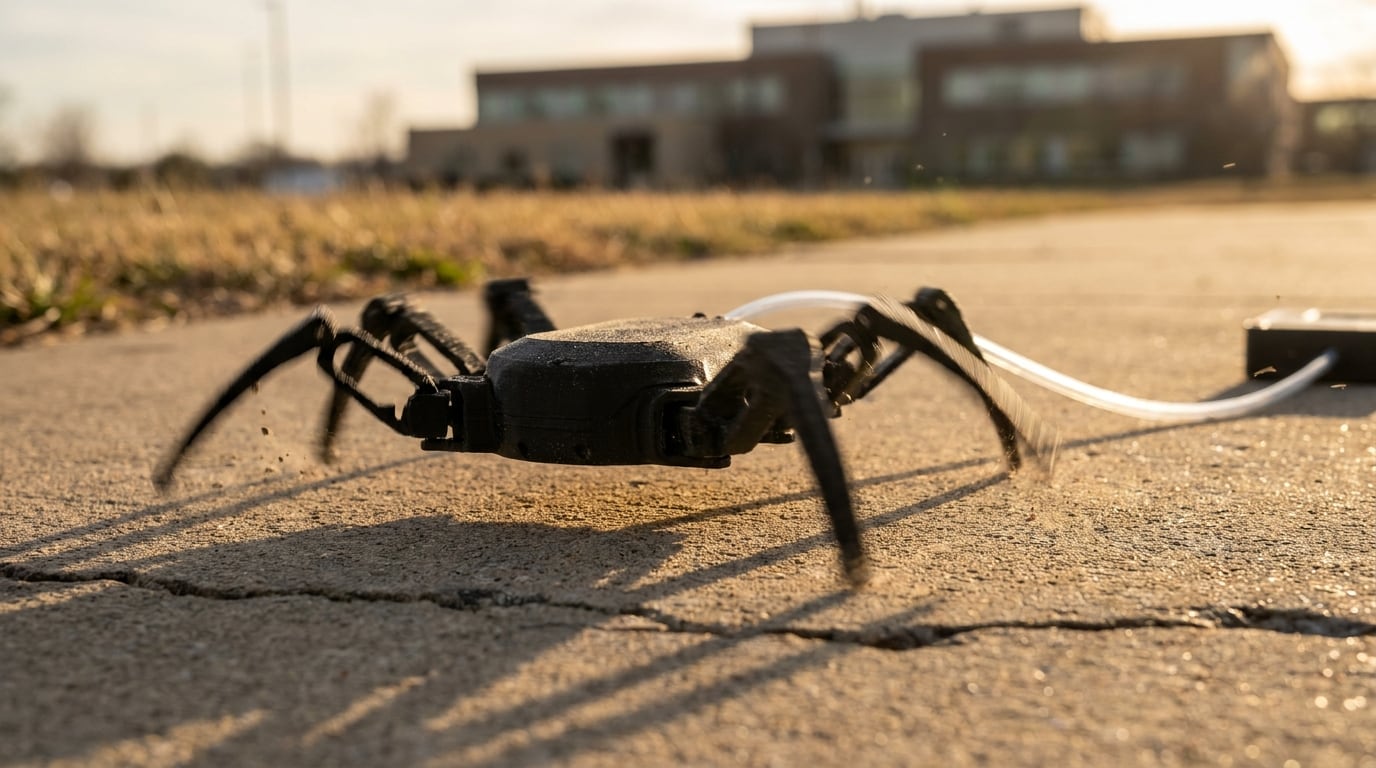
A 3D-printed hexapod robot reached a top speed of 4.72 metres per second without any electronics. The robot is printed in one go from a single material.
The work appears in Science Robotics, in a peer-reviewed paper titled 'Printing powerful soft robots on a desktop' by Yichen Zhai and Michael T. Tolley. The team designed, built and tested the robot at the UC San Diego Jacobs School of Engineering.
At its top speed, the team reports an estimated mechanical power output of 169 watts. The researchers describe the machine as a monolithically 3D-printed hexapod running robot. The 4.72 m/s figure is the top speed the team reports.
How the pneumatic circuit works
Inside the electronics-free robot, a connected series of chambers, valves and tubes drives the legs once pressurised air passes through.
To handle higher pressures and faster airflow, the researchers made the robot and its internal structures bigger and stronger. Higher pressures, however, can make the robot move so quickly that it becomes very inefficient, exhausting high-pressure air that still contains a lot of energy.
The team turned to the compound steam engine, which lets steam expand through multiple chambers to make the most of the energy in high-pressure air. The researchers built a series of chambers and valves into the robot so that pressurised air circulates twice: first in smaller, high-pressure chambers to power the valves, then in larger, low-pressure chambers to move the legs.
The paper calls the core of this architecture a double-expansion pneumatic oscillator inspired by the compound steam engine. It converts a constant high-pressure gas input into four-phase pressure signals at high frequency.
Comparison with the 2022 robot
The new design builds on the team's first 3D-printed, air-powered soft robot, developed in 2022 and detailed in a 2025 article in Science Robotics. That robot could go 4 centimetres per second, and its speed was limited by the air pressure and airflow it could handle.
According to the researchers, the new design runs more than 100 times faster than the original version.
Zhai and Professor Michael T. Tolley led the team in the Bioinspired Robotics and Design Laboratory at the UC San Diego Jacobs School of Engineering.
Where the robot was tested
The team tested the robot on concrete, gravel, lawn, mulch and sand. They showed it could run down stairs, swim in water and still function underwater. The paper also reports that the robot could be operated with a liquid working medium, tap water.
The paper states that the robot traversed rough outdoor terrain and aquatic environments. These are results reported by the research team from its own tests.
Limits the team reports
For now, the robot can only function when tethered to a source of compressed air, such as a traditional air compressor. The researchers plan to explore designs that use less compressed air so that the robot can operate untethered with a portable air source, such as a cartridge of compressed air. They also envision designs capable of more complex motions allowing steering and object manipulation.
The researchers suggest that this class of 3D-printed, electronics-free robots could eventually be used in settings where electronics cannot function, including scientific reconnaissance in areas with high radiation or magnetic fields, disaster response and space exploration.
Technical fact box
- Top speed: up to 4.72 metres per second
- Estimated mechanical power output: 169 watts at top speed
- Speed increase over the 2022 robot: more than 100 times
- 2022 robot speed: 4 centimetres per second
- Construction: 3D-printed in one go from a single material, no electronics
- Internal drive: double-expansion pneumatic oscillator converting constant high-pressure gas into four-phase pressure signals
- Test surfaces: concrete, gravel, lawn, mulch, sand; also stairs, swimming and walking underwater
- Current limitation: tethered to a compressed-air source such as an air compressor
Sources
- Printing powerful soft robots on a desktop — Science Robotics — Yichen Zhai, Michael T. Tolley
- The fastest soft robot ever built doesn't need electronics to function — Phys.org (Technology)
Discussion
Technical questions and corrections are welcome. Comments are signed and checked before they appear.
No comments yet.
Sign in to add a typed review comment. Reviews are signed with your name.