What the researchers built
Researchers at ETH Zurich's Environmental Robotics Lab have developed a quadcopter whose frame is designed to bend on impact rather than break. Named FlexiQuad, it was developed by Luca Girardi with Stefano Mintchev, according to New Atlas.
Conventional quadcopters have four rigid arms with propellers extending from a rigid central body. That design provides the structural stiffness needed for stable, precise flight, but it can make collisions disastrous: an impact can damage the frame, destabilise the aircraft or destroy it. Modern drones often rely on navigation and obstacle-avoidance systems to steer clear of obstacles, but these are not foolproof, and at high speeds or in cluttered environments an obstacle may be detected too late.
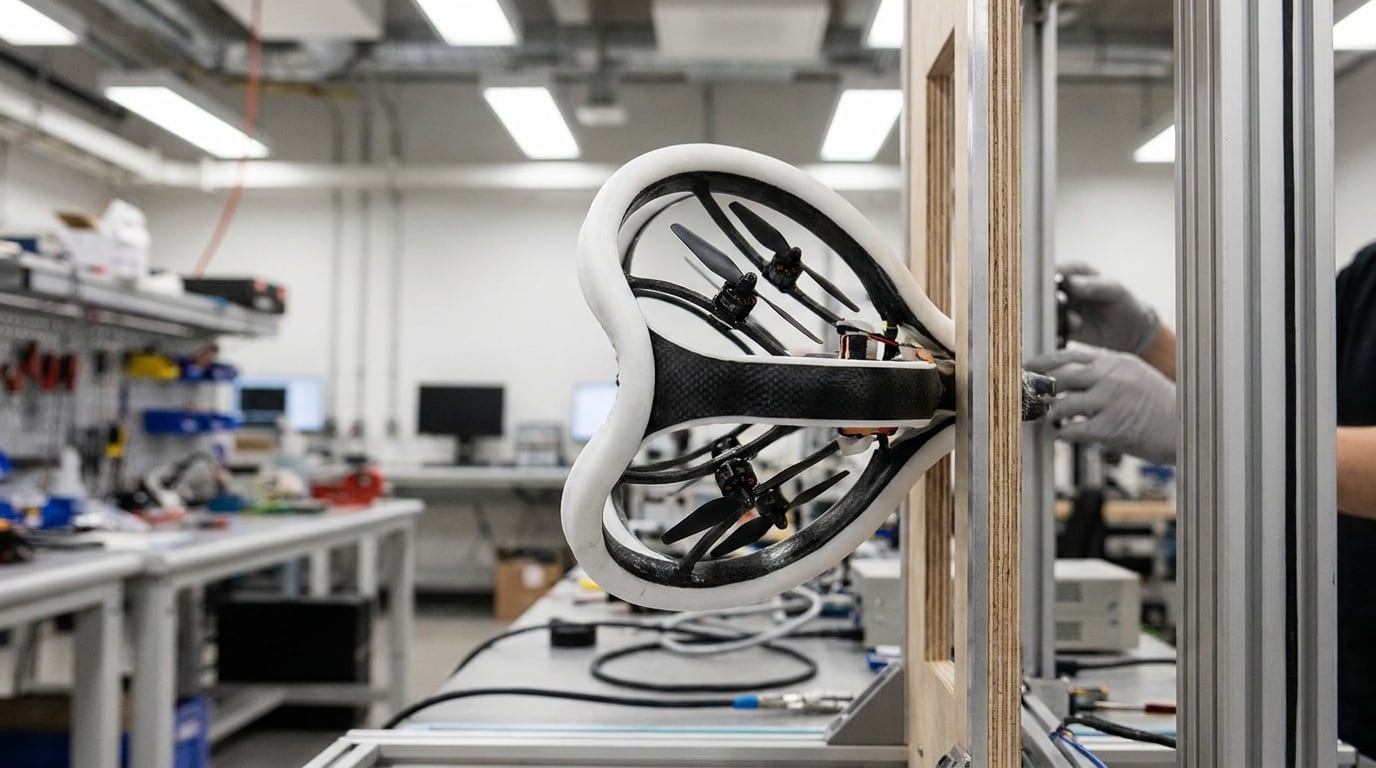
FlexiQuad takes a different approach, adding protection that lets the drone withstand collisions even when obstacle avoidance fails. Instead of a rigid body and four arms, it has a soft, ring-shaped frame with a hollow centre. Its four rotors, batteries and control electronics are distributed around the ring, so the whole structure can deform when it meets an obstacle.
How the frame absorbs an impact
Rather than transmitting the full force of an impact to rigid components, the frame bends, absorbing some of the collision energy and spreading the remaining forces over a longer period. Once the impact is over, the flexible structure springs back toward its original shape, allowing the drone to continue flying.
The frame stays stiff enough for controlled flight through anisotropic stiffness: the structure has different degrees of stiffness depending on the direction in which a force is applied. The researchers drew inspiration from the wings of birds and insects. "We were interested in how stiff their wings are," Girardi explains, according to New Atlas.
FlexiQuad's frame is highly flexible horizontally, so it can bend sideways and absorb impacts. Vertically it is considerably stiffer, providing the structural support needed to transmit the forces generated by the rotors and maintain controlled flight. According to the report, this combines structural flexibility with high flight performance, two characteristics that are traditionally difficult to achieve together.
Squeezing through gaps and grasping objects
Because its body is a deformable ring, FlexiQuad can compress itself to pass through openings that would be too narrow for its full-sized frame. The researchers implemented this with a small servomotor and pulley mechanism that pulls the frame inward, reducing the drone's width while maintaining controlled flight. In one experiment, a prototype weighing 405 g flew through an opening just 180 mm wide, approximately 70 % of its normal width.
The frame can also deform passively when passing through tight openings, using the drone's own momentum to squeeze through without a separate folding mechanism. The same deformation can be used to grasp objects: by contracting its hollow frame around an item, FlexiQuad can pick it up without a conventional robotic gripper. In demonstrations, the drone grasped, transported and released a soft first-aid kit weighing 136 g. The researchers also demonstrated its ability to lift a payload heavier than the drone itself.
What the tests measured
According to the study, published on arXiv, FlexiQuad can reach speeds of around 80 km/h, with linear and angular accelerations comparable to those of conventional rigid-frame quadcopters. Accelerations exceeded three times the force of gravity, despite the prototype being substantially more flexible than conventional drones.
In collision tests, the researchers deliberately flew the drone into obstacles at speeds of up to approximately 25 km/h. The frame briefly deformed on impact and the drone was able to continue flying. It survived frontal collisions at speeds of up to 18 km/h without any structural or functional damage.
Limits the team reports
Challenges remain before FlexiQuad can move from the laboratory to real-world applications. Its flexibility complicates flight control; as Girardi acknowledges, "a rigid structure makes precise control easier," which is one reason rigid frames have remained the standard for so long.
When FlexiQuad collides with an obstacle, the frame can oscillate as it recovers its shape. These ripples may blur images from onboard cameras, making it difficult for the drone to determine its position and navigate its surroundings. The aircraft therefore needs a control system capable of handling changes in its shape and movement.
The researchers have made progress on this front, using reinforcement learning to teach FlexiQuad a reflex-like recovery response: after a collision, the drone uses information from its onboard motion sensors to stabilise itself before returning to autonomous flight. However, reliable perception and autonomous navigation in complex, real-world environments still require further development.
Next steps include improving its autonomous capabilities and exploring how its flexible structure can support sensing and control. The researchers have filed a patent application for its structural design. They suggest possible uses in confined industrial spaces such as ships' ballast tanks, or in collapsed buildings during search-and-rescue missions, where the ability to deform could let a relatively large drone carry more sensors or batteries and squeeze through narrow openings without sacrificing as much payload capacity or flight endurance.
Technical fact box
- Prototype mass: 405 g
- Maximum speed: up to 80 km/h
- Collision tests: flown into obstacles at up to approximately 25 km/h
- Frontal collisions survived without structural or functional damage: up to 18 km/h
- Accelerations in tests: exceeded three times the force of gravity
- Opening flown through: 180 mm wide, approximately 70 % of normal width
- Object grasped and released: soft first-aid kit weighing 136 g
- Frame: soft ring-shaped structure with hollow centre, anisotropic stiffness
Sources
- Flexy Swiss drone survives head-on collisions with flair — New Atlas
Other news outlets are named as sources but not linked.
Discussion
Technical questions and corrections are welcome. Comments are signed and checked before they appear.
No comments yet.
Sign in to add a typed review comment. Reviews are signed with your name.