What the study examined
A research team at Tohoku University has reported how three different ions behave when inserted into the same electrode material. The work, published in the journal Chemistry of Materials, focused on hollandite-type manganese dioxide (α-MnO₂). Its crystal structure contains tiny one-dimensional tunnels that give ions a pathway to enter and move through the material.
The questions behind the work matter for next-generation rechargeable batteries that use abundant elements such as sodium, magnesium and calcium instead of lithium. According to the researchers, having enough space for ions does not by itself guarantee that they can move easily or that the surrounding crystal structure will stay stable.
How the measurements were made
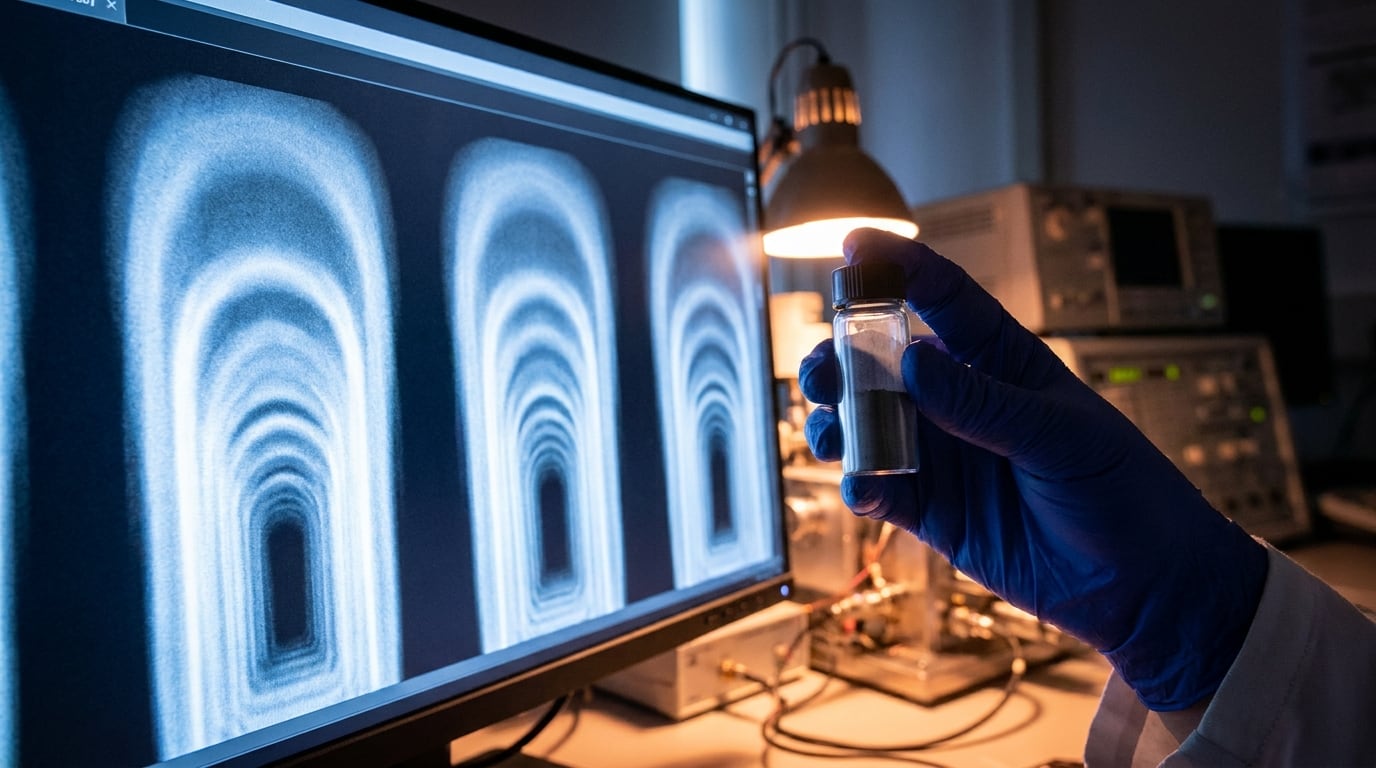
The team combined electrochemical analyses with atomic-resolution scanning transmission electron microscopy and soft X-ray absorption spectroscopy, according to the paper. The microscopy was carried out at the Tohoku Center of Excellence for Microscopy (TCEM) at Tohoku University. The X-ray absorption spectroscopy was done at NanoTerasu, described in the release as a next-generation synchrotron radiation facility.
According to the researchers, this combination let them examine both where the inserted ions sat and how the surrounding atomic structure and electronic states changed. It also let them correlate reaction kinetics with the configurations of the guest ions.
Sodium, magnesium and calcium behave differently
The differences between the ions were pronounced. Sodium ions spread relatively uniformly throughout the particles and occupied positions near the centres of the tunnels. Magnesium ions also entered the particles, but they tended to accumulate near the surfaces, away from the tunnel centres, and this came with significant distortion of the surrounding crystal structure. Calcium ions remained mainly near the particle surfaces, with little evidence of insertion into the interior tunnels.
The paper describes the same pattern at atomic resolution. Sodium homogeneously occupied tunnel-centre sites throughout the particles. Magnesium occupied both tunnel-centre and off-centre sites, with pronounced near-surface enrichment and local tunnel distortion. The calcium reaction was largely confined to the near-surface region, with no clearly detectable occupation of the internal tunnel sites.
Electrochemical measurements showed substantial diffusion-controlled contributions for both sodium and magnesium, while calcium behaved predominantly in a surface-controlled way. According to the researchers, sodium and magnesium therefore have comparable macroscopic kinetic contributions despite distinctly different microscopic insertion modes.
Electronic changes and local damage
X-ray absorption measurements revealed another difference. Magnesium insertion caused more pronounced changes in the electronic states of manganese near the particle surfaces. Sodium produced relatively uniform changes, and calcium produced only minor ones. The spectroscopy also showed spatially heterogeneous manganese reduction, with more pronounced reduction near the structurally less constrained particle surface.
The researchers also found that repeated magnesium insertion and extraction damaged parts of the tunnel structure near the particle surfaces, even though the overall crystal structure remained largely intact. This local damage was associated with material loss and declining battery capacity.
What the results imply for electrode design
The findings indicate that designing better battery electrodes requires more than providing pathways for ions.
The paper presents the results as a direct relationship between guest-ion occupation modes, electrochemical reaction pathways and the resulting structural evolution. It frames this as an atomic-scale design principle for engineering tunnel-type host materials for multivalent-ion insertion. The release states that the insights could help researchers develop more durable, higher-capacity cathode materials for next-generation rechargeable batteries.
Technical fact box
- Material studied: hollandite-type manganese dioxide (α-MnO₂), with one-dimensional tunnels in its crystal structure
- Sodium: occupied tunnel-centre sites relatively uniformly throughout the particles
- Magnesium: occupied tunnel-centre and off-centre sites, with pronounced near-surface enrichment and local tunnel distortion
- Calcium: reaction largely confined to the near-surface region, with no clearly detectable occupation of internal tunnel sites
- Electrochemistry: substantial diffusion-controlled contributions for sodium and magnesium; predominantly surface-controlled behaviour for calcium
- Magnesium cycling: damaged parts of the tunnel structure near particle surfaces, associated with material loss and capacity decline
- Methods: electrochemical analyses, atomic-resolution scanning transmission electron microscopy and soft X-ray absorption spectroscopy
- Facilities: Tohoku Center of Excellence for Microscopy (TCEM) and the NanoTerasu synchrotron facility
Sources
- Atomic-Scale Origin of Spatially Heterogeneous Insertion in Hollandite-Type MnO2 — Chemistry of Materials — Hongyi Li, Yue Qi, Shusuke Fukui et al.
- Where do ions go? Hidden differences inside next-generation battery materials — Phys.org (Technology)
Discussion
Technical questions and corrections are welcome. Comments are signed and checked before they appear.
No comments yet.
Sign in to add a typed review comment. Reviews are signed with your name.