What the experiment achieved
About 20,000 rubidium atoms aboard China's Tiangong space station reached an equivalent temperature of 9.7 picokelvin, according to a peer-reviewed paper in Science by Wei Xiong, Tang Li, Shengjie Jin and colleagues. That is four times lower than the 38 picokelvin record set in 2021, the paper states.
The paper reports a value of 9.7 picokelvin, with an uncertainty range of −2.7 to +3.2 picokelvin, and a free expansion time of 7.0 seconds. The previous lowest equivalent temperature in such a system, 38 picokelvin, came with a free expansion time of 2 seconds and was achieved in atom-chip-based magnetic traps in microgravity, according to the abstract.
The authors describe the figure as an equivalent temperature: it is an estimate derived from the energy associated with the cloud's expansion, not a conventional thermometer reading, according to the paper and a New Atlas report.
How the atoms were cooled
The team used an optical dipole trap, in which intersecting laser beams hold atoms in a magnetically insensitive state. Earlier microgravity work had used magnetic traps. The abstract notes that optical dipole trap systems offer better optical access and the flexibility to condense both magnetic and non-magnetic atoms, but had not previously been used to prepare quantum degenerate gases under microgravity conditions.
According to New Atlas, the team first used a mix of lasers to slow fast-moving atoms and evaporative cooling to produce a Bose-Einstein condensate. A gentle gradient in an applied magnetic field then expelled even faster-moving atoms. The remaining slower atoms were transferred into a second, wider optical trap, whose strength was reduced to ease the cloud's confinement before release.
In orbital free fall, gravity does not pull the atoms away, so the researchers could relax that confinement much further than on Earth's surface, New Atlas reports. The paper describes the result as an optical-dipole-trap-based Bose-Einstein condensate created aboard the China Space Station.
What the measurements showed
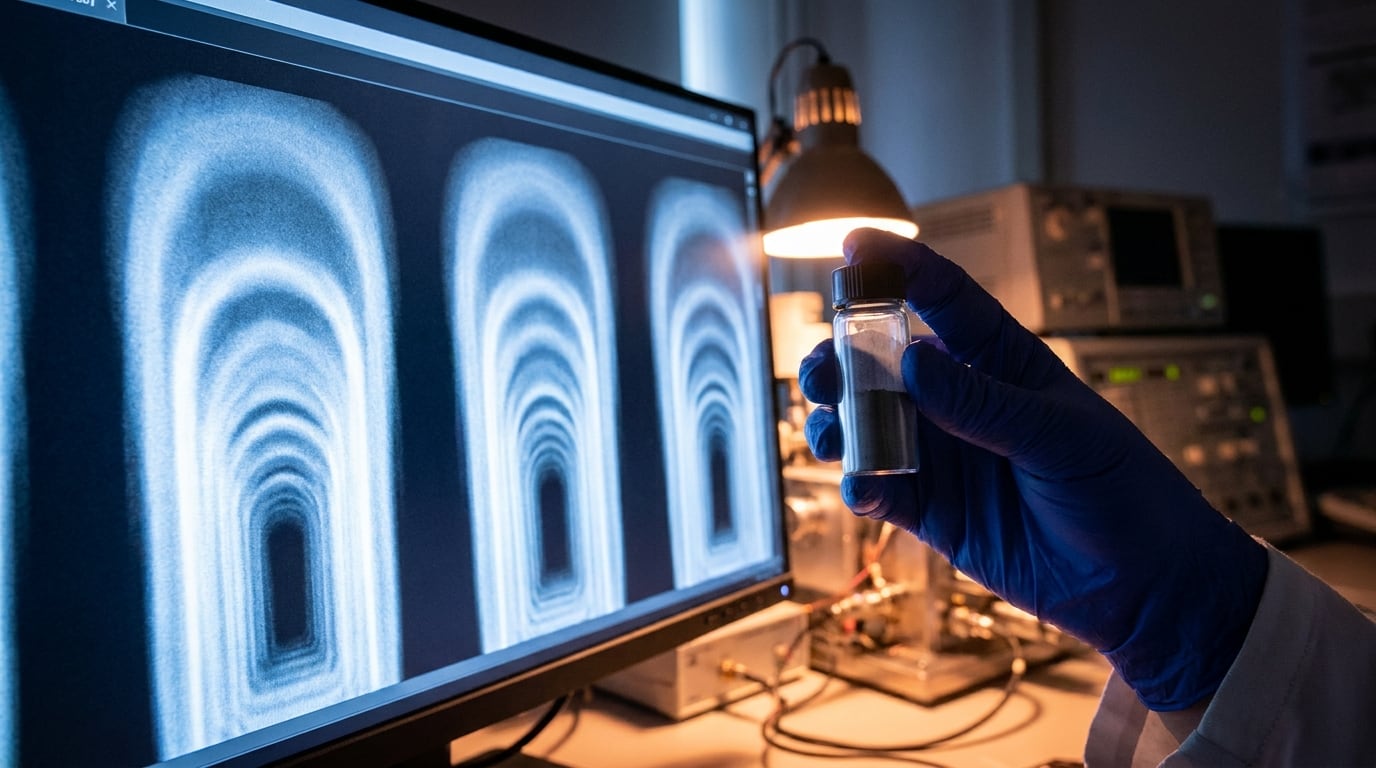
Images taken from two directions revealed how quickly the cloud spread along three axes, New Atlas reports. From that expansion the team derived the equivalent temperature of 9.7 picokelvin, with the uncertainty range given in the paper.
The slower expansion also extended the observation window. The cloud expanded slowly enough to be observed for 7.0 seconds, against 2 seconds in the 2021 microgravity experiment, giving physicists a longer window to study its quantum behaviour before it becomes too diffuse to use. The abstract states that ultracold atom platforms enable low temperatures and long free evolution times, which it describes as crucial for fundamental physics tests and atom interferometry.
Why the team wants colder atoms
The paper states that the record-low temperature could stimulate a new generation of optical-dipole-trap-based experiments in quantum simulation and precision measurements in space. New Atlas reports that the combination of lower temperature and longer observation could benefit experiments using interferometers that split and recombine matter waves to reveal tiny differences in their paths.
According to New Atlas, such instruments could test whether different atoms fall identically, which could provide new ways to test general relativity, and carefully patterned laser fields could turn the platform into a simulator for unusual quantum states.
The paper's abstract frames the work in the context of atom interferometry and fundamental physics tests. It does not report results from interferometry or general-relativity tests; those are described as applications the platform could enable.
Limits the sources report
The 9.7-picokelvin figure is an estimate based on the energy associated with the cloud's expansion, not a direct thermometer reading, according to New Atlas. The paper gives the value with an uncertainty range of − 2.7 and + 3.2 picokelvin.
New Atlas notes that reaching absolute zero is a mathematical impossibility.
Where the record sits
The 2021 record of 38 picokelvin was set using a drop tower at the University of Bremen in Germany, where rubidium was made weightless long enough for a magnetic lens to force it to expand and cool, New Atlas reports. The first Bose-Einstein condensate in orbit was produced on the International Space Station in 2020, according to the same report.
Earlier milestones cited by New Atlas include the 1995 creation of a Bose-Einstein condensate by a collaboration between the US National Institute of Standards and Technology and the University of Colorado at Boulder, which cooled rubidium to 20 billionths of a degree above absolute zero, and a 2003 MIT-led team that cooled sodium to 450 picokelvin using a magnetic trap.
Technical fact box
- 9.7 − 2.7 + 3.2 pK: equivalent temperature reported for the rubidium cloud
- 7.0 s: free expansion time of the cloud
- 2.0 × 10^4 atoms: number of rubidium atoms in the condensate
- 38 pK: previous record equivalent temperature, set in 2021
- 2 s: free expansion time of the 2021 record experiment
- Optical dipole trap: confinement method used, aboard the China Space Station
- Science, DOI 10.1126/science.aea5324: peer-reviewed paper reporting the result
Sources
- Quantum gases below 10 picokelvin in space — Science — Wei Xiong, Tang Li, Shengjie Jin et al.
- Space experiment shatters record for lowest temperature — New Atlas
Other news outlets are named as sources but not linked.
Discussion
Technical questions and corrections are welcome. Comments are signed and checked before they appear.
No comments yet.
Sign in to add a typed review comment. Reviews are signed with your name.