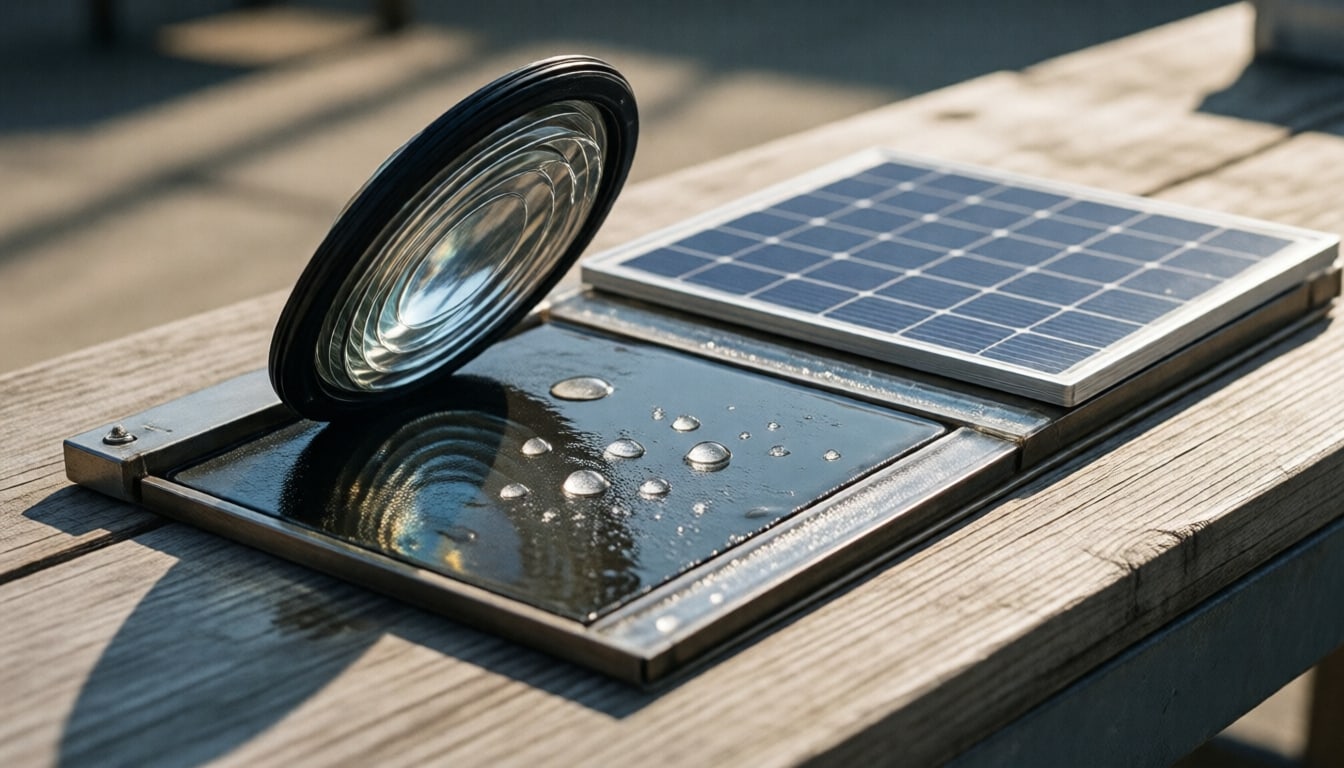
What the prototype does
A research team at Soochow University in China has built a portable solar-powered device that produces drinking water from turbid, saline, oily and highly acidic water, according to a study published in Nature Water. In outdoor tests, the prototype produced 1.64 litres of clean water in eight hours using an evaporation surface of 30.72 cm2, which the researchers describe as smaller than a standard bank card.
The device needs neither a grid connection nor an external fuel supply, the study reports, because it integrates photovoltaic modules with an optical solar concentration system. The researchers say the configuration could be used where conventional water supply infrastructure is damaged or unavailable, and as a portable treatment option in emergencies such as floods, earthquakes and conflicts.
How the evaporator works
The system relies on electrothermal evaporation. An electrically powered heating element heats a surface that absorbs contaminated water, causing the water to evaporate. The vapour is then collected and condensed into clean water, while salts and other contaminants remain behind in the source water.
The team's main change is what it calls an interlayer electrothermal evaporator. Rather than heating the entire volume of the wet material, the researchers placed the heating element within an internal layer of the structure. According to the study, this reduced heat losses to the surrounding water and air, and cut heat losses and energy consumption by nearly two-thirds compared with a conventional electrothermal evaporator based on volumetric heating.
The device draws on two forms of solar energy at once. Foldable solar cells generate electricity to drive the electrothermal evaporator, while a foldable Fresnel lens concentrates sunlight directly onto the evaporation surface. The study does not specify the rated capacity or electrical characteristics of the photovoltaic system.
What the tests measured
When concentrated solar energy is counted, the device reached an apparent energy efficiency of 93.31 % and a water production rate of 69.46 litres per square metre per hour, the study reports. Under concentrated sunlight the system achieved evaporation rates exceeding 90 kg/m2 per hour.
The researchers tested the system on several kinds of water: sediment-laden water, oil-contaminated water, highly saline wastewater and strongly acidic water. The tests also included real seawater, with water samples analysed before and after treatment.
The outdoor trials used a small-scale prototype on selected days in January and February 2025. The reported output of 1.64 litres in eight hours comes from that prototype and that test programme.
Limits the team reports
The researchers present the results as a demonstration of feasibility. They state that larger systems and longer-term testing under real-world conditions are still needed to assess the technology's potential for large-scale deployment. The published work therefore rests on a small prototype tested on selected winter days, not on a deployed product or an extended field trial.
Technical fact box
- Clean water output: 1.64 litres in eight hours (outdoor prototype test)
- Evaporation surface: 30.72 cm2, described as smaller than a standard bank card
- Apparent energy efficiency with concentrated solar: 93.31 %
- Water production rate: 69.46 litres per square metre per hour
- Evaporation rate under concentrated sunlight: exceeding 90 kg/m2 per hour
- Heat loss and energy consumption: reduced by nearly two-thirds versus volumetric-heating evaporator
- Outdoor tests: small-scale prototype, selected days in January and February 2025
- Water types tested: sediment-laden, oil-contaminated, highly saline wastewater, strongly acidic water and real seawater
Sources
- Portable solar-powered system produces 1.64 liters of drinking water in 8 hours — pv magazine
Other news outlets are named as sources but not linked.
Discussion
Technical questions and corrections are welcome. Comments are signed and checked before they appear.
No comments yet.
Sign in to add a typed review comment. Reviews are signed with your name.