Ohm's law says that the current through a conductor is proportional to the voltage across it. Written the way engineers use it:
Three forms, one law
Solve (1) for each variable and you have the three questions you ask every day: what voltage will I see (V = IR), how much current will flow (I = V/R), and what resistor do I need (R = V/I). Combine it with electrical power, P = VI, and you get P = I²R and P = V²/R — the reason a resistor gets hot.
A worked example: an LED resistor
A red LED drops about 2.0 V and wants 10 mA. From a 5 V supply the resistor must drop 3.0 V:
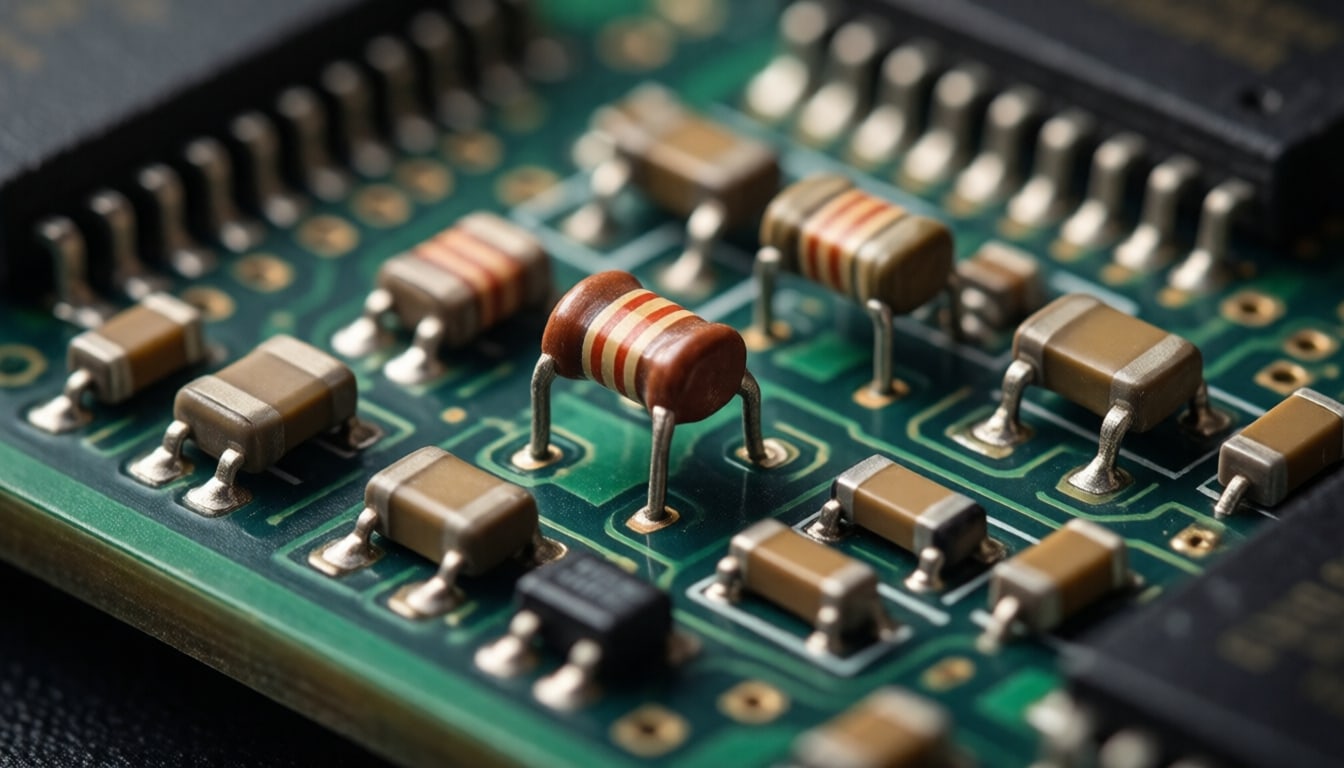
The nearest standard E24 value is 300 Ω; with 330 Ω (E12) the current falls to about 9 mA — fine. The resistor dissipates P = I²R ≈ 0.03 W, so a ¼ W part has a big margin. Check your own values in the Ohm's law calculator and read the bands with the resistor colour decoder.
Where it stops being true
Even a plain metal wire departs from it when it heats up: copper's resistance rises about 0.4 % per kelvin. An incandescent lamp's filament has roughly ten times less resistance cold than hot, which is why bulbs fail at switch-on.
For AC circuits with capacitors and inductors, replace R with the complex impedance Z — the form V = IZ still holds, but voltage and current are no longer in phase.
The takeaway
Use V = IR with confidence for resistors, cables, heaters and sensors at steady temperature. For anything with a junction, read the datasheet's I–V curve instead.
Use it
Voltage across a resistor equals current times resistance.
Power delivered to a load equals voltage times current.
Enter any two of voltage, current, resistance and power — get the other two.
Pick the bands visually — or type a value and see its colours. 3, 4, 5 and 6 bands.
Discussion
Technical questions and corrections are welcome. Comments are signed and checked before they appear.
No comments yet.
Sign in to add a typed review comment. Reviews are signed with your name.