What DIAL combines
Engineers at Northwestern University have developed a 3D printing method called direct ink additive lithography, or DIAL. It combines the speed and precision of light-based printing with the material versatility of extrusion-based techniques, according to a paper published in Science Advances. The researchers report that DIAL printed complex objects more than four times faster than conventional extrusion printing, with finer details and without separate support structures.
The paper describes DIAL as combining translational photopatterning with ink sheet deposition for rapid, voxel-based 3D printing. The work is a laboratory-stage demonstration: the researchers say they have shown manufacturing capabilities but have yet to produce complete functional objects.
How the printing process works
The process begins with a slot-die nozzle, a long, narrow opening that deposits paste-like ink onto a flat printing surface. A blade then sweeps across the deposited material and spreads it into a smooth, uniform layer 50 micrometres thick, which the researchers describe as thinner than a human hair.
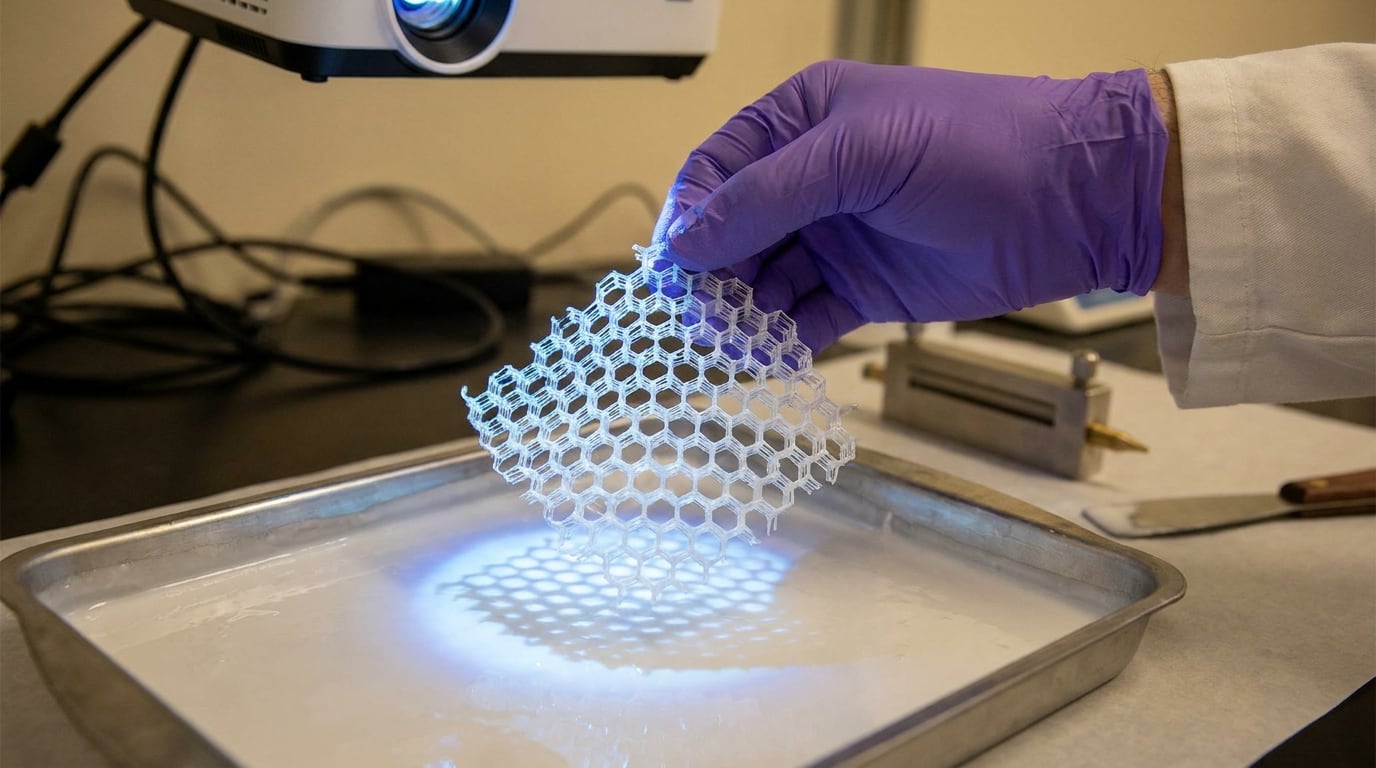
A projector then shines a precisely controlled light pattern onto the sheet. The illuminated portions of the ink undergo photopolymerisation, a chemical reaction that solidifies the photosensitive material into the desired cross-section of the object, while the surrounding ink remains uncured. The printer deposits another layer, spreads it and projects the next pattern, repeating until the object is built; the remaining uncured material is then removed to reveal the finished structure.
Because the projector can solidify an entire pattern at once, DIAL does not trace every feature individually. The level of detail depends largely on the projector's pixel size and the thickness of each deposited layer, rather than on the diameter of the ink-delivery nozzle, the researchers report.
The ink that supports itself
Printing overhangs, bridges and delicate internal features usually requires temporary scaffolding, which uses extra material and must be removed afterwards, sometimes damaging the structures it protects. The Northwestern team instead developed an ink that doubles as its own support material.
The researchers mixed light-curable resin with fumed silica nanoparticles, giving the mixture a yield stress that lets it resist flow until sufficient force is applied. When the spreading blade sweeps across the ink, the force makes it flow into a thin sheet; once the blade passes, the ink regains its resistance and largely holds its shape. Adjusting the concentration of silica nanoparticles controls this behaviour, according to the paper.
The unhardened ink surrounding each solidified feature therefore stays firm enough to support delicate structures while subsequent layers are printed. After printing, the surrounding ink can be washed away, and excess material left on the printing surface can be collected and reused.
What the tests measured
The team printed several challenging geometries and compared the results with existing techniques. In one experiment involving a porous, grid-like structure, DIAL completed the print in 30 minutes, compared with 124 minutes using conventional extrusion printing — more than four times faster, with sharper features and fewer defects, the researchers report.
The researchers also produced intricate lattices with walls as thin as 150 micrometres, which their conventional extrusion setup could not replicate. Other demonstrations included delicate lattice structures and interlocking chainmail, geometries that are difficult to make conventionally without additional supports.
DIAL also printed multiple objects simultaneously and combined different materials in successive layers. In another experiment, the team printed a honeycomb-like structure covering nearly four times the projector's illumination area by repositioning the projector over overlapping ink sheets. Unlike conventional vat-based light printing, DIAL is not confined to a container of liquid resin, which the researchers say could make it easier to scale to larger objects.
Functional inks demonstrated
To show the method with materials that conventional light-based printers struggle to accommodate, the researchers developed two additional ink formulations. The first was a structural electrolyte made from a polymerisable ionic liquid, a type of liquid salt that can conduct ions. With it, DIAL printed 15 intricate, porous lattices approximately the size of small coin-cell batteries in a single 15-minute run; the paper says such electrolyte structures could eventually contribute to new energy-storage devices.
The second was a hydrogel, a soft, water-rich material that can mimic certain properties of biological tissue. The team used it to print miniature containers inspired by laboratory cell-culture inserts, complete with microscopic inverted pyramids resembling surfaces used to grow cells and organoids.
Limits the team reports
The researchers note that none of DIAL's fundamental capabilities is entirely new: extrusion printing, projector-based curing and yield-stress materials have all existed for years. They describe the advance as integrating them into a single manufacturing process.
DIAL remains a laboratory-stage technology. Questions remain about how well the process will perform across different materials, larger production scales and demanding industrial applications, according to the report. The team is working to extend the technology to other materials and structures, and further improvements to the printing system, including streamlining how it switches between tools, are underway.
Senior author Ryan Truby says progress needs more than one component: “To print these types of materials, we don’t just need new software capabilities, new hardware, or new inks. We need all three, working in concert.”
Technical fact box
- Printing speed: porous grid printed in 30 minutes with DIAL versus 124 minutes with conventional extrusion
- Speed gain: more than four times faster than conventional extrusion printing
- Layer thickness: ink sheets spread to 50 micrometres
- Feature size: lattice walls as thin as 150 micrometres, not replicated by the team's extrusion setup
- Ink: light-curable resin with fumed silica nanoparticles, kilopascal-scale yield stress
- Electrolyte demo: 15 porous lattices about the size of small coin-cell batteries in one 15-minute run
- Area demo: honeycomb structure covering nearly four times the projector's illumination area
- Status: laboratory-stage technology; no complete functional objects produced yet
Sources
- Rapid, voxel-based 3D printing with yield-stress fluid inks — Science Advances — Pranav Kaarthik, Michael E. Bayer, EunBi Oh et al.
- New 3D printing tech makes intricate objects over 4 times faster — New Atlas
Other news outlets are named as sources but not linked.
Discussion
Technical questions and corrections are welcome. Comments are signed and checked before they appear.
No comments yet.
Sign in to add a typed review comment. Reviews are signed with your name.