What the prototype does
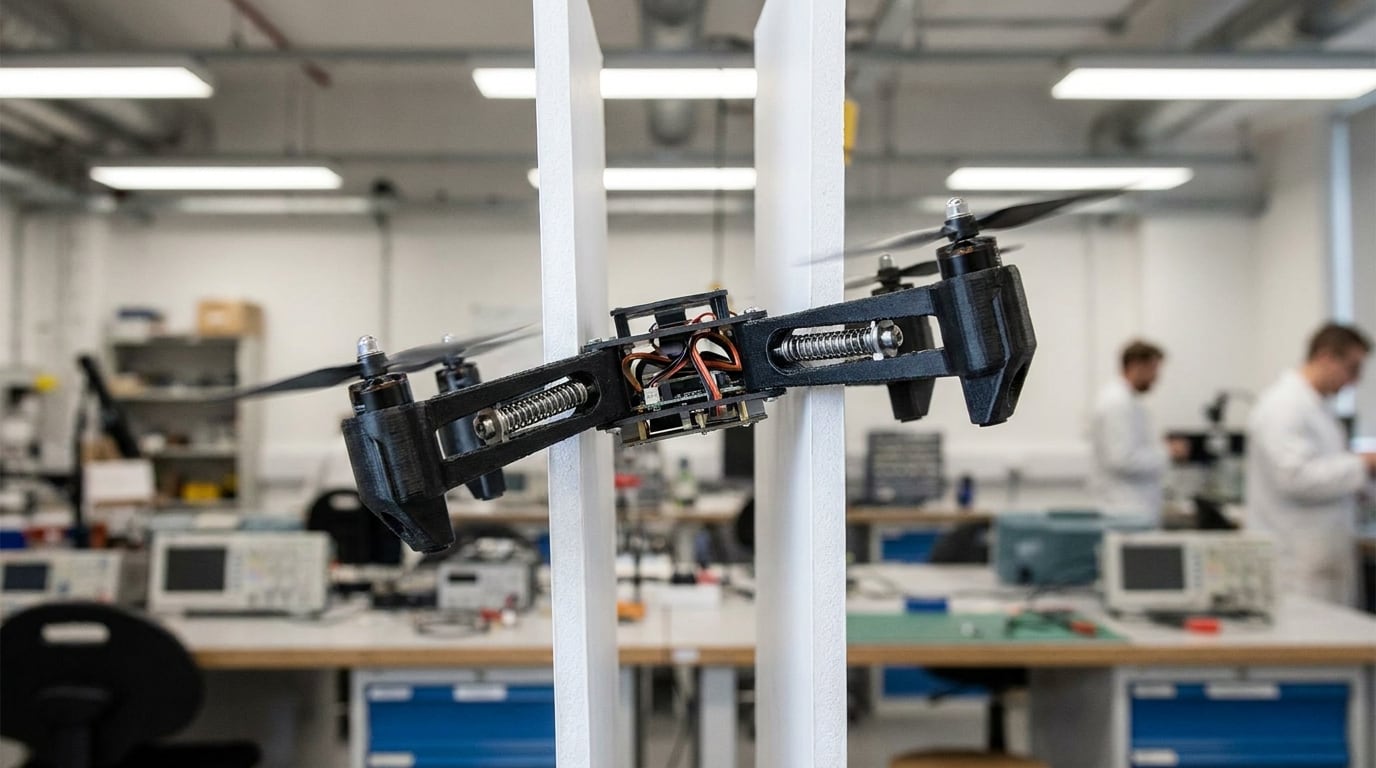
A team of researchers in Europe has built a drone prototype that folds its side arms during flight to fit through openings smaller than its normal span, according to a preprint arXiv paper by Etor Arza and colleagues. When its side arms contacted the edge of an opening, the prototype reduced its width by 55%, from 31.3 cm to 14.1 cm. The researchers say folding drones are not a new concept, but that past designs had reached only up to 29% width reduction.
The prototype was built from 3D-printed parts and spring-loaded joints. According to the study authors, the joints stand up to normal flight forces but fold when the arms meet the edges of small openings. Unlike past designs, the prototype required no dedicated folding motors, which the team says reduces its complexity.
How the design was found
The team used what it calls a closed-loop design optimization method, which optimized both the body shape and the passive joint compliance of the drone through a series of simulations. The automated search tested candidate designs by simulating contact between the arms and edges, folding of the arms, passage through various openings and recovery upon exit. The best-performing candidate was then used to guide further designs at each step.
The study authors write that they jointly optimized a 22-parameter quadrotor geometry and the programmable nonlinear torque deflection response of two passively folding side arms directly for traversal success. The compliant response is achieved using elastic rolling cam (ERC) joints, whose cam profiles can be synthesized to produce nonlinear restoring torque as a function of the bending angle. According to the authors, this nonlinearity can be tuned so that airframes remain rigid near the nominal configuration while bending with low effort after contact.
What the flight tests measured
The prototype underwent four flight tests: traversal of narrow openings, passage through a tube, angled approaches, and a comparison with a rigid counterpart in ordinary flight. In the first test, the drone crossed a 5.9-inch-wide (15 cm) gap, 52% narrower than its unfolded size, while approaching at roughly 4.5 mph (2 m/s). In the second, it traversed a 15.7-inch-long (40 cm) tube with an 8.9-inch (22.5 cm) diameter, which held its arms folded throughout the passage.
For the angled-approach test, the team used a 7.9-inch-wide (20 cm) opening with the path rotated from the gap center by 0°, 10°, 20°, 30° and 35°. The drone traversed the path without issue throughout 20 trials of each angle up to 20°. An arm dislocated in one of 20 attempts at 30° and multiple times at 35°.
In ordinary flight, the flexible joints added just 2 mm to position-tracking error and less than 1% to electrical power use compared with an otherwise identical rigid version, according to the team's comparison.
Limits the team reports
The researchers note that passage during the other tests was not smooth. The narrow-gap and tube crossings produced roughly 90° tilts and altitude losses of around 0.6 metres (2 feet), but the drone recovered afterwards without crashing.
The study authors report that gap traversal is robust on traversals up to 30°, which they say nears the ideal limit of 45.2°. They write that up to 30° the system does not fail due to body design or control issues and only experiences mechatronic problems of arm dislocation owing to its prototype realization through 3D printing and other manufacturing limitations. At an approach angle of 35°, they report, mechanical issues are more frequent, while one altitude loss-based failure is encountered.
The team also reports that the original simulation underestimated real-world rotational disturbances, partly because the built drone was heavier and its motors responded differently. The study authors write that despite the discrepancy in the modelled dynamics during optimization, the proposed methodology guided the discovery of an effective design for gap traversal, and that more accurate simulation could potentially enable designs to achieve even better real-world performance.
Technical fact box
- Width reduction on contact: 55 % (31.3 cm to 14.1 cm)
- Previous folding-drone designs: up to 29 % width reduction
- Gap crossed in first test: 15 cm wide, 52% narrower than unfolded drone
- Approach speed in first test: roughly 2 m/s (4.5 mph)
- Tube traversed: 40 cm long, 22.5 cm diameter
- Angled approaches: 20 trials each at 0°, 10°, 20°, 30°, 35°; arm dislocated once at 30°, multiple times at 35°
- Ordinary-flight penalty: 2 mm extra position-tracking error, less than 1 % extra electrical power
- Confined passages: roughly 90° tilts and about 0.6 m altitude loss, with recovery
Sources
- New drone prototype folds itself through gaps half its width during flight — Phys.org (Technology)
Discussion
Technical questions and corrections are welcome. Comments are signed and checked before they appear.
No comments yet.
Sign in to add a typed review comment. Reviews are signed with your name.