What the model simulates
Researchers at Cornell and City University of Hong Kong have built a three-dimensional computational model of water electrolysis that tracks how hydrogen and oxygen bubbles affect the energy needed to produce hydrogen, according to a Cornell press release. Lenan Zhang, assistant professor in Cornell's Sibley School of Mechanical and Aerospace Engineering, and Weihong Li, associate professor of mechanical engineering at City University of Hong Kong, led the work. Muhan Zhang of City University of Hong Kong and Kaiyu Li of Cornell, who contributed equally, are co-first authors. The findings were published on 9 November in the journal EES Catalysis.
The press release describes the model as a digital twin of an electrolyzer: a virtual device that reproduces electrode geometries, materials and operating conditions while showing microscopic processes that conventional experiments cannot easily observe. It simulates interconnected processes across eight orders of magnitude in length, from electrochemical reactions occurring over distances smaller than a nanometre to the centimetre-scale dimensions of an electrolyzer. The researchers introduced a new method for representing the smallest electrochemical interactions, and say it cut the computational effort required by nearly 1,000 times without sacrificing numerical accuracy.
Why bubbles cost energy
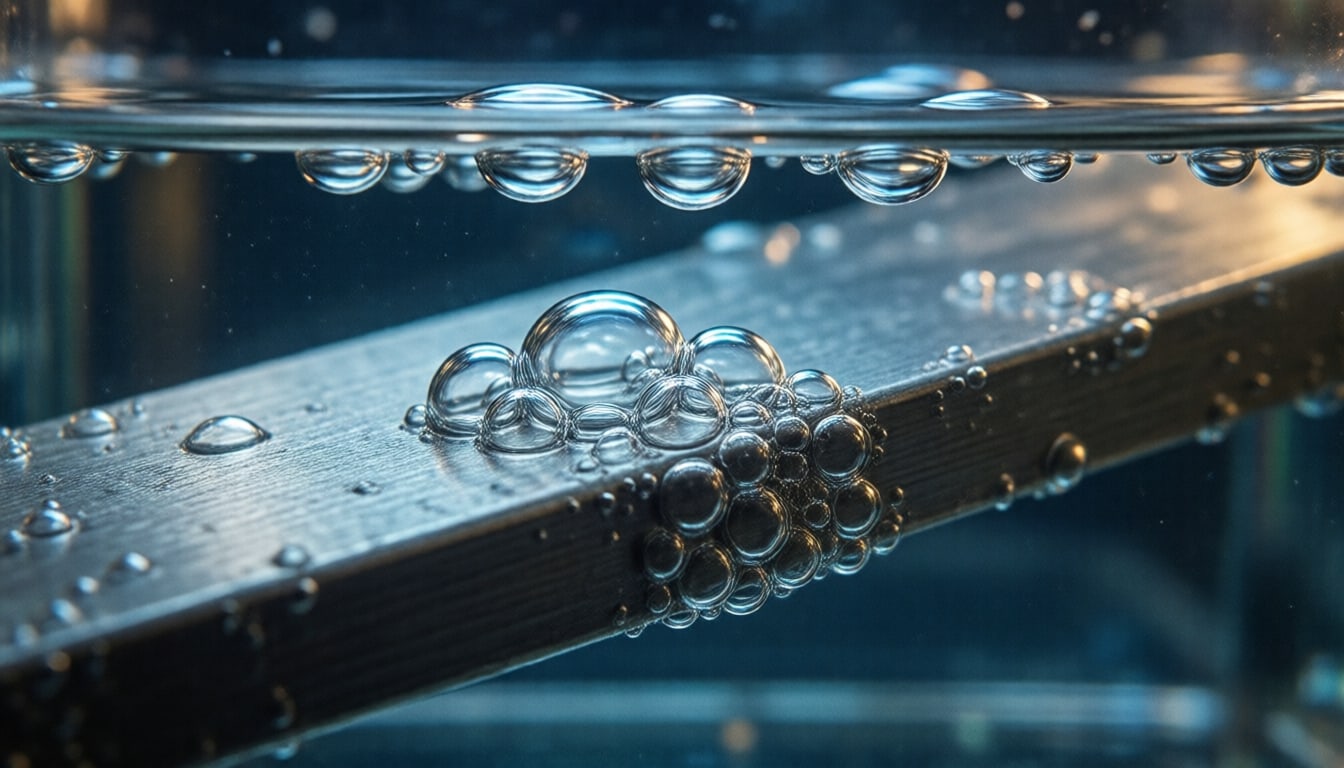
As electricity passes through an electrolyzer, hydrogen and oxygen bubbles form on the electrodes where the chemical reactions occur. According to the press release, those bubbles can cover active reaction sites, prevent liquid from reaching the electrode surface and interfere with the movement of electrically charged particles, forcing the system to consume additional energy. The problem becomes more consequential as electrolyzers grow larger and operate at higher current densities to increase hydrogen production.
Zhang said the missing element has been a reliable way to quantify precisely how much energy bubbles waste and to determine when intervention becomes necessary. The difficulty, he said, is that the physical processes span enormous differences in scale. "Experimentally, it's really challenging to isolate the impact of bubbles on each individual scale," Zhang said in the release.
What the single-bubble simulations found
Using the model to examine individual hydrogen bubbles forming on an electrode in an alkaline electrolyzer, the researchers found that obstructing active electrode surface area was the largest source of bubble-induced energy loss. They also identified a critical bubble radius: once a bubble exceeds that size, the additional voltage required to sustain electrolysis increases exponentially. In certain modelled conditions, the total additional voltage can exceed its bubble-free value by more than 50 %.
The critical radius depends on electrode geometry and how readily liquid wets the electrode surface, rather than on operating current density, according to the release.
A design ratio for electrodes
The finding suggests a practical design strategy: engineer electrode surfaces so bubbles detach before reaching the critical size. The researchers introduced a design parameter comparing the radius at which bubbles detach with the critical radius. Their simulations indicate that keeping this ratio below one could limit the additional voltage required because of an individual bubble to within 3 %.
The release notes that scientists have long recognised that bubbles reduce efficiency, and that researchers have experimented with modifying electrode shapes, changing liquid flows and altering surface properties to encourage bubbles to detach.
Limits and next steps
The current study focuses on a single bubble. Zhang and Li are extending the model to investigate interactions among multiple bubbles, which can grow, merge and influence one another. The researchers also envision combining the modelling framework with computational optimisation and additive manufacturing to create electrodes designed specifically to minimise energy losses. Ultimately, they hope to develop the framework into broadly accessible software that engineers can use to evaluate materials, electrode structures and operating conditions.
The press release describes green hydrogen, produced by splitting water using electricity from renewable sources, as a promising alternative to fossil fuels, particularly for industries such as steelmaking and chemical manufacturing.
Technical fact box
- Model span: eight orders of magnitude in length, from below 1 nm to centimetre scale
- Computational effort reduced by nearly 1,000 times with the new small-scale method, without loss of numerical accuracy
- Largest source of bubble-induced loss in the simulations: obstruction of active electrode surface area
- Additional voltage can exceed the bubble-free value by more than 50 % in certain modelled conditions
- Critical bubble radius depends on electrode geometry and surface wettability, not operating current density
- Detachment-to-critical radius ratio below one: added voltage from an individual bubble limited to within 3 % in simulations
- Study scope: single hydrogen bubble in an alkaline electrolyzer
- Published 9 November 2026 in EES Catalysis, DOI 10.1039/d6ey00288a
Sources
- Double-layer-resolved full-field multiscale simulation unraveling impacts of bubbles on water electrolysis — EES Catalysis — Muhan Zhang, Kaiyu Li, Weihong Li et al.
- Green hydrogen production has a bubble problem—new model reveals threshold for steep energy losses — Phys.org (Technology)
Discussion
Technical questions and corrections are welcome. Comments are signed and checked before they appear.
No comments yet.
Sign in to add a typed review comment. Reviews are signed with your name.