Load a simply supported beam with a point load F at mid-span and it deflects most at the centre:
Every symbol is a design decision. L is the span — and it is cubed. E is Young's modulus: the material. I is the second moment of area: the shape.
The cube of the span
Doubling L multiplies δ by 2³ = 8. That is why long spans need dramatically deeper sections, and why adding a support in the middle of a shelf is so effective.
Shape beats material
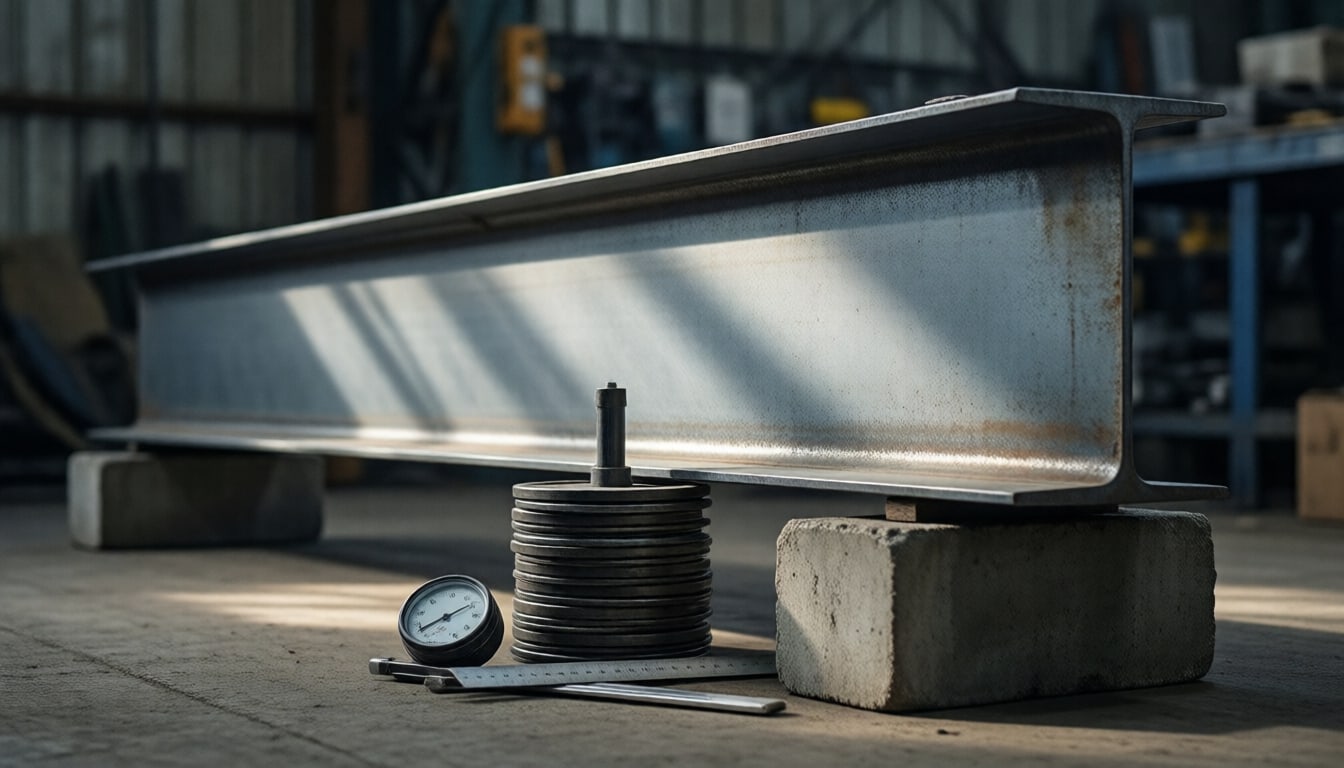
For a rectangular section, I = bh³/12. Doubling the depth h multiplies stiffness by eight; doubling the width only by two. Turning a plank on edge is the cheapest stiffness upgrade in engineering. An I-beam goes further: it puts material in the flanges, far from the neutral axis, where it contributes most to I.
Swapping steel (E ≈ 200 GPa) for aluminium (E ≈ 69 GPa) makes the same section about three times more flexible — compare in the material comparison.
Is it stiff enough?
Building codes typically limit floor deflection to around L/360 under live load, so plaster doesn't crack and floors don't feel bouncy; the governing code for your project decides the actual limit. The beam calculator shows the ratio L/δ directly.
Use it
Mid-span deflection of a simply supported beam with a point load at the centre.
Tip deflection of a cantilever with a point load at its free end.
Simply supported and cantilever beams with point or distributed loads: deflection, moment, shear and bending stress.
Compare stiffness, strength, density, expansion and conductivity — and specific stiffness and strength.
Discussion
Technical questions and corrections are welcome. Comments are signed and checked before they appear.
No comments yet.
Sign in to add a typed review comment. Reviews are signed with your name.