What the team demonstrated
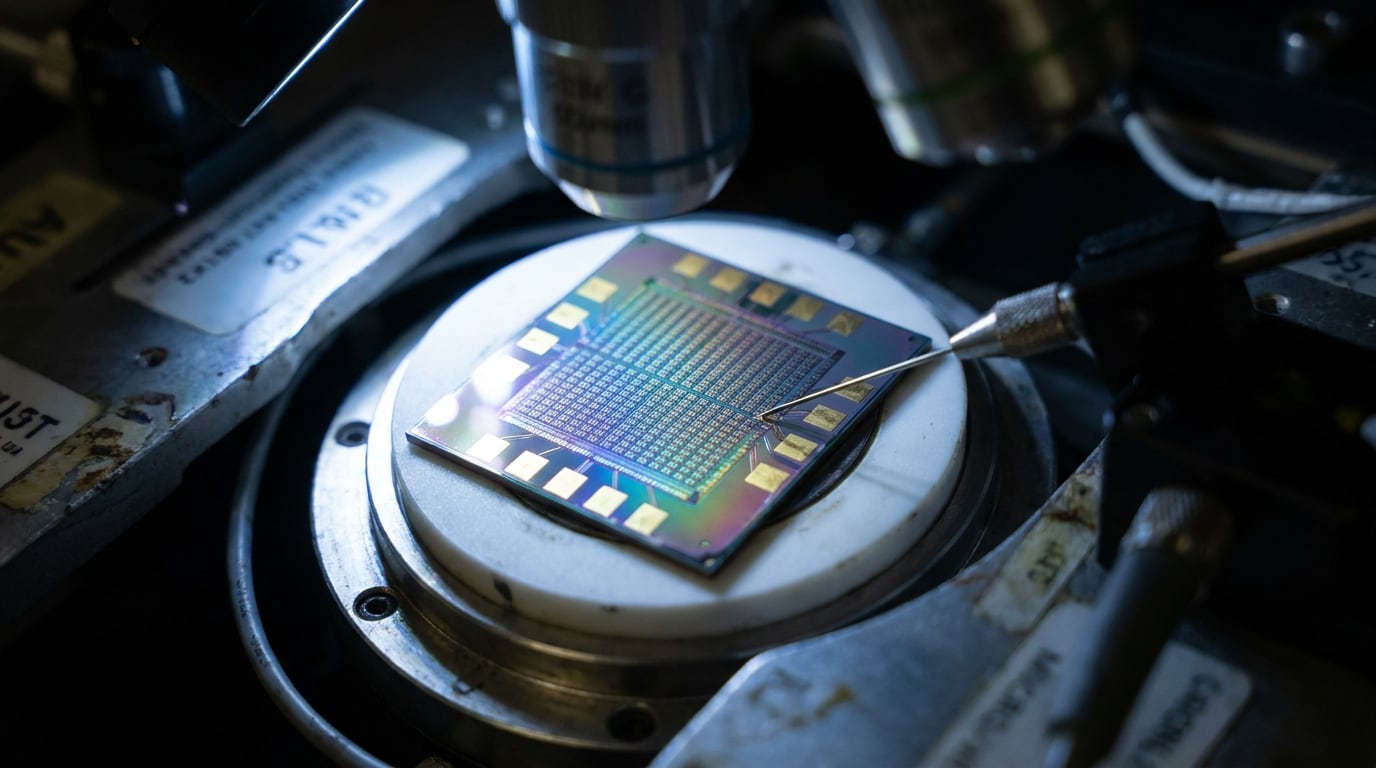
Researchers at Sandia National Laboratories, Infineon Technologies and Arizona State University have demonstrated a method for performing fast Fourier transforms (FFTs) on an analog in-memory computing chip, according to a paper published in Nature Electronics. The chip ran the main Fourier transform calculations on a SONOS flash memory array, with other steps completed digitally.
The FFT is the algorithm digital processors generally use to identify the frequencies that make up a signal. Its divide-and-conquer structure gives the O(N log N) scaling law, which dictates how the time and energy needed to compute a Fourier transform scale with the size of the transform (N). Analog computers, which process data as electrical voltage or other continuous physical quantities, had not traditionally been used to run large Fourier transforms.
The researchers report that their system could process 65,536 points, where a point is an input value such as a single sample extracted from an audio recording. Similar analog chips had previously been shown to compute Fourier transforms of up to 128 points, according to the paper.
How the FFT is split across the array
The team used one of the original formulations of the FFT algorithm, which breaks each Fourier transform down into two smaller transforms, each of which can be broken down again. The researchers stopped dividing when the subproblem matched the size of the physical memory array. First author T. Patrick Xiao described this as the optimal point: a memory array of any size can now compute very large FFTs, but dividing as few times as possible gives the best energy efficiency, which favours large arrays over small ones.
The chip was built using SONOS flash memory. Each memory cell traps electrical charge in a thin insulating layer, which allows it to retain a value without power. When running the FFT, the cells stored the coefficients of the discrete Fourier transform, complex numbers with real and imaginary components, and the stored values were used to perform calculations.
Xiao said the team used more than half a million flash devices at the same time, within the same array, to compute a matrix multiplication. He said a SONOS memory is very precisely controllable, and that this precision lets the team scale up to a large array. According to Xiao, there are very few memory technologies that can support that scale of array-parallel computation without error accumulation getting out of control.
Why the decomposition matters
According to the paper, the approach could make large transforms easier to run on analog in-memory computing chips without requiring a proportionally large memory array. Without it, such transforms would have required such a large collection of memory arrays that the advantage of analog computing would have been jeopardized.
Xiao said the work addresses a limitation: analog in-memory computing had been explored as an efficient accelerator for matrix multiplications, a function that covers most AI processing, but the hardware had not been able to accelerate the FFT. He said the team's method means in-memory computing chips can now run both FFT-heavy and matrix-multiplication-heavy applications, covering signal processing and AI workloads at low power within the same chip.
What the evidence covers
The researchers have so far demonstrated the approach on one-dimensional audio signals and two-dimensional images. They describe these results as preliminary assessments of the hardware's viability in real applications.
Based on the researchers' modeling, the approach could reduce the energy needed to process signals, which would be useful for edge computing, where devices process data locally rather than waiting for a response from a data centre. The energy saving is a modelling result, not a measured field result.
Xiao said analog in-memory computing is known to introduce a little bit of error, which can be reduced by making the devices and circuits more precise and by engineering algorithmic corrections. The researchers state that further tests are needed to understand how much their system's computation errors would affect performance on real problems.
Limits and planned tests
As part of their next studies, the researchers plan to test the system on complex real-world workloads that require other computations in addition to FFT algorithms. Future studies could also assess its potential for edge computing applications based on specific sensor system details and the energy budget of a given edge platform, such as satellites and UAVs.
Xiao said a workload could involve, for example, in-sensor computing that combines FFT-based signal processing with AI algorithms, and that finding or developing such workloads and using them to evaluate the technology is an important next step.
Last author Christopher Bennett said the ability to implement large FFTs using in-memory compute would be a huge unlock for edge sensing workloads in particular, allowing small systems to perform workloads not previously possible in those settings. He gave the example of a satellite with both a standard digital processor and an analog coprocessor implementing the methods, which could produce optical or radar images an order of magnitude higher in resolution and/or scale than before.
Technical fact box
- 65,536 points: transform size processed by the researchers' system, where a point is an input value such as one audio sample
- 128 points: largest Fourier transform previously shown on similar analog chips, according to the paper
- More than half a million flash devices: used at the same time within the same array to compute a matrix multiplication
- SONOS flash memory: technology used to build the chip; each cell traps electrical charge in a thin insulating layer and retains a value without power
- O(N log N): scaling law for the FFT, dictating how time and energy scale with transform size N
- 1D audio signals and 2D images: demonstrations reported so far, described by the researchers as preliminary assessments
- Modelling: basis for the projected reduction in signal-processing energy, not a measured field result
Sources
- Analogue fast Fourier transforms for scalable and efficient signal processing — Nature Electronics — T. Patrick Xiao, Ben Feinberg, David K. Richardson et al.
- Team unlocks large-scale Fourier transforms for analog in-memory computing — Phys.org (Technology)
Discussion
Technical questions and corrections are welcome. Comments are signed and checked before they appear.
No comments yet.
Sign in to add a typed review comment. Reviews are signed with your name.