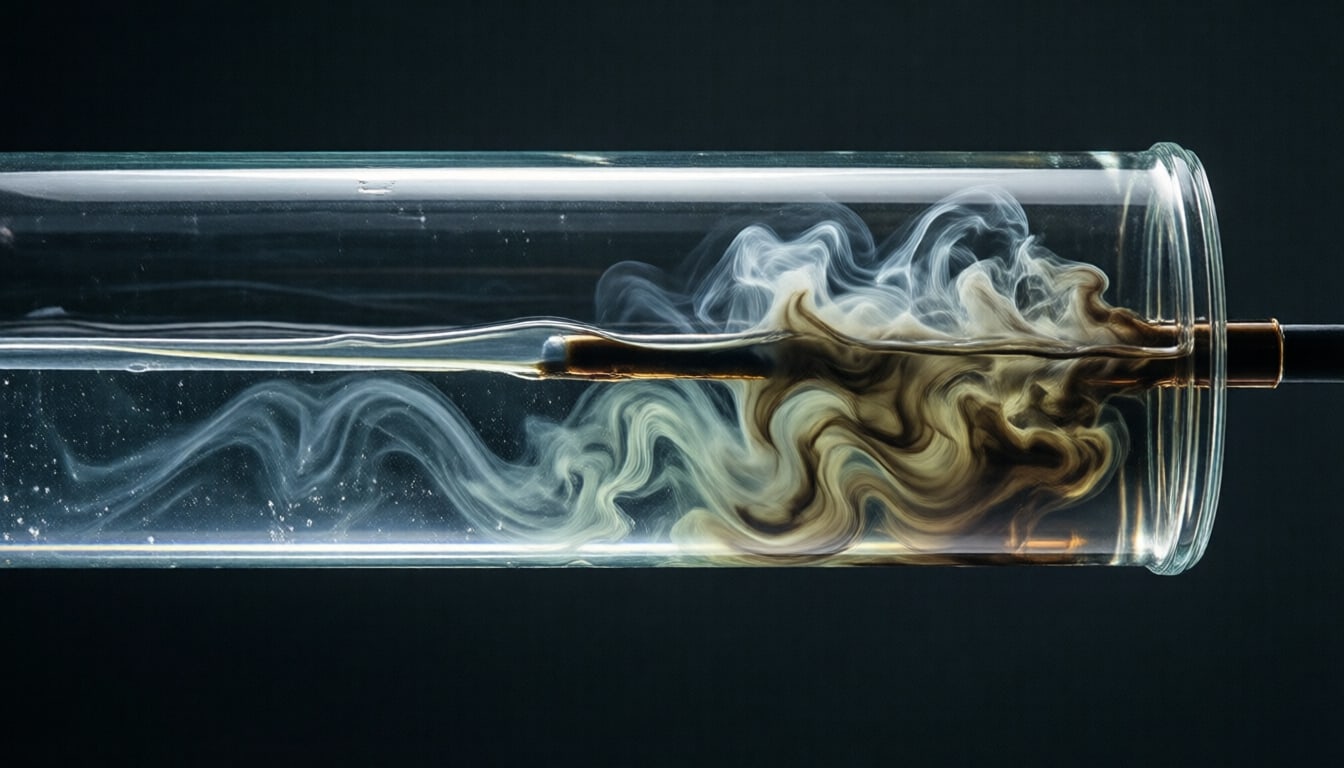
Pour honey and it folds over itself in smooth layers. Open a tap fully and the water churns. The difference is captured by one dimensionless number:
where ρ is the fluid's density, v its mean velocity, D the pipe diameter and µ the dynamic viscosity. The numerator measures the fluid's momentum (inertia); the denominator, the viscous forces that smooth disturbances out.
The thresholds
In a round pipe, flow is reliably laminar below Re ≈ 2300 and usually turbulent above about 4000. In between it is transitional — it may switch back and forth, and small disturbances decide.
| Situation | Typical Re |
|---|---|
| Honey in a 10 mm tube | about 1 |
| Blood in a capillary | about 0.001 |
| Water at 1 m/s in a 50 mm pipe | about 50,000 |
| Air over a car | millions |
Why engineers care
Pressure drop. Laminar friction factor is simply f = 64/Re. Turbulent flow has a higher friction factor that also depends on pipe roughness (the Colebrook equation). Use the pipe flow calculator to see the jump.
Heat transfer. Turbulent mixing carries heat to and from walls far better, which is why heat exchangers are designed to run turbulent.
Scaling. Two flows with the same Reynolds number — and the same geometry — behave alike. That is why wind tunnels can test scale models, provided they match Re (often with pressurised or cooled air).
Use it
Discussion
Technical questions and corrections are welcome. Comments are signed and checked before they appear.
No comments yet.
Sign in to add a typed review comment. Reviews are signed with your name.