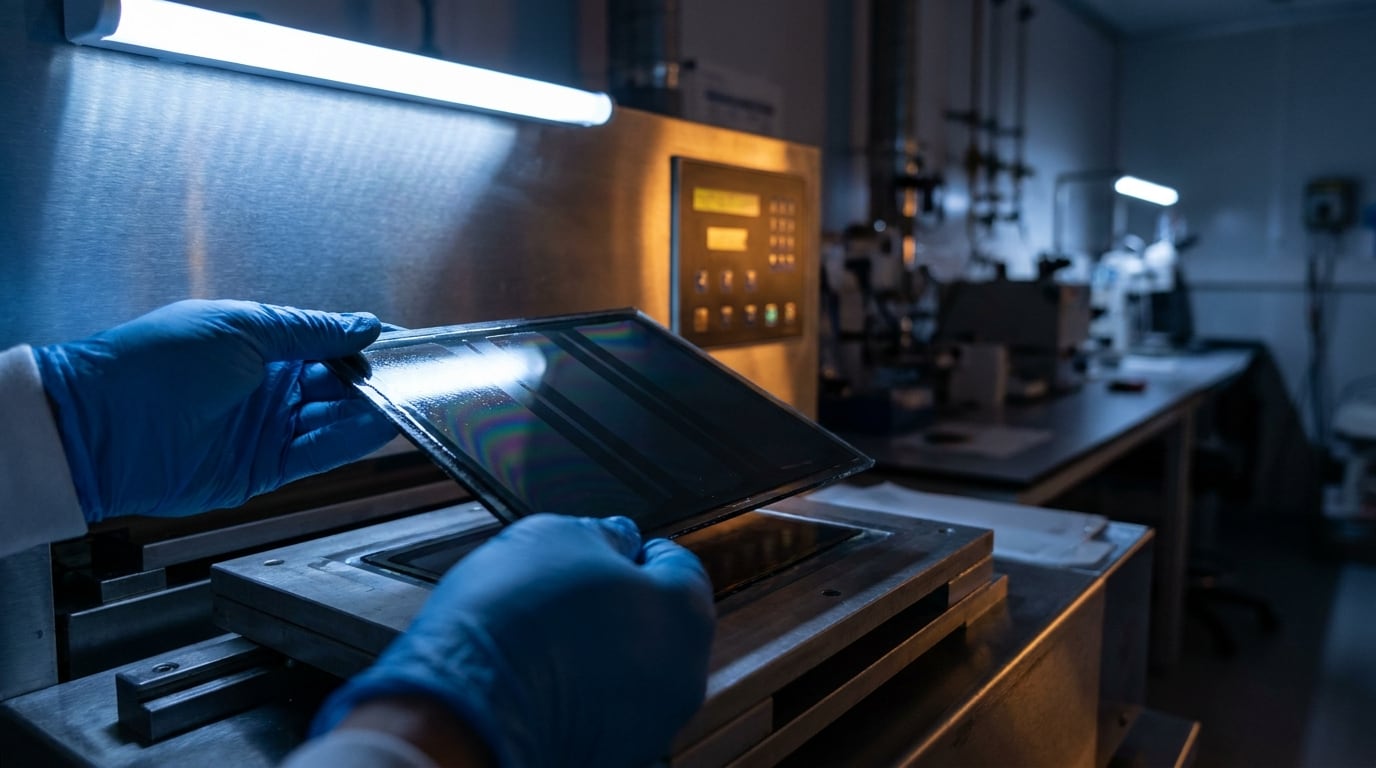
Researchers from the Chinese Academy of Sciences and Dalian Jiaotong University have fabricated a small perovskite solar module without methylammonium (MA) and reported a power conversion efficiency of 22.70% over an active area of 54.80 cm², according to pv magazine. Small-area solar cells reached 26.16%. The scientists said a reference module made without their additive strategy recorded 15.8% efficiency.
The work addresses MA, which the researchers describe as intrinsically thermally and chemically unstable. At elevated temperatures, MA-containing perovskites such as MAPbI₃ can decompose and release volatile species including methylamine (CH₃NH₂) and hydrogen iodide (HI), promoting degradation of the crystal structure and formation of lead iodide (PbI₂).
The team used slot-die coating under ambient conditions and a combined additive strategy based on rubidium thiocyanate (RbSCN) and formamidinium thiocyanate (FASCN) to control crystal formation during deposition. According to the researchers, the two additives work through an in situ coordination mechanism that converts the non-photoactive δ-phase into the photoactive α-phase while preventing unwanted secondary phases.
Corresponding author Zhihua Zhang told pv magazine that the combined additives lower the energy barrier for the δ-to-α transition and broaden the processing window between film deposition and annealing. The researchers report that the processing window for uniform crystallization extended to more than 100 seconds, producing dense films with large crystal grains, a uniform vertical compositional gradient and lower residual stress.
In stability testing, unencapsulated devices maintained 97.76% of their initial efficiency after 1,300 hours of continuous operation at the maximum power point under AM 1.5G illumination at 65 °C, the scientists said. Reference devices under identical conditions retained 65.86%. The researchers note that achieving homogeneous film coverage and controlled crystallization remains challenging when moving from laboratory-scale devices to large-area modules. The work was published in Advanced Materials.
Key facts
- 22.70% power conversion efficiency over an active area of 54.80 cm² for the module
- 26.16% power conversion efficiency for small-area solar cells
- 15.8% efficiency for the reference module without the additive strategy
- 97.76% of initial efficiency retained after 1,300 hours at the maximum power point under AM 1.5G illumination at 65 °C
- Processing window for uniform crystallization extended to more than 100 seconds
Sources
- Chinese scientists build 54.80 cm² methylammonium-free perovskite solar module with 22.7% efficiency — pv magazine
Other news outlets are named as sources but not linked.
Discussion
Technical questions and corrections are welcome. Comments are signed and checked before they appear.
No comments yet.
Sign in to add a typed review comment. Reviews are signed with your name.