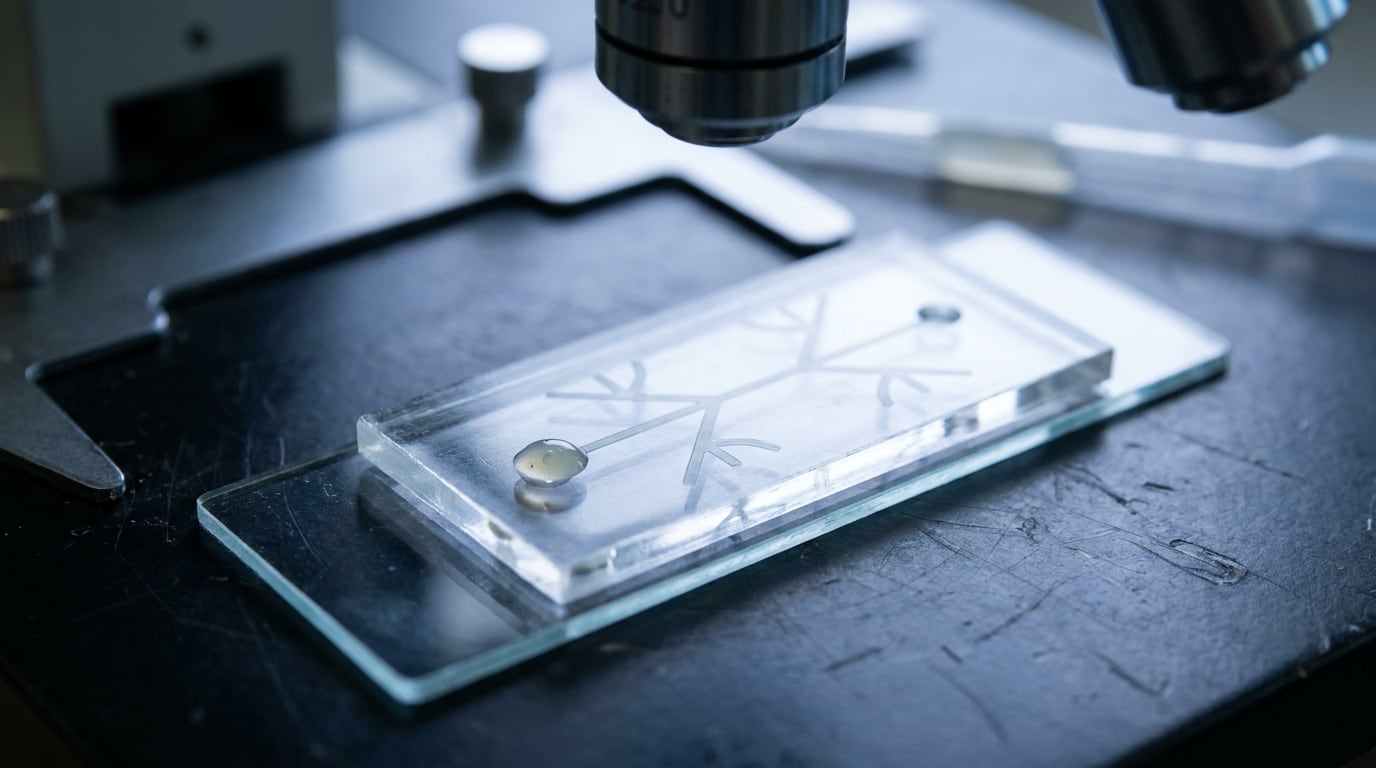
Researchers at McGill University in Canada, working with an international team, have built an experimental biological computer in which living bacteria act as computing agents inside a microfluidic chip. The study was published in Microsystems & Nanoengineering.
The chip contains an interconnected network of microscopic channels and junctions. It is moulded from polydimethylsiloxane (PDMS) against a silicon template and sealed to a glass substrate. Each channel represents a possible mathematical path. At splitting junctions, bacteria take one of two routes, representing the decision to include or exclude a number from a sum. Other junctions let them continue or merge into shared channels.
The team demonstrated the system on the Subset Sum Problem, in which combinations of given numbers must add up to a target. They successfully solved problems involving up to seven numbers. Navigation error rates were relatively low: E. coli incorrectly changed direction at just 1.3 % of pass-through junctions, and V. natriegens at 0.3 %. Automated image analysis of which exits the bacteria reached was used to determine which combinations satisfied the problem.
Because the bacteria reproduce while exploring, the number of computing agents grows during operation. In one experiment lasting approximately 26 minutes, V. natriegens, which can double its population roughly every 9 to 12 minutes under favourable conditions, completed two population-doubling cycles. The researchers directly observed division inside the channels and measured more bacteria leaving the network than entering it.
The researchers also tested larger, specially structured networks containing up to 200 repeated values of one. In the 100-value version, the network encoded 2,100 possible subsets, which produced only 101 distinct sums. The study describes this as a demonstration of physical scalability rather than proof that the computer can solve arbitrary 100-number problems.
The system remains an experimental proof of concept. Claims of superior speed and efficiency for larger problems are based partly on theoretical modelling. The study lists navigation errors, bacterial overcrowding, nutrient availability and the effort of constructing complex microfluidic networks as practical challenges. Senior author Dan Nicolau says the approach is tailored for problems electronic computers are not designed to solve, such as mapping protein structure.
Key facts
- Up to seven numbers: largest subset-sum problems the chip solved
- 1.3 % of pass-through junctions: E. coli wrong turns
- 0.3 % of pass-through junctions: V. natriegens wrong turns
- 9 to 12 minutes: V. natriegens population doubling time under favourable conditions
- 2,100 possible subsets encoded in the 100-value network, producing 101 distinct sums
Sources
- One-of-a-kind biological computer runs on living bacteria — New Atlas
Other news outlets are named as sources but not linked.
Discussion
Technical questions and corrections are welcome. Comments are signed and checked before they appear.
No comments yet.
Sign in to add a typed review comment. Reviews are signed with your name.