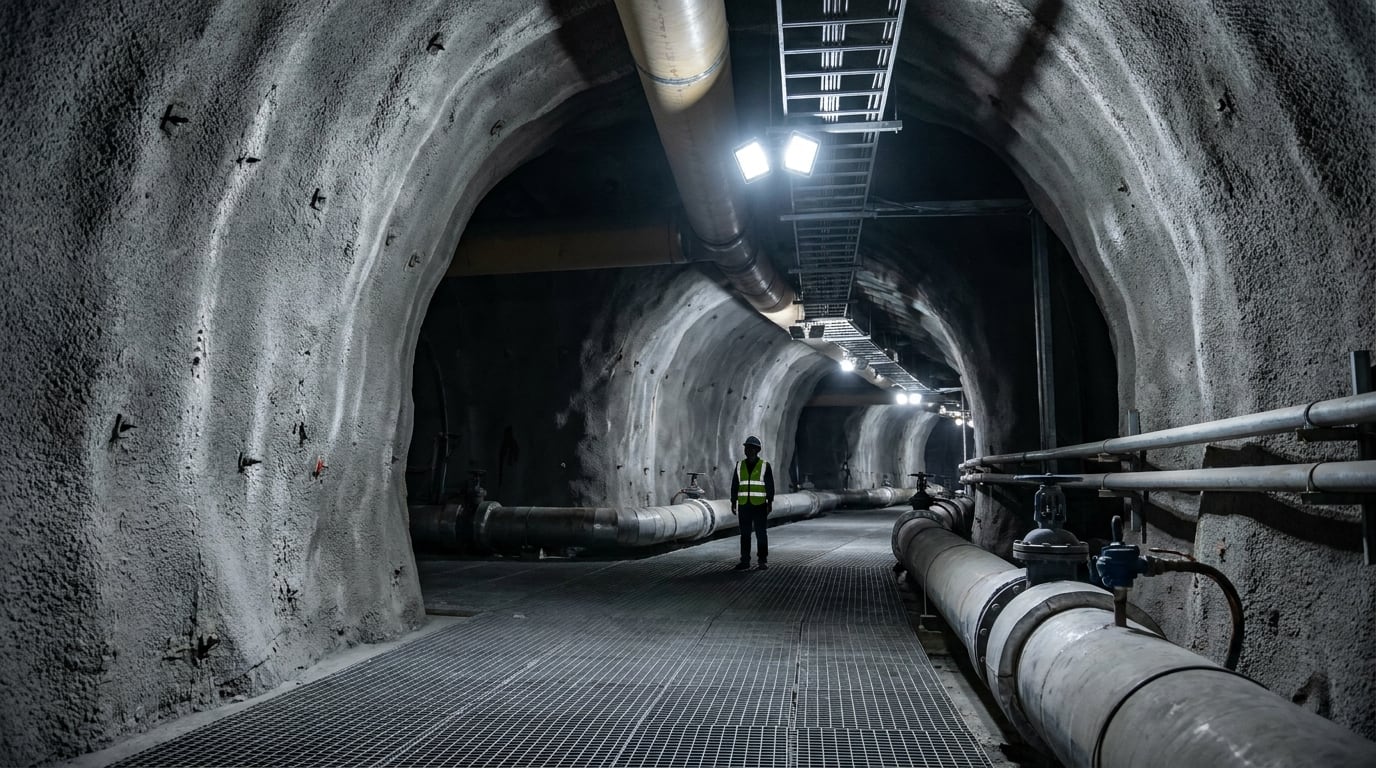
China has grid-connected a 300 MW/1,800 MWh compressed air energy storage (CAES) plant in Yumen, in the northwestern province of Gansu. The developer, China Energy Digital Technology Group, a subsidiary of China Energy Engineering Corporation, describes it as the world's first grid-connected CAES facility using purpose-excavated underground rock caverns.
The plant is designed for an eight-hour charging cycle and six hours of continuous discharge. Total investment reached approximately CNY 2.5 billion (USD 368 million), with projected annual electricity generation of 600 GWh.
Its storage system consists of four interconnected chambers excavated approximately 110 metres below the surface in hard rock, creating a pressurised storage space of around 200,000 cubic metres. The design pressure is 18 MPa.
The plant uses non-combustion, adiabatic CAES. During charging, electricity drives compressors that pressurise air, and heat generated during compression is recovered and stored. During discharge, the stored heat reheats the compressed air before it expands through turbines, eliminating supplementary natural gas combustion. According to molten-salt supplier Shandong Huayang Dier Chemical, the thermal system combines low-melting-point ternary molten salt with pressurised hot water: lower- and medium-temperature compression heat is stored in pressurised water tanks, while higher-temperature heat goes to molten-salt tanks. The developer also reports shared heat-exchange equipment for charging and discharging, reducing equipment duplication.
The developer reports a round-trip electrical efficiency of 72 %, although sustained operational data have not yet independently confirmed the figure. The artificial-cavern approach addresses a geographical constraint on CAES deployment: salt caverns offer relatively economical underground storage but require suitable geological formations, while excavating and sealing chambers in competent hard rock could broaden site selection. Geological conditions and construction costs remain important considerations.
Yumen lies within the Hexi Corridor, a major wind and solar development region in northwest China. The plant is intended to absorb surplus renewable electricity during off-peak periods and return it to the grid when demand rises, providing multi-hour balancing capacity.
China has been expanding its large-scale CAES fleet. According to an October 2026 report by the Energy Storage Application Branch of the China Industrial Association of Power Sources, 13 CAES projects were under construction, totalling 4.95 GW/23.95 GWh. Separately, industry figures cited in November indicated more than 36 GW of projects in preparation as of the first quarter of 2026, with nearly 100 project filings nationwide. Many proposed projects remain subject to financing, geological assessments and commercial viability. Long-term efficiency, cavern integrity and operating costs will determine whether artificial-cavern technology can be replicated economically.
Key facts
- Four interconnected chambers excavated about 110 m below the surface, around 200,000 m³ of storage
- Design pressure of 18 MPa
- Developer-reported round-trip electrical efficiency of 72 %, not independently confirmed
- Projected annual electricity generation of 600 GWh
Sources
- China grid-connects world’s first artificial-cavern CAES plant — pv magazine
Other news outlets are named as sources but not linked.
Discussion
Technical questions and corrections are welcome. Comments are signed and checked before they appear.
No comments yet.
Sign in to add a typed review comment. Reviews are signed with your name.