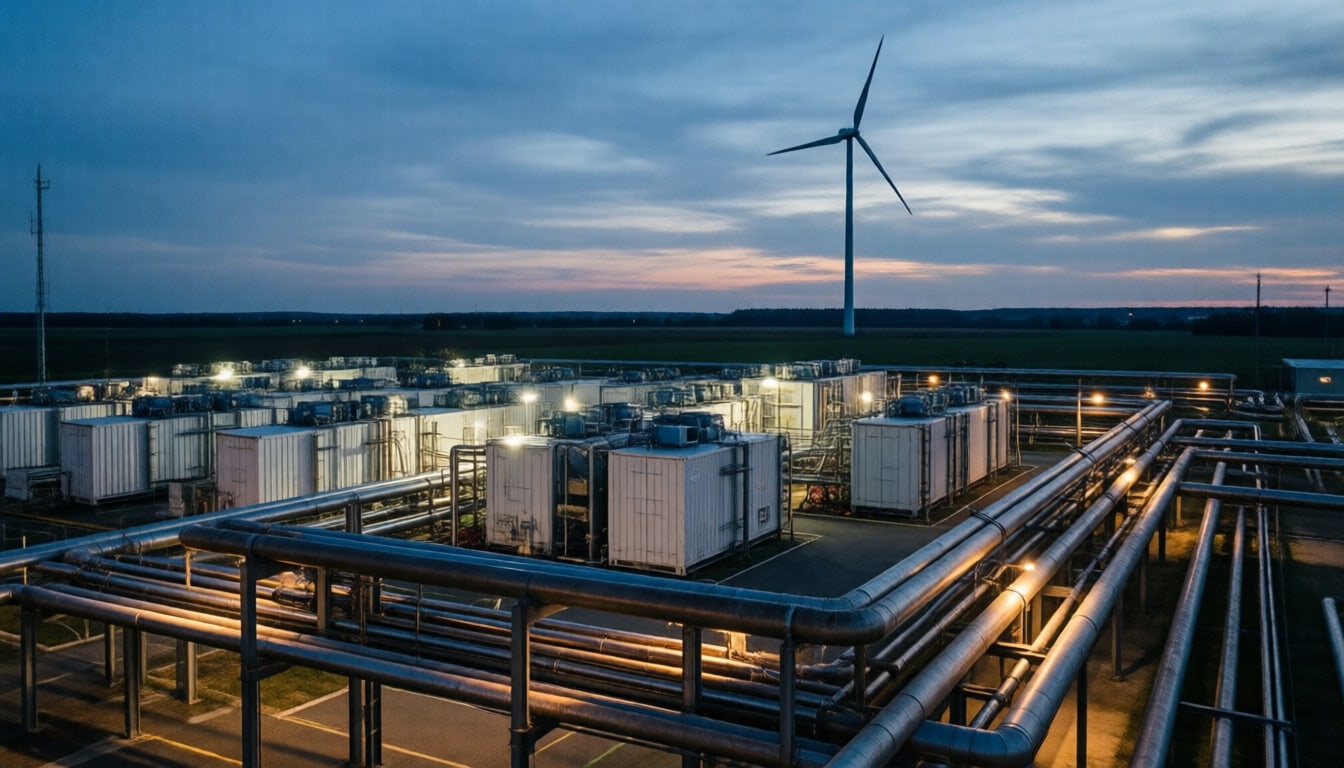
Uniper and VNG have produced their first green hydrogen at the 30 MW electrolyser facility at the Bad Lauchstädt Energy Park in Saxony-Anhalt, Germany, according to pv magazine. The facility uses renewable electricity from a connected wind farm and is entering a testing phase to assess the components of the integrated energy system.
The hydrogen will be transported through a roughly 25 km former natural gas pipeline converted to carry hydrogen. Deliveries to TotalEnergies' refinery in Leuna are scheduled to begin in 2027, and full commissioning is expected in 2027, when the facility is scheduled to begin supplying industrial customers. The project aims to demonstrate an integrated hydrogen value chain combining renewable power generation, electrolysis, storage, pipeline transport and industrial consumption.
In a separate study published in the International Journal of Hydrogen Energy, researchers Yifei Lu, Abeeb Adekunle Garba, Thiemo Pesch and Andrea Benigni assessed potential hydrogen transport corridors connecting West Africa to Europe via existing and planned natural gas pipeline routes. They estimated a combined transport capacity of up to 7.16 million metric tons of green hydrogen per year.
The study examined scenarios involving the West African Gas Pipeline (WAGP), Nigeria-Morocco Gas Pipeline (NMGP), Trans-Saharan Gas Pipeline (TSGP) and Maghreb-Europe Gas Pipeline (MEGP), comparing a coastal corridor through Morocco and Spain with an inland route through Niger and Algeria, and a combined configuration using both. The researchers report that the combined configuration could transport almost twice as much hydrogen as either individual route, requiring a pipeline network spanning approximately 15,082 km and an estimated investment of €25.3 billion.
Using a two-stage framework combining mixed-integer linear programming optimisation and physical gas network simulations, the researchers also assessed pressure drops, flow velocities and compression requirements. At operating pressures of 80 bar to 100 bar, the combined configuration would require 34 compressor stations with a total installed capacity of 661 MW. Reducing the minimum operating pressure to 50 bar could increase hydrogen flow velocities to 22.37 m/s, exceeding the assumed nominal design velocity of 15 m/s.
The researchers said developing both export corridors could diversify Europe's renewable hydrogen supply routes. They cautioned that the estimated capacity represents a long-term technical planning scenario rather than a deployment forecast, as actual hydrogen availability will depend on regional demand, infrastructure development, investment and cross-border cooperation.
Other hydrogen developments
Hydroplane will lead the development of a hydrogen fuel cell-powered watercraft designed to transport modular hydrogen tank containers across New York's inland waterways. The project is supported by the New York State Energy Research and Development Authority (NYSERDA) and aims to reduce the costs, emissions and logistical complexity of clean hydrogen distribution across the state. Hydroplane says it will lead a consortium that includes Serco North America, Hornblower Group, Pacific Hydrogen, Messer North America and Unitrove.
India's Ministry of New and Renewable Energy has agreed to extend the commissioning deadlines for approximately 1.5 GW of subsidised electrolyser manufacturing capacity awarded under the first tranche of its Strategic Interventions for Green Hydrogen Transition (SIGHT) programme, according to The Economic Times. The decision affects several manufacturers, including Reliance, Ohmium and John Cockerill Greenko, which received support under a funding programme worth approximately USD 220 million. The delays reportedly reflect slower-than-expected growth in India's green hydrogen market, with a lack of confirmed orders and delays in reaching financial close for several hydrogen and green ammonia projects weighing on demand for electrolyser equipment.
Key facts
- 30 MW — capacity of the electrolyser facility at Bad Lauchstädt Energy Park
- roughly 25 km — length of former natural gas pipeline converted to carry hydrogen
- up to 7.16 million metric tons per year — estimated combined transport capacity of West Africa–Europe corridors in the study
- approximately 15,082 km — pipeline network length for the combined corridor configuration
- €25.3 billion — estimated investment for the combined corridor configuration
- 34 compressor stations with 661 MW total installed capacity at 80 bar to 100 bar
Sources
- The Hydrogen Stream: Uniper and VNG Produce first green hydrogen at 30 MW facility in Germany — pv magazine
Other news outlets are named as sources but not linked.
Discussion
Technical questions and corrections are welcome. Comments are signed and checked before they appear.
No comments yet.
Sign in to add a typed review comment. Reviews are signed with your name.