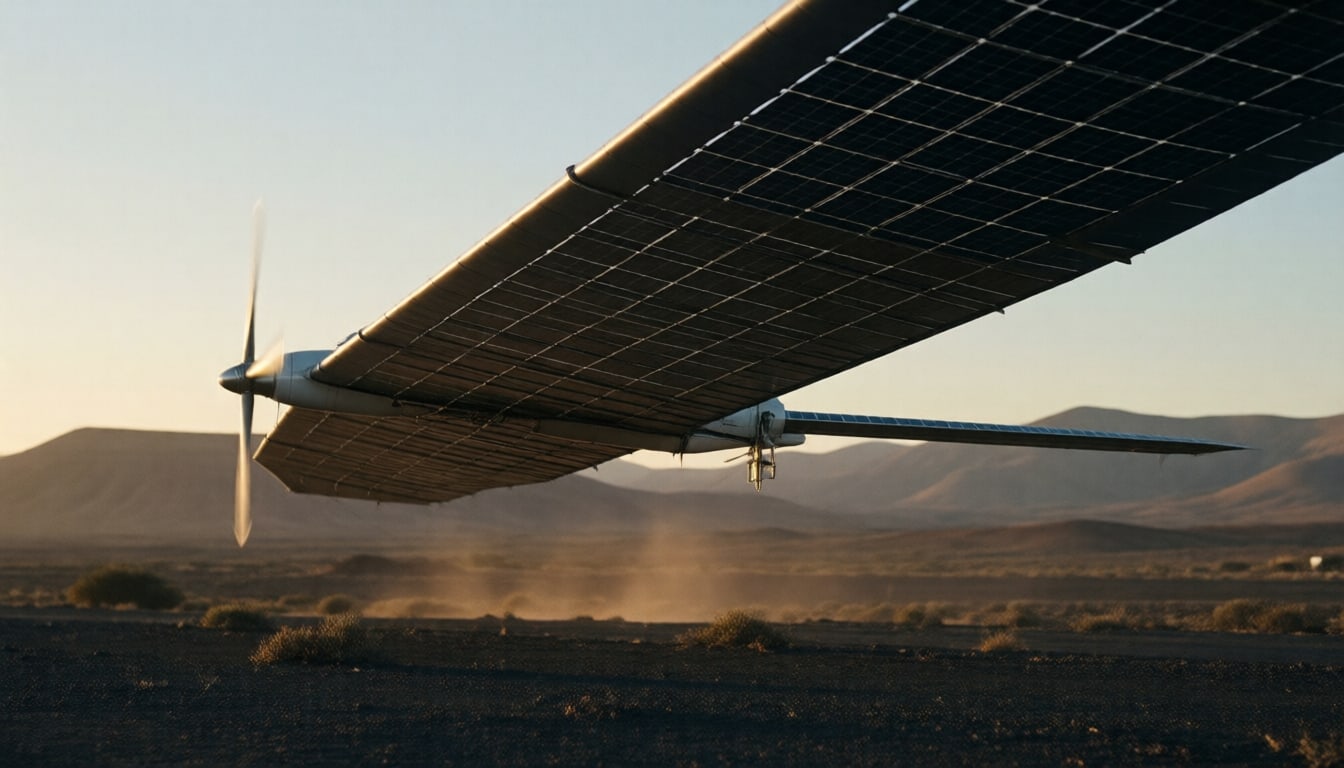
A solar-powered aircraft with a 59-ft (18-m) wingspan spent 29 hours flying over the island of Fuerteventura, running at night on stored sunlight, according to UAVOS. The company says the ApusNeo is the first solar plane to fly at 47,600 ft (14,500 m) in European airspace.
The aircraft took off on 16 October from the Canarias Stratoport for HAPS & UAS at the Fuerteventura Technology Park in Spain. UAVOS founder and CEO Aliaksei Stratsilatau told New Atlas that the plane could have climbed higher; the 47,600 ft mark was the ceiling set by the NOTAMs published for the flight, which Spain's air navigation manager ENAIRE coordinated.
Solar panels on the wing power the motors and charge the batteries during the day. After sunset the aircraft runs on those batteries until sunrise. It weighs up to 104 lb (47 kg) at takeoff, and a reinforced version can carry up to 7.5 lb (3.4 kg) of payload. On this flight the payload was an Earth observation pod — a high-resolution camera plus infrared sensors — sending images to the ground in real time.
Endurance came earlier: in September, two flights from the same stratoport lasted 29 and 52 hours nonstop, according to CATEC, the Andalusian aerospace centre that operates the aircraft.
The company wants the aircraft to watch for wildfires. The infrared sensor picks up heat rather than smoke. A high-altitude platform station can stay over the same patch of forest for days or weeks, unlike a low-orbit satellite that passes over a spot for a few minutes, or a crewed aircraft or regular drone that must land to refuel.
The International Telecommunication Union places HAPS platforms 20 to 50 km (12 to 31 miles) up, so strictly speaking ApusNeo has not reached HAPS territory. UAVOS says its earlier ApusDuo reached 54,744 ft (16,686 m) in a 10.5-hour test in Rwanda in 2023. AALTO's Zephyr has reached 76,100 ft (23,195 m) and in 2025 stayed aloft for 67 days, 6 hours and 52 minutes, according to AALTO. SoftBank, developing its own solar stratospheric aircraft Sunglider, has pointed out that short winter days make year-round flights difficult. UAVOS says it is ready to prepare the aircraft for future missions with more advanced payloads.
Key facts
- 29 hours: duration of the October flight from Fuerteventura
- 47,600 ft (14,500 m): altitude reached, the ceiling set by the flight's NOTAMs
- 59-ft (18-m) wingspan; up to 104 lb (47 kg) takeoff weight
- Up to 7.5 lb (3.4 kg) payload on a reinforced version
- More than 80 hours logged on a later flight, with 100 hours as the goal, per UAVOS
Sources
- Solar plane soars to 47,600 ft, on target to fly 100 hours — New Atlas
Other news outlets are named as sources but not linked.
Discussion
Technical questions and corrections are welcome. Comments are signed and checked before they appear.
No comments yet.
Sign in to add a typed review comment. Reviews are signed with your name.