A research team in South Korea has built a model that predicts power output and hot-spot risk in coloured building-integrated photovoltaic (c-BIPV) systems that display artistic images, pv magazine reports. The team simulated arrays displaying 50 masterpieces, among them Johannes Vermeer's Girl with a Pearl Earring and Vincent van Gogh's Café Terrace at Night. The study, from Seoul National University of Science and Technology and Gachon University, appeared in Energy.
An image-based array holds many differently coloured cells, and each colour needs its own optical reflection profile. The photocurrent from each cell can therefore vary across the array, corresponding author Hyung-Jun Song told pv magazine. Song said the work links the visual characteristics of a candidate image directly to the electrical performance and reliability of the whole array.
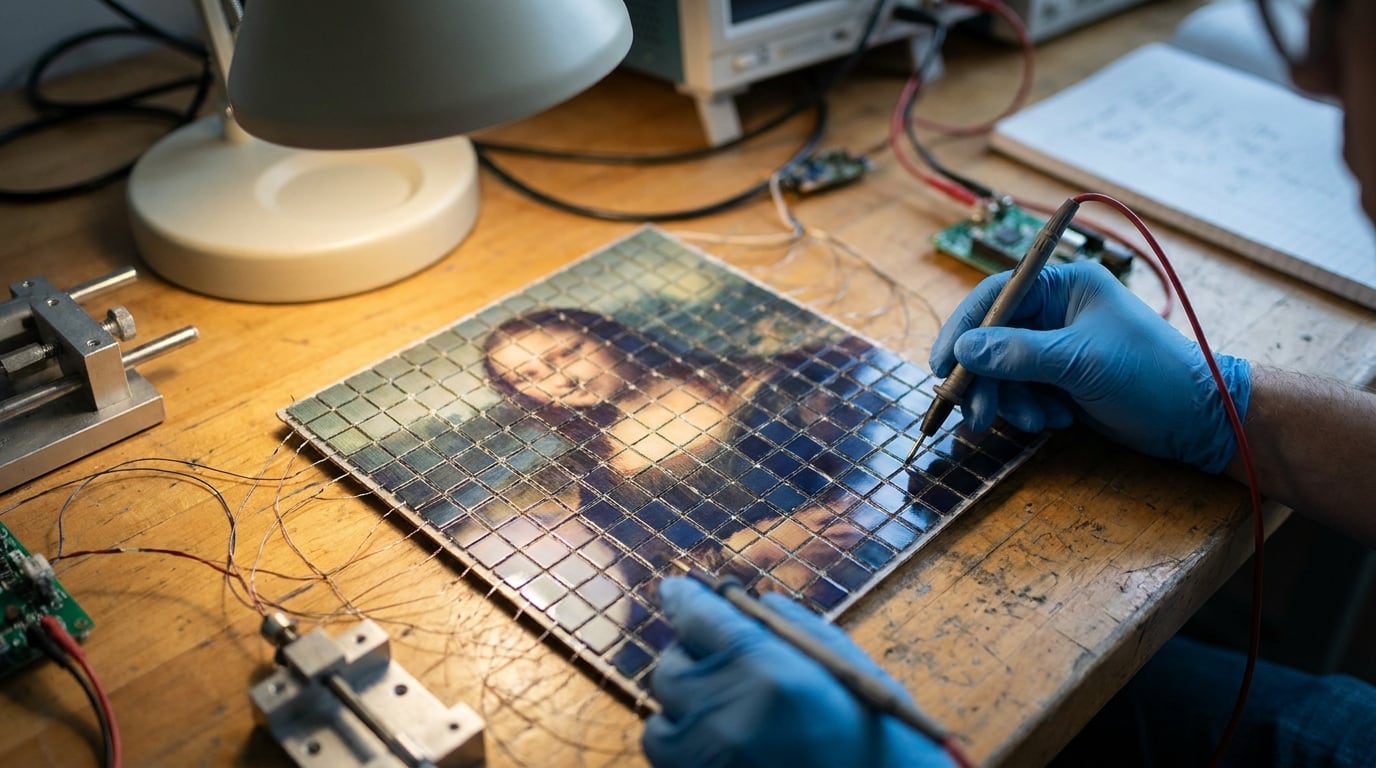
The group turned each artwork into a 36 × 36-pixel mosaic. Each of the 1,296 pixels stands for one series-connected PV cell. For each colour, the researchers calculated an ideal dual-band selective-reflection spectrum and the photocurrent it produces, taking into account the wavelength-dependent internal quantum efficiency of the cell underneath. They then modelled each cell's current-voltage characteristics at 300 K using a single-diode equivalent circuit calibrated to commercial TOPCon cells, and simulated the fully series-connected array in LTspice. They compared configurations without bypass diodes against configurations with one diode protecting between one and 36 cells.
In the simulations, the array displaying Café Terrace at Night reached 91.7 % of the power output of an equivalent black reference array without bypass diodes. Girl with a Pearl Earring reached 74.3 %. Song said an image's overall brightness or colourfulness does not necessarily determine its photovoltaic performance; the spatial distribution of brightness plays a larger role. He added that even a small number of extremely bright pixels can limit the power output of an entire series-connected array.
For Girl with a Pearl Earring, installing one bypass diode per cell raised normalized power from 74.3 % to 84.4 % of the black reference array's output, a 13.6 % relative improvement. At the maximum power point, however, 24 of the 1,296 cells entered reverse bias. Selectively darkening those 24 pixels instead raised normalized power to 84.8 % without bypass diodes, and under the simulated conditions no cells entered reverse bias.
Song said the team developed a screening framework that classifies artistic images by expected power performance and hot-spot risk. The framework uses two parameters taken from the image: the brightest pixel and the overall brightness variation. The team examined it further with additional images, showing its potential to assess candidate artwork without a full circuit-level simulation for every image. Planned follow-up studies include incorporating measured reflectance spectra into a more realistic optical model, expanding the image database, and developing an AI-assisted tool that assesses uploaded images and suggests modifications to improve power output and reduce hot-spot risk while preserving appearance.
Key facts
- 1,296 series-connected PV cells per simulated array, arranged as a 36 × 36-pixel mosaic
- Café Terrace at Night array: 91.7 % of black reference array output without bypass diodes (simulation)
- Girl with a Pearl Earring array: 74.3 % of black reference output; 84.4 % with one bypass diode per cell
- 24 of 1,296 cells entered reverse bias at maximum power point with one diode per cell (Girl with a Pearl Earring)
- Cell current-voltage characteristics modelled at 300 K using a single-diode circuit calibrated to commercial TOPCon cells
Sources
- Predicting power output from artistic BIPV pixel by pixel — pv magazine
Other news outlets are named as sources but not linked.
Discussion
Technical questions and corrections are welcome. Comments are signed and checked before they appear.
No comments yet.
Sign in to add a typed review comment. Reviews are signed with your name.