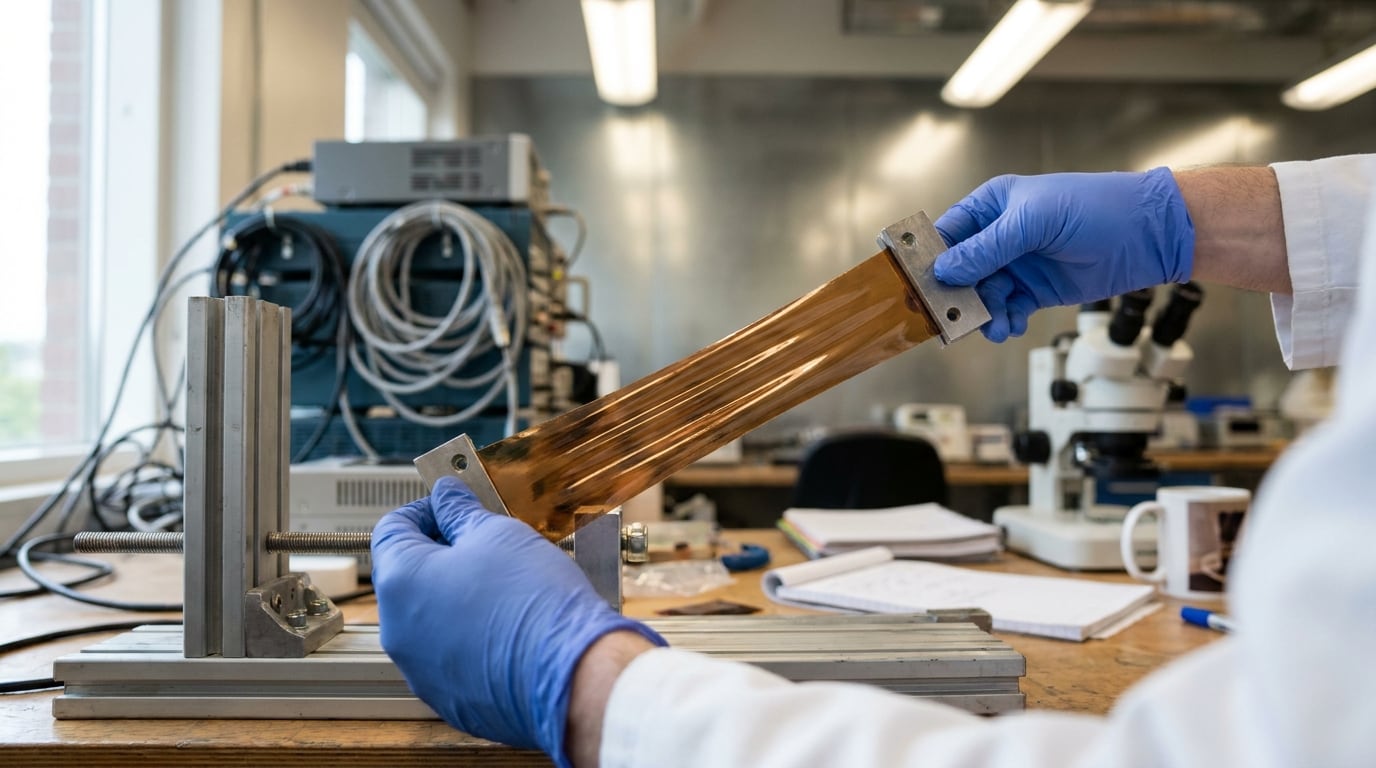
A research team led by professor Joon Hak Oh of the Department of Chemical and Biological Engineering at Seoul National University College of Engineering has developed an n-type polymer semiconductor that stretches like rubber and returns to its original shape. Collaborators at Queensland University of Technology and Fudan University took part, and the findings are published in Science Advances.
Conventional polymer semiconductors crack when stretched, the researchers say, which disrupts charge pathways, and they can undergo plastic deformation. N-type semiconductors, which use electrons as charge carriers, have lagged behind stretchable p-type versions in electrical performance.
The team's strategy, described in the paper as solubility-driven morphological decoupling, introduced approximately 10 % of planar, insoluble PyF units into a semicrystalline PySe backbone. The introduced molecules stacked and acted as nano-anchors, holding the soft polymer chains in place at multiple points while maintaining conduction pathways. The press release states the researchers turned poor solubility, previously regarded as a drawback, into a design tool.
The paper reports a near-unity initial electron mobility of about 1.0 square centimetre per volt per second, retaining 0.5 square centimetres per volt per second under 100 % applied strain, which the authors describe as the highest performance reported to date. The press release says the material showed approximately twice the charge-carrier mobility of conventional stretchable n-type semiconductors when stretched to twice its original length, and is comparable to amorphous silicon used to drive displays.
In the reported tests, a conventional n-type polymer semiconductor cracked after being stretched once to 1.75 times its original length. The new semiconductor returned to its original state without cracking after 1,000 cycles of stretching to twice its original length and releasing. An inverter fabricated with the material operated reliably when stretched to twice its original length.
The researchers also built a fully stretchable phototransistor with stretchable semiconductor, electrodes and substrate. At 100 % strain it sustained a responsivity of 15.8 amperes per watt and an external quantum efficiency exceeding 2900 %, and could amplify and detect weak light signals, with more than 29 charge carriers flowing per incident photon. The press release ranks this among the highest reported for stretchable organic photosensors.
Key facts
- 0.5 square centimetres per volt per second: electron mobility retained at 100 % applied strain
- 1,000 cycles: stretching to twice original length and releasing without cracking
- 15.8 amperes per watt: phototransistor responsivity at 100 % strain
- More than 2900 %: external quantum efficiency at 100 % strain
- Approximately 10 %: PyF units incorporated into the PySe backbone
Sources
- Solubility-driven morphological decoupling enables elastic electron-deficient semiconducting polymers for fully stretchable electronics — Science Advances — Hayeong Park, Qian Liu, Wenhao Li et al.
- Rubberlike semiconductor combines elasticity and high electrical performance for stretchable electronics — Phys.org (Technology)
Discussion
Technical questions and corrections are welcome. Comments are signed and checked before they appear.
No comments yet.
Sign in to add a typed review comment. Reviews are signed with your name.