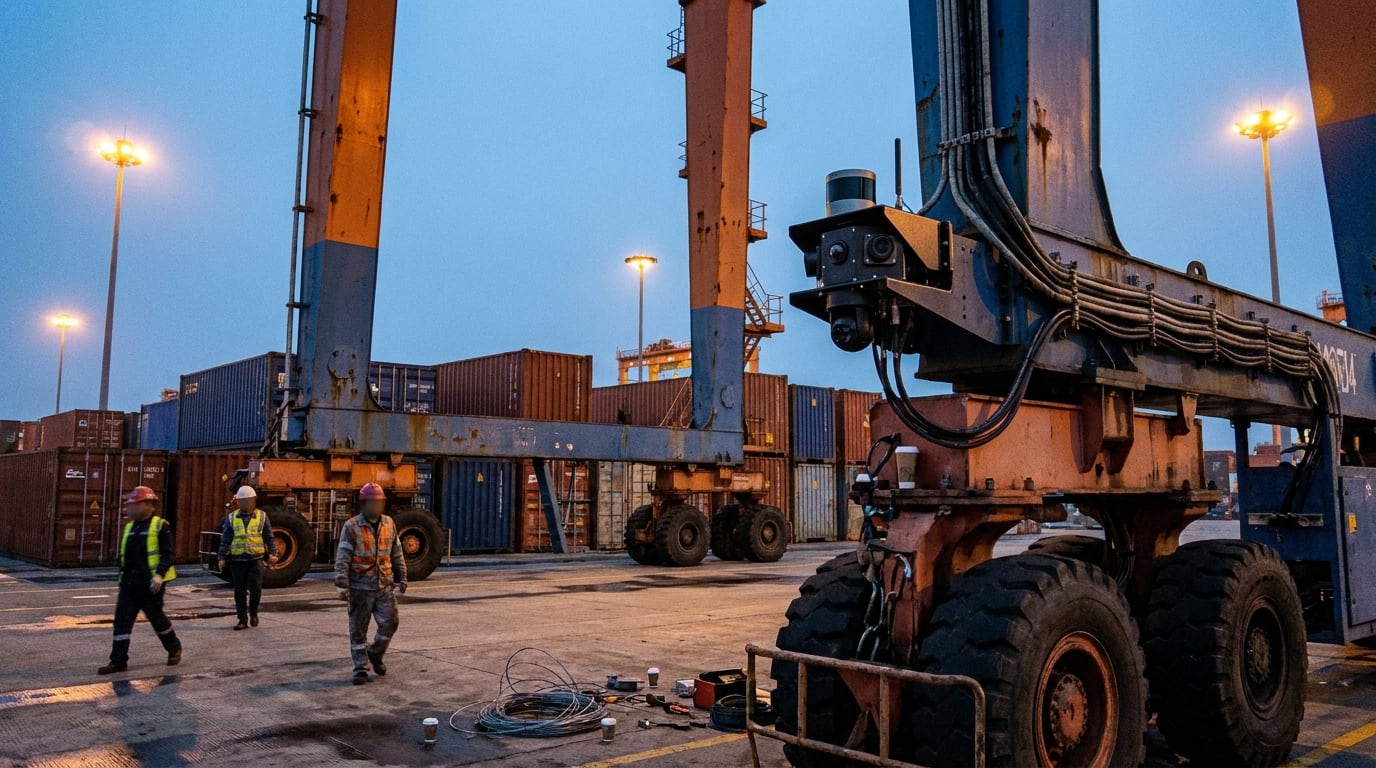
Autane, a system for the autonomous operation of port cranes, has been installed on more than 60 rubber-tired gantry (RTG) cranes at ports in Shanghai, Ningbo, Suzhou and Hong Kong. According to the university's announcement, it achieved a 91.23% task success rate across more than 60,000 operations, averaged approximately 25.93 container moves per hour, and resolved approximately 90% of transient faults without human intervention. The paper reports that the deployed system has autonomously handled more than 2 million 20-foot equivalent units in full-day operation.
Researchers at the Hong Kong University of Science and Technology (Guangzhou), Southeast University and Shanghai Master Matrix Information Technology introduced the system in a paper published in Science Robotics. The team set out to automate existing RTG cranes, the wheeled structures that straddle rows of shipping containers, rather than designing new cranes that are easier to automate.
Autane combines cameras, LiDAR, satellite-positioning tools and motion sensors. It fuses this sensor data to locate containers and obstacles, uses simultaneous localization and mapping (SLAM) to estimate the crane's position while building a map of its surroundings, and feeds planning and control algorithms that adjust trajectories. The researchers also incorporated sensor calibration and fault detection and recovery techniques.
The authors write that the work highlights the potential of fully autonomous RTG cranes to enable sustained, resilient and low-intervention port automation. They add that Autane could in future be refined and tested in a broader range of ports in China and potentially other countries, and could eventually help automate hazardous crane operations, reducing workers' exposure to situations that can lead to accidents or injuries.
Key facts
- 91.23% task success rate across more than 60,000 operations, per the university's announcement
- Approximately 25.93 container moves per hour on average
- More than 2 million 20-foot equivalent units handled autonomously
- More than 60 cranes equipped at ports in Shanghai, Ningbo, Suzhou and Hong Kong
- Approximately 90% of transient faults resolved without human intervention
Sources
- Autane: An autonomous crane for sustained port operations — Science Robotics — Jun Yang, Zheng Tian, Junming Hong et al.
- Autonomous crane system handles port containers with centimeter-level precision — Phys.org (Technology)
Discussion
Technical questions and corrections are welcome. Comments are signed and checked before they appear.
No comments yet.
Sign in to add a typed review comment. Reviews are signed with your name.