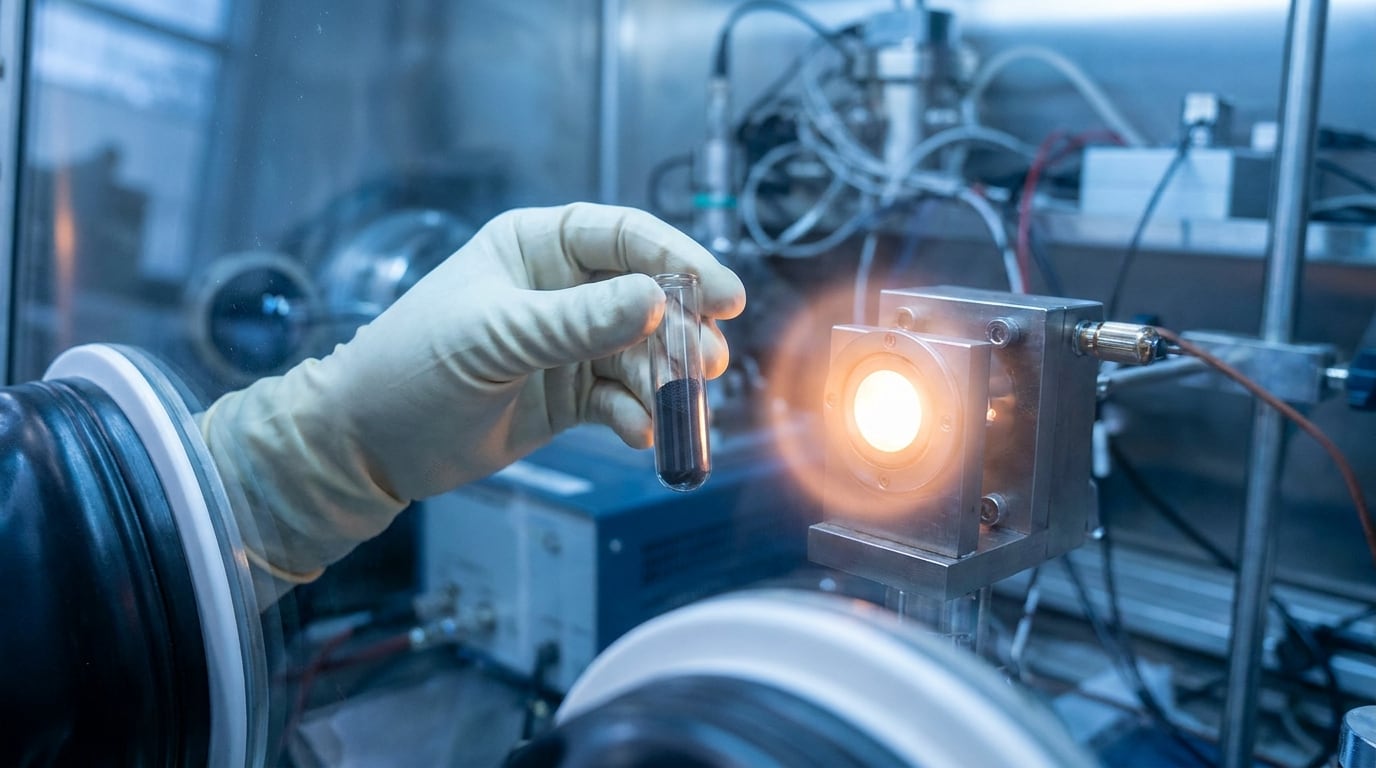
A lab at Rice University has developed a synthetic graphite made with a trace nickel compound and a single short electrical pulse, which the researchers say supports much faster charging in lithium-ion battery anodes. The study, led by James Tour's group and published in Advanced Materials, describes adding a small amount of the nickel compound to petroleum coke, a low-cost carbon residue from oil refining, then heating the mixture to about 2,500°C in one pulse. The researchers report the transformation into ordered graphite takes two-tenths of a second.
According to the paper, the nickel forms nanoclusters that catalyze the conversion of amorphous carbon — carbon without an ordered crystal structure — into graphite in under one second. Diffraction showed an interlayer spacing of 3.4 Å, and Raman spectroscopy gave an I D / I G of 0.09, a measure of structural defects that the authors describe as indicating an exceedingly clean graphite material. The researchers say the nickel slightly expanded the interlayer spacing, giving lithium greater access during charging. First author Haojie Zhu said the nickel acts "almost like a temporary construction worker" in organizing the carbon layers.
In lab battery tests, the nickel-formed graphite tolerated a charging rate equivalent to a four-minute charge and retained 80% of its capacity after 1,000 charge and discharge cycles. The paper reports a reversible capacity of 347.4 mAh g−1 at 0.25 C and 158.8 mAh g−1 at 15 C, which the authors say outperforms both commercial graphite and graphite made by flash Joule heating, an earlier rapid-heating route. The benefits persisted after more than 99% of residual nickel was removed, suggesting the advantage comes from how the nickel builds the structure rather than from nickel left in the material.
The team also reports that too much heat did not improve the product: at excessively high temperatures much of the nickel was lost, while lower temperatures gave less ordered graphite. Tour's lab estimates, based on its production analysis rather than measured commercial-scale output, that the route could cut energy use and greenhouse gas emissions by more than 80% compared with conventional graphite production and lower the production cost of premium fast-charging synthetic graphite by about 80%, to US$0.84 kg−1.
Key facts
- 0.2 seconds: time for the nickel-assisted pulse to convert petroleum coke into graphite
- 3.4 Å: interlayer spacing measured by diffraction in the resulting graphite
- 347.4 mAh g−1 at 0.25 C and 158.8 mAh g−1 at 15 C: reversible capacity reported
- 80% capacity retention after 1,000 charge and discharge cycles
- US$0.84 kg−1: estimated production cost of premium fast-charging synthetic graphite
Sources
- Trace‐Metal‐Assisted Flash Synthesis for Fast‐Charging Graphite Anodes — Advanced Materials — Haojie Zhu, Yi Cheng, Shichen Xu et al.
- New synthetic graphite paves way for rapid EV charging — Phys.org (Technology)
Discussion
Technical questions and corrections are welcome. Comments are signed and checked before they appear.
No comments yet.
Sign in to add a typed review comment. Reviews are signed with your name.