Remedy Robotics, based in San Francisco, is testing whether surgeons can perform stroke surgery from afar using its N1 System, IEEE Spectrum reports. The robot is designed for emergency operations including thrombectomies—the standard brain operation for acute ischemic strokes, which are caused by blood clots that cut off blood flow.
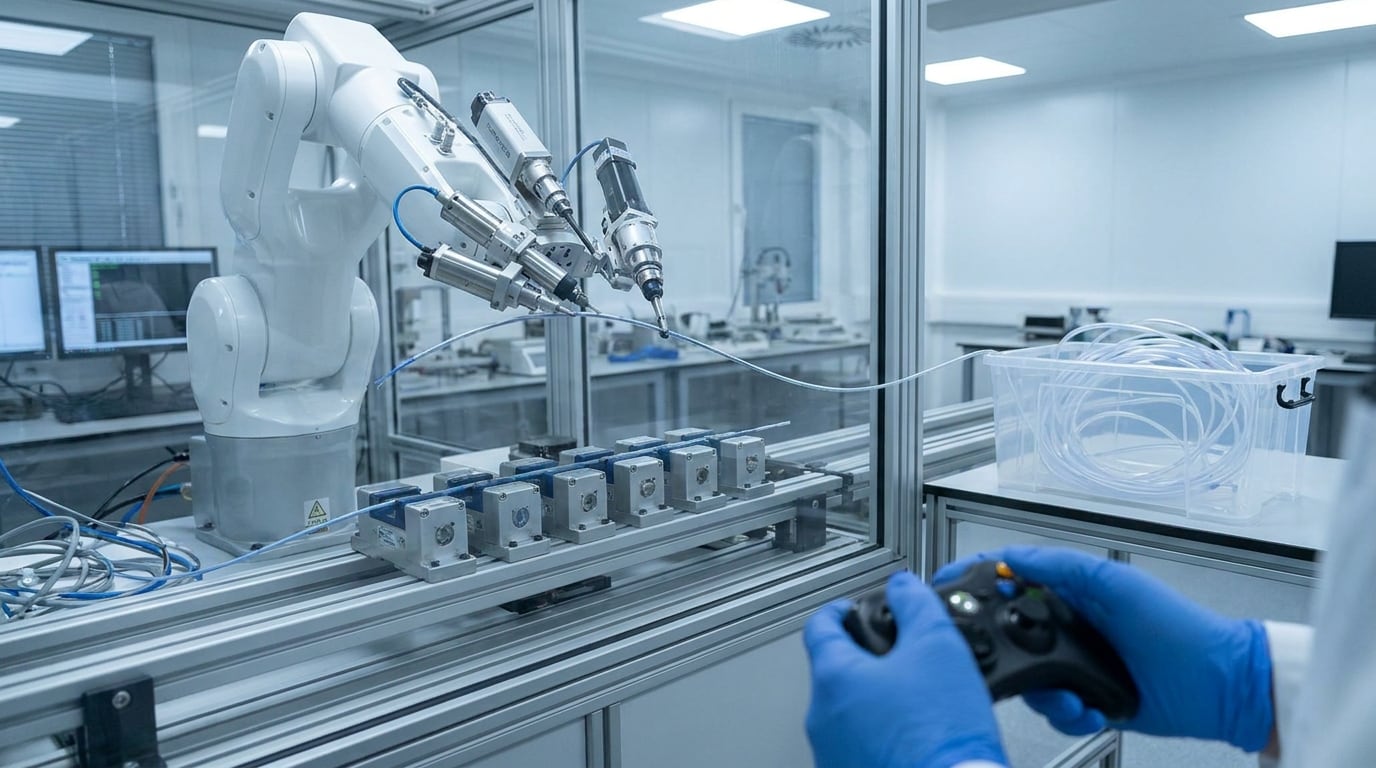
At a visit to the company's office in January, IEEE Spectrum's reporter steered the system's steerable catheter through silicone tubing using an Xbox controller; the tubing, standing in for a patient, lay about 6 meters away, out of sight, with the surgical robot in an adjoining room. Cofounder David Bell, a clinician and former cardiac-surgery trainee from Australia, told the reporter that smoothness and precision are not clinical outcomes, nor is a surgeon's ergonomics.
The N1 robot feeds the catheter along a rail lined with seven modules, using a thin wire that allows control through a patient's vascular system, the article states. Motorized cartridges on the robotic arm grip threadlike instruments and move them in and out of the body. Among those instruments is a stent, an expandable wire-mesh tube used to grab and pull a clot back out. Remedy's catheter is steerable, so unlike in a standard thrombectomy it does not need a guide wire to set its route through the blood vessels. Small markings on it are read by a computer-vision algorithm that tracks the catheter's rotation inside the body, according to cofounder Jake Sganga.
Remedy says it has taken a first step by remotely testing its system on a small group of patients, according to the article; the article does not report published results from that testing. The company's goal is to reach ischemic stroke patients in remote and rural places, who lose crucial hours while being transferred to hospitals able to provide care. According to 2025 data cited in the article, at least 5 million people worldwide suffer ischemic strokes every year, and in the United States stroke is the fourth leading cause of death. The article also states that only about 1 in 10 patients eligible for thrombectomy receive one.
The article notes open questions: making telesurgery a practical part of stroke care will depend on communications infrastructure, hospital resources and workflows, and ultimately evidence that patients actually benefit. The patient in the demonstration was a plastic container of silicone tubing, not a person.
Key facts
- 7 modules line the rail that feeds the N1 catheter
- About 6 meters separated the operator's console from the robot in the demonstration
- At least 5 million people worldwide suffer ischemic strokes every year, per 2025 data cited
- Only about 1 in 10 patients eligible for thrombectomy receive one
Sources
- Can Robots Bring Stroke Surgery to Remote Hospitals? — IEEE Spectrum
Other news outlets are named as sources but not linked.
Discussion
Technical questions and corrections are welcome. Comments are signed and checked before they appear.
No comments yet.
Sign in to add a typed review comment. Reviews are signed with your name.