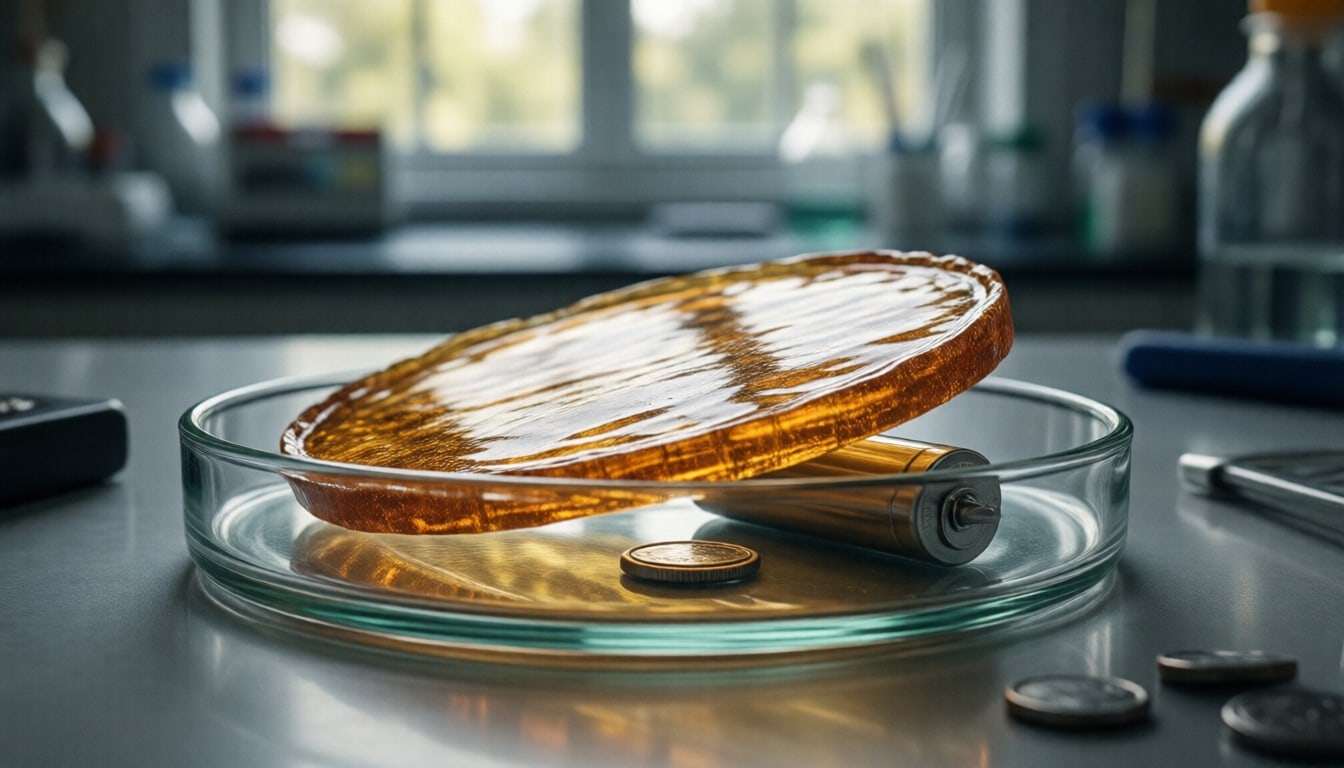
Researchers at the Department of Chemistry, Materials and Chemical Engineering "Giulio Natta" at Politecnico di Milano have developed a nonflammable, quasi-solid polymer gel membrane that carries fluoride ions inside batteries at room temperature. The university announced the work in a press release; it is published in the peer-reviewed journal Energy Storage Materials.
The study defines the concept of a fluoride exchange membrane (FEM), by analogy with proton exchange membranes (PEMs) and anion exchange membranes (AEMs), according to the release. Maurizio Sansotera, head of the Fluoritech laboratory, coordinated the research. Luca Magagnin led the electrochemical characterisation, and Giuseppina Raffaini contributed molecular dynamics work on how fluoride ions move through the membrane.
According to the release, fluoride-ion batteries could use materials more readily available and far more abundant than lithium. Sansotera says renewable energy sources have production peaks that do not coincide with peak consumption, and that widespread adoption of storage systems is often limited by concerns about fire risk associated with batteries. "The technology we are developing is based on the use of a nonflammable polymer membrane that reduces the risk of fire," he says in the release.
Magagnin says the batteries could offer higher theoretical energy densities. "We are talking about approximately 600 watt-hours per kilogram, compared with around 150–250 for standard lithium-ion batteries," he says. In practice, he adds, this would mean roughly twice the battery life, and an electric car could travel twice as many kilometres. The release names possible applications: energy storage systems, drones, satellites and aircraft.
Raffaini says the quasi-solid membrane enables fluoride ion transport at room temperature, avoiding the energy required to preheat the battery. Earlier generations of fluoride-ion batteries required operating temperatures of around 100–150 degrees to improve ionic conductivity, according to the release, consuming part of the stored energy as heat.
Key facts
- Approximately 600 watt-hours per kilogram: theoretical energy density cited for fluoride-ion batteries, compared with around 150–250 for standard lithium-ion batteries
- Around 100–150 degrees: operating temperatures required by previous generations of fluoride-ion batteries to improve ionic conductivity
- Room temperature: operating condition at which the new quasi-solid membrane enables fluoride ion transport
- Nonflammable quasi-solid polymer gel membrane: the electrolyte developed at Politecnico di Milano
Sources
- Toward room temperature fluoride-ion batteries: quaternary ammonium-bearing fluoride-exchange membrane as a quasi-solid polymer electrolyte — Energy Storage Materials — Federico Maria Scesa, Maurizio Sansotera, Eugenio Gibertini et al.
- Nonflammable gel membrane could help batteries run twice as long on a single charge — Phys.org (Technology)
Discussion
Technical questions and corrections are welcome. Comments are signed and checked before they appear.
No comments yet.
Sign in to add a typed review comment. Reviews are signed with your name.