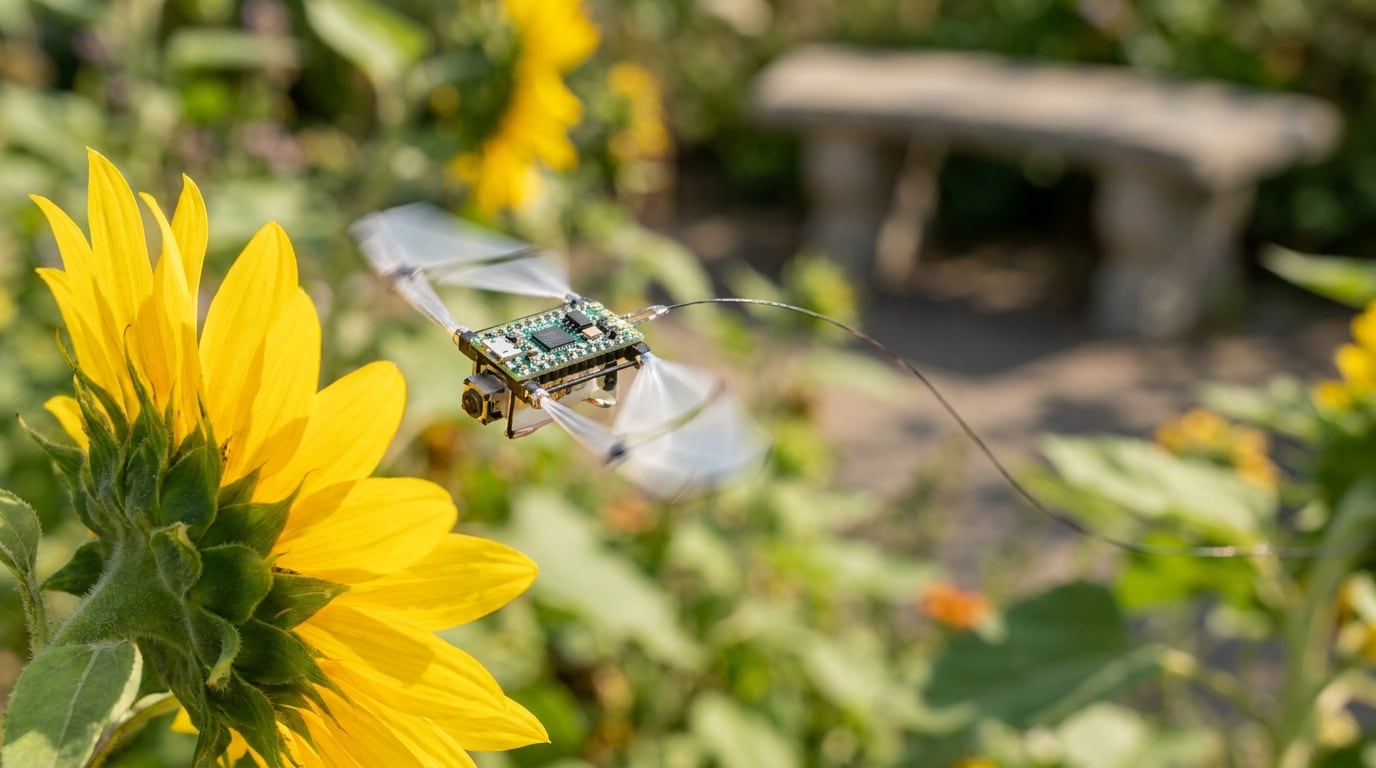
The work, published in Science Robotics, is a peer-reviewed lab demonstration: a single 30-second outdoor flight in which the robot avoided obstacles and landed on a sunflower, while still receiving power from an offboard source.
To carry the extra weight of the electronics, the team enlarged the soft actuators — artificial muscles that flap the wings — by 50%. Net lift forces rose by 46%, and the researchers report a lift-to-weight ratio of 1.9.
The onboard electronics package weighs 244 milligrams. It contains an inertial measurement unit that estimates attitude, an optical flow sensor that estimates lateral flight speed and position, and a time-of-flight sensor that measures height, along with a microcontroller. The researchers report that estimating position continuously at a faster rate worked better than a slower, more accurate estimate.
In flight demonstrations that included hovering at different heights and following point-to-point trajectories, the robot showed positional errors of only a few centimeters. A hierarchical controller let a human operator send high-level position commands by joystick, guiding the robot around several plants before it landed on the sunflower.
The researchers analyzed the robot's power use and found the electronics consume about 6% of total power; the rest drives the artificial muscles and wings. They identified ways to cut electronics power consumption, which would allow more components such as a camera. They are working toward onboard camera-based object recognition and obstacle avoidance, and toward integrating power electronics.
Key facts
- 1.29 grams: mass of the aerial robot
- 244 milligrams: mass of the onboard electronics package
- 46%: increase in net lift forces after enlarging actuators by 50%
- 1.9: lift-to-weight ratio
- About 6%: share of total power consumed by the electronics
Sources
- Controlled flight of an insect-scale flapping-wing robot via integrated onboard sensing and computation — Science Robotics — Yi-Hsuan Hsiao, Quang Phuc Kieu, Zhongtao Guan et al.
- Featherweight flying robot carries its own sensors and computers — Phys.org (Technology)
Discussion
Technical questions and corrections are welcome. Comments are signed and checked before they appear.
No comments yet.
Sign in to add a typed review comment. Reviews are signed with your name.