Researchers from Pakistan and China have built a self-powered robot that cleans photovoltaic modules without water, using commercially available off-the-shelf components at a build cost of approximately USD 64, according to a paper published in Energy Reports. The team included scientists from the Islamia University of Bahawalpur in Pakistan and the University of Shanghai for Science and Technology, Yan'an University and Shanghai University of Medicine and Health Sciences in China.
The prototype uses two identical 5 V reference panels to decide when cleaning is needed. A servo-driven wiper cleans one panel every 30 seconds while the other accumulates dust, and an ESP32 controller compares the two voltages, with a difference of at least 2 V as the primary cleaning trigger. The system also monitors airborne dust at a threshold of 250 µg/m³ and blocks cleaning when module temperature exceeds 45 °C.
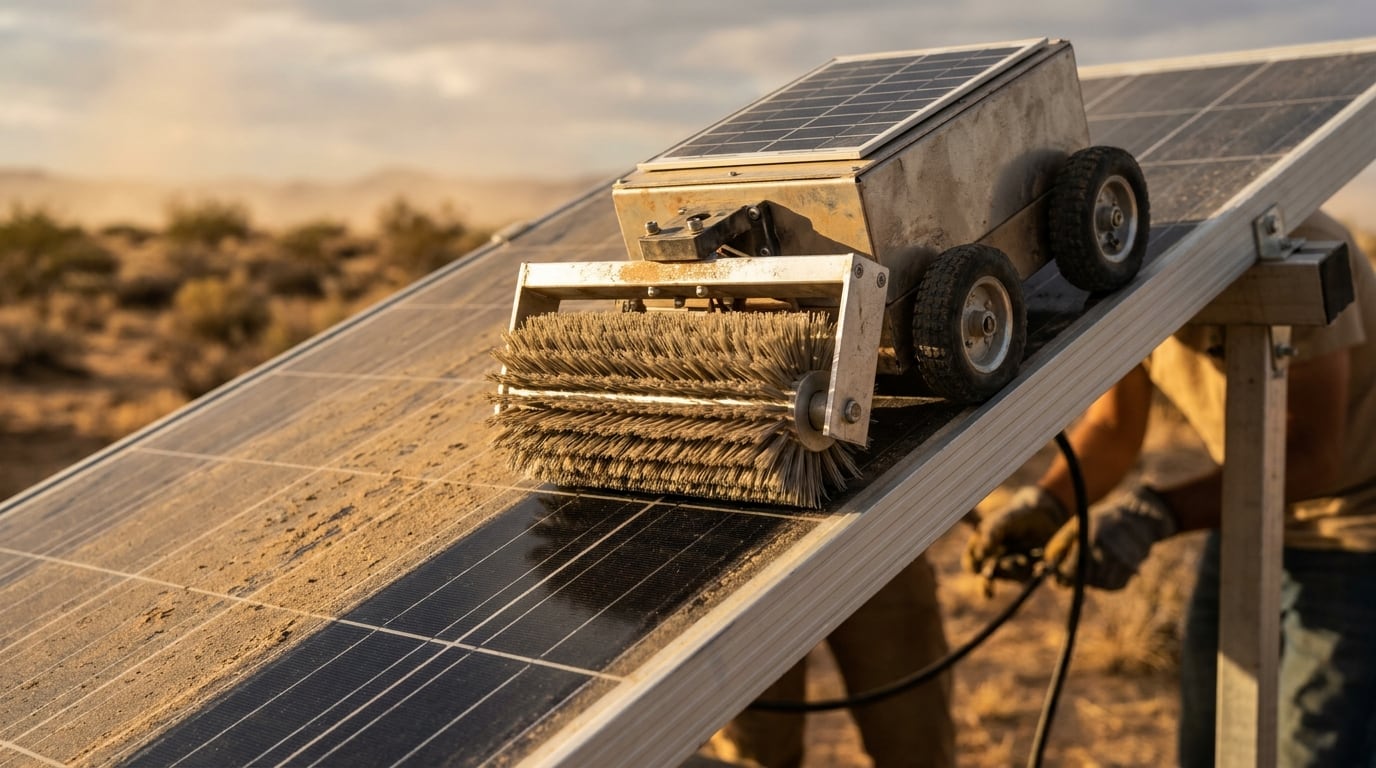
When activated, the 7.6 kg robot travels along the module's length while a motor-driven nylon roller brush cleans its full width. Ultrasonic sensors detect the module edges, and a dedicated 20 W solar panel charges the robot's 12 V, 3 Ah battery.
The researchers report that the approach was validated through a three-month field deployment in Bahawalpur, Pakistan, a high-soiling desert environment, on a single 180 W monocrystalline silicon module measuring 1,480 mm × 670 mm at a fixed tilt of 28 degrees. Sensor readings and operating data were recorded at one-second intervals through dust storms and intermittent rainfall.
Using 132 paired observations of reference-panel voltage difference and test-module power losses to calibrate the trigger, the team compared power output before and after each of 30 autonomous cleaning cycles under comparable conditions. They report that average output rose from 93 W under heavily soiled conditions to 173.7 W after cleaning, which the researchers describe as an efficiency improvement of 86.7 % and a recovery of 93 % of soiling-induced power losses. Cleaning intervals ranged from 4 to 14 days, with dust storms accelerating soiling by up to a factor of three and rainfall extending intervals through partial surface cleansing.
Key facts
- Approximately USD 64 to build the robot from off-the-shelf components
- Average module output rose from 93 W to 173.7 W after cleaning, an 86.7 % efficiency improvement
- 93 % of soiling-induced power losses recovered across about 30 autonomous cleaning cycles
- Cleaning trigger: at least 2 V difference between two 5 V reference panels
- Robot mass 7.6 kg; dedicated 20 W solar panel charges a 12 V, 3 Ah battery
Sources
- $64 solar-powered robot cleans PV modules without water — pv magazine
Other news outlets are named as sources but not linked.
Discussion
Technical questions and corrections are welcome. Comments are signed and checked before they appear.
No comments yet.
Sign in to add a typed review comment. Reviews are signed with your name.