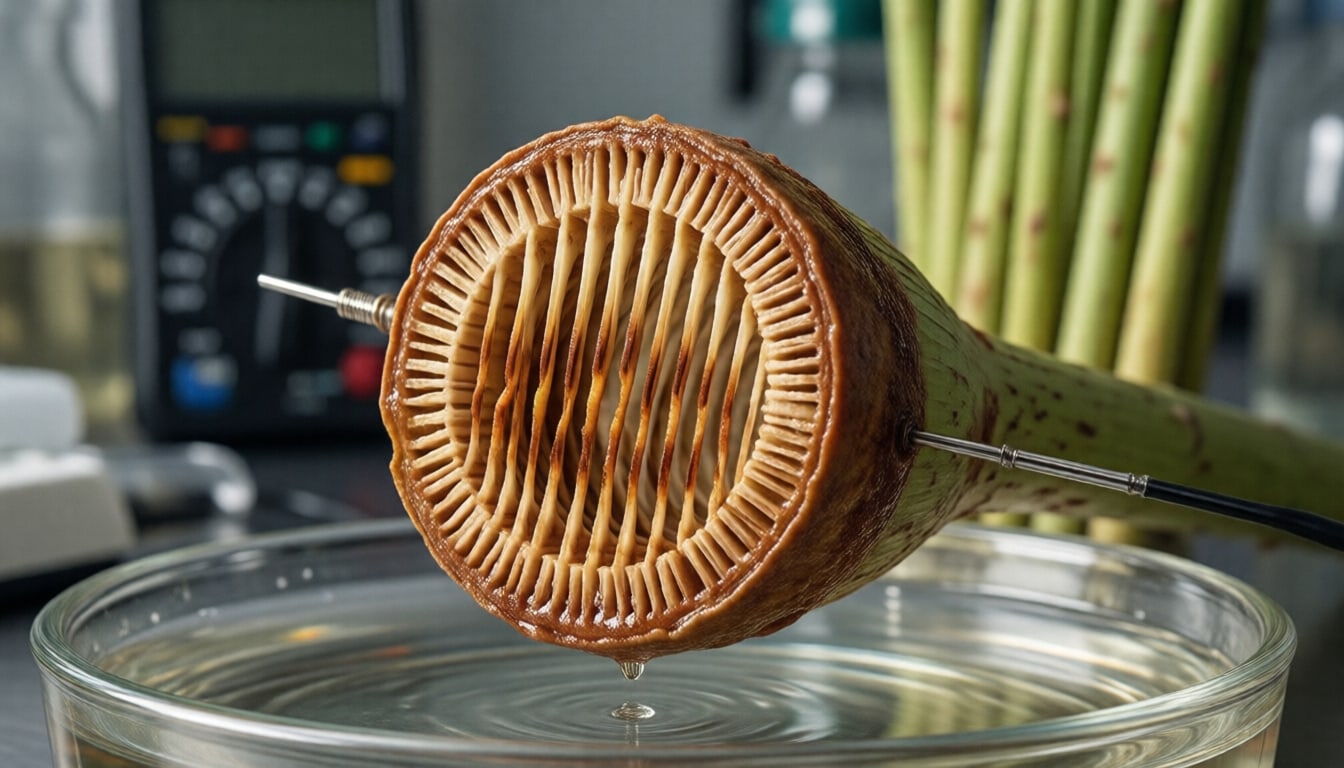
A hydrovoltaic generator built from lotus stems and a bacterial biofilm reached a steady-state power density of 63 microwatts per square centimetre and an open-circuit voltage of 1.48 volts, according to a peer-reviewed study published in Device. The researchers, based in China, report that the devices powered small electronics such as pocket calculators and lights and held stable output for over 30 days.
Water evaporation–driven generators harvest environmental heat as water evaporates and turn it into small amounts of power. According to the study, many such devices rely on materials such as carbon nanotubes or nanofiber polymers, whose tangled pore networks hinder the movement and collection of electrical charge. The researchers instead combined straight lotus-stem channels with conductive films of Geobacter sulfurreducens, a bacterium that earlier work showed can generate electricity during water evaporation.
To build the devices, the researchers soaked lotus-stem segments in a bacterial suspension, freeze-dried them and attached electrodes at both ends. Coated stems produced more electricity than untreated stems and had lower internal electrical resistance, the team reports.
The study authors write that the stem architecture "reduces hydraulic resistance and optimizes water molecule transport pathways". Output was maintained over 30 days; long-term output was below the optimised values, but the authors say the decay was less than 15%.
In the reported tests, three series-connected units powered a calculator, while six units powered a small lamp or an electronic ink display. A 256-unit array demonstrated a phone-charging connection through a voltage-boosting circuit.
The team says challenges remain before widespread commercialisation. Device performance depends on water availability and environmental conditions, with higher humidity reducing voltage, and commercial costs, manufacturing scale and durability beyond laboratory tests are unresolved. The authors suggest the generators could provide supplementary power for low-power sensors and wireless modules in environmental monitoring, such as agricultural IoTs, where continuous evaporation is available but battery replacement is difficult and costly.
Key facts
- 63 microwatts per square centimetre: steady-state power density of the optimised lotus stem/G. sulfurreducens generator
- 1.48 volts: open-circuit voltage of the optimised device
- Over 30 days: period over which the devices maintained electrical output
- Less than 15%: reported decay in long-term output relative to optimised values
- 256 units: size of the array demonstrated charging a phone via a voltage-boosting circuit
Sources
- Lotus-stem hydrovoltaic generators with enhanced ionic conductivity from aligned microchannels and electroactive biofilms — Device — Xiuyu Lin, Qichang Hu, Zihan Lin et al.
- Lotus stems and biofilms generate electricity from evaporating water to power small electronics — Phys.org (Technology)
Discussion
Technical questions and corrections are welcome. Comments are signed and checked before they appear.
No comments yet.
Sign in to add a typed review comment. Reviews are signed with your name.