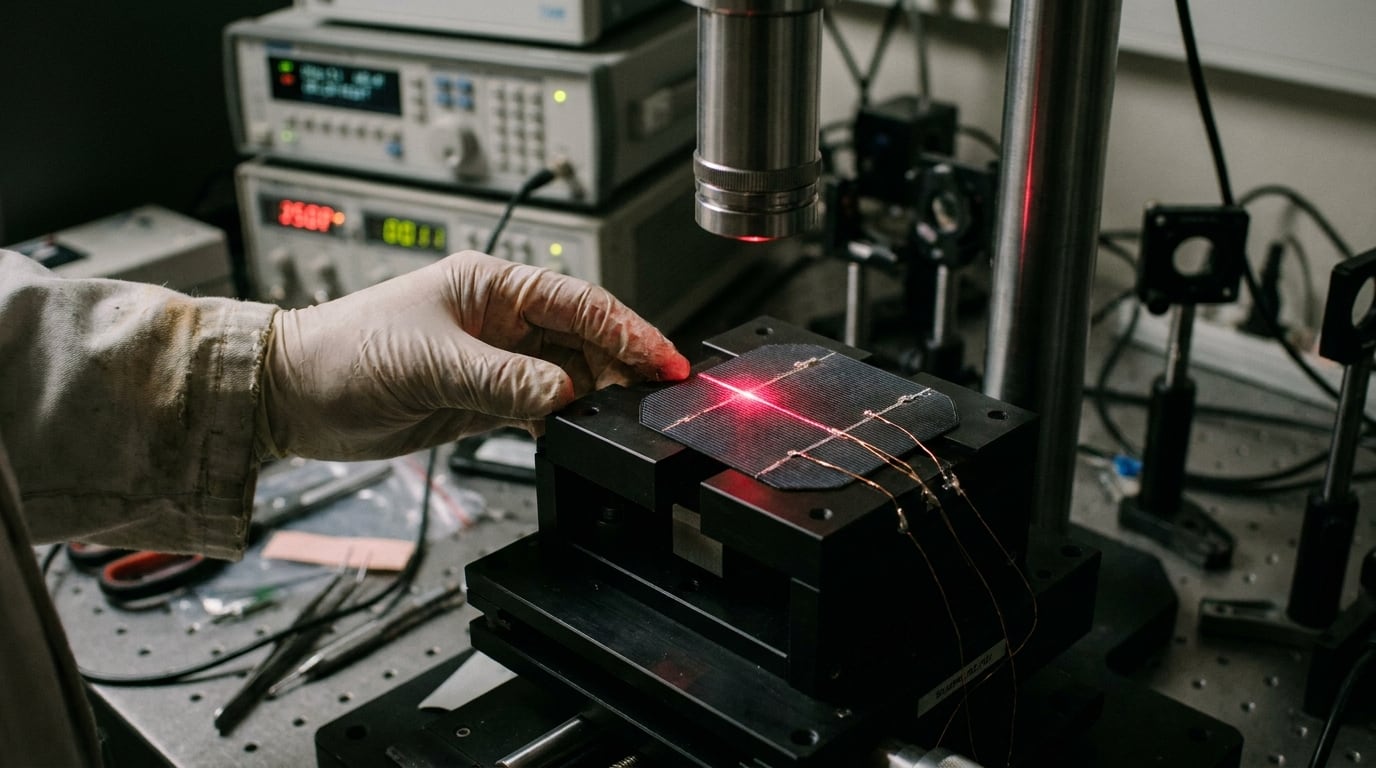
Researchers at Karlstad University in Sweden used light beam-induced current (LBIC) phase mapping to study how half-cell solar modules behave electrically at the local level. The findings appear in the study "Probing interconnection defects in solar modules via LBIC phase mapping", published in Solar Energy Materials and Solar Cells.
LBIC mapping is a non-destructive technique that scans a focused light beam across a photovoltaic cell or module and measures the resulting photocurrent. LBIC phase mapping instead uses modulated illumination and measures the phase shift of the photocurrent response. That shift reflects the electrical impedances encountered as photogenerated charge carriers travel through the cell and are collected at its contacts, so it gives additional information on local electrical resistance and contact quality. Corresponding author Markus Rinio told pv magazine that the experiments detected variations in contact quality, including regions with good contacts and regions with intentionally reduced contact area and discontinuous wire contact.
For the experiments, the scientists used an 828 nm laser with a power of 22 μW, a spatial resolution of 6 μm and a typical penetration depth of 15 μm in silicon. They modulated the laser at 640 Hz and measured the alternating photocurrent with lock-in amplifiers to reduce noise. The team used 156.75 mm × 156.75 mm monocrystalline bifacial silicon solar cells with five busbars from Chinese manufacturer Lightway Solar, cut in half by laser scribing followed by mechanical cleaving. The half-cells were laminated using The Tape Solution, an interconnection method developed by Sweden-based Sticky Solar Power that attaches low-temperature solder-coated wires to both sides of the cells with transparent tapes, followed by simultaneous lamination and soldering.
To assess interconnection quality, the researchers deliberately reduced the contact area between wires and busbars in selected regions by applying less pressure. They then compared LBIC phase maps recorded before and after lamination. Phase shifts became more negative after lamination, consistent with increased local series resistance from the interconnection wires. Regions with high-quality contacts showed average phase differences of around 150 millidegrees, compared with approximately 250 millidegrees in areas where the contact area had been deliberately reduced. Optical microscopy and scanning electron microscopy supported the findings: they showed nearly continuous connections between solder and silver pads in well-connected regions, and visible gaps where contacts were poorer.
The researchers report that electroluminescence imaging could not easily distinguish the localised resistance variations that LBIC detected. Co-author Majid Salari said a central contribution of the work is an analytical equivalent-circuit model and an equation describing the relationship between the measured LBIC phase shift and the electrical parameters of the solar cell. This provides a physical basis for interpreting phase maps rather than relying solely on empirical correlations.
Rinio said possible changes in parallel capacitance or other effects cannot be completely excluded, though their analysis indicates changes in local series resistance are the primary explanation. Salari said the study does not establish a definitive distinction between partially soldered and completely disconnected contacts, and the technique has not yet been systematically tested across the full range of contact conditions. The researchers also noted that the five-busbar M2 cells are no longer representative of current industrial standards, but provided a simplified platform for validating a methodology that could also be applied to larger solar cells.
Key facts
- Average phase difference of around 150 millidegrees in regions with high-quality contacts
- Approximately 250 millidegrees in areas with deliberately weakened contacts
- Laser wavelength of 828 nm at a power of 22 μW
- Spatial resolution of 6 μm and typical penetration depth of 15 μm in silicon
- Laser modulated at 640 Hz; cells 156.75 mm × 156.75 mm with five busbars
Sources
- Researchers show LBIC phase mapping accurately detects solar module interconnection defect — pv magazine
Other news outlets are named as sources but not linked.
Discussion
Technical questions and corrections are welcome. Comments are signed and checked before they appear.
No comments yet.
Sign in to add a typed review comment. Reviews are signed with your name.