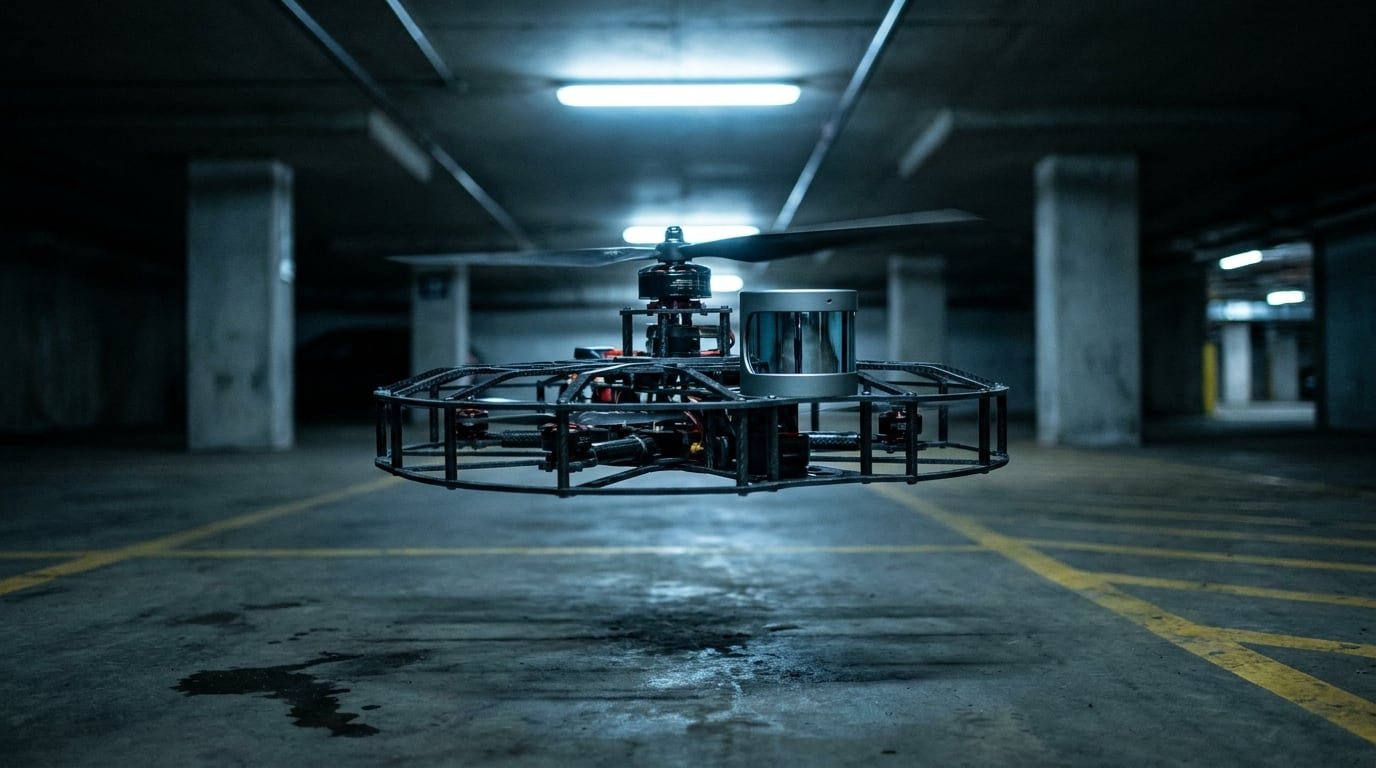
PULSAR II weighs about 1.12 kg and hovered for a measured 15 minutes and 50 seconds. The drone is described in Nature Communications; Nan Chen is first author and Fu Zhang is corresponding author.
One motor turns two propeller blades through a swashplate-less mechanism. Within each revolution, the researchers adjust rotational speed to change the blades' angle of attack and generate the torque needed to steer. The body spins naturally in flight, and a LiDAR mounted vertically on it sweeps the ceiling, the ground and the surroundings as the drone turns.
In experiments, the drone built only a partial indoor map before takeoff. After takeoff, as the LiDAR rotated, it built a more complete 3D point-cloud map without the original blind spots, the researchers report. The team established a propulsion model through experiments, designed a compensation method and introduced model predictive control on manifolds. In high-speed figure-eight and in-air flipping attitude tests, the researchers say trajectory tracking error was greatly reduced compared with the conventional control method used in the study.
With the frame, the drone kept stable flight when a soft ball was dropped on it while hovering, and when it flew forward into obstacles and pushed them away, according to the release.
The team then tested the full autonomous system in forests and in underground parking garages. The drone traversed passages and bypassed obstacles at speeds exceeding 6 metres per second, with mapping, obstacle avoidance and flight control all done onboard without GPS, external motion capture or a ground computer.
The team says it may suit environments where satellite navigation is weak or unavailable, including dense forests, caves, tunnels and underground facilities. It plans to improve localisation in open spaces lacking sufficient laser reflection points.
Key facts
- 1.12 kg total weight of PULSAR II
- 15 minutes 50 seconds measured hover time
- Over 6 metres per second flight speed in field tests
- One motor and one vertically mounted LiDAR
Sources
- An autonomous single-actuator UAV with omnidirectional field of view, high agility, and collision resistance — Nature Communications — Nan Chen, Haotian Li, Yunfan Ren et al.
- Single-propeller drone uses its own spin to scan surroundings in all directions — Phys.org (Technology)
Discussion
Technical questions and corrections are welcome. Comments are signed and checked before they appear.
No comments yet.
Sign in to add a typed review comment. Reviews are signed with your name.