A single organic semiconductor layer can drive either hydrogen or oxygen evolution, depending only on the molecular layer beneath it, researchers at EPFL have shown. Using this effect, the team built a photocatalyst sheet that splits water under simulated sunlight with no applied bias, according to the study published in Nature Energy.
Photocatalyst sheets place hydrogen- and oxygen-evolving regions side by side on one conductive substrate. This design avoids the external wiring of photoelectrochemical cells and the dissolved redox mediators of particle suspensions. According to the paper, existing sheets have relied on inorganic semiconductor nanoparticles and processing techniques that can be difficult to scale.
The team led by Dr. Nicolas Diercks and Dr. Jin Su Park of the LIMNO lab deposited a solution-processed semiconducting polymer bulk heterojunction (PBDTTTPD:PNDIHDT) onto FTO substrates modified with self-assembled small molecules whose dipoles point in opposite directions. On a carbazole-based contact (2PACz), the film acts as a photocathode for hydrogen evolution; on a new naphthalimide-based contact (NI-PA), the same film acts as a photoanode for oxygen evolution.
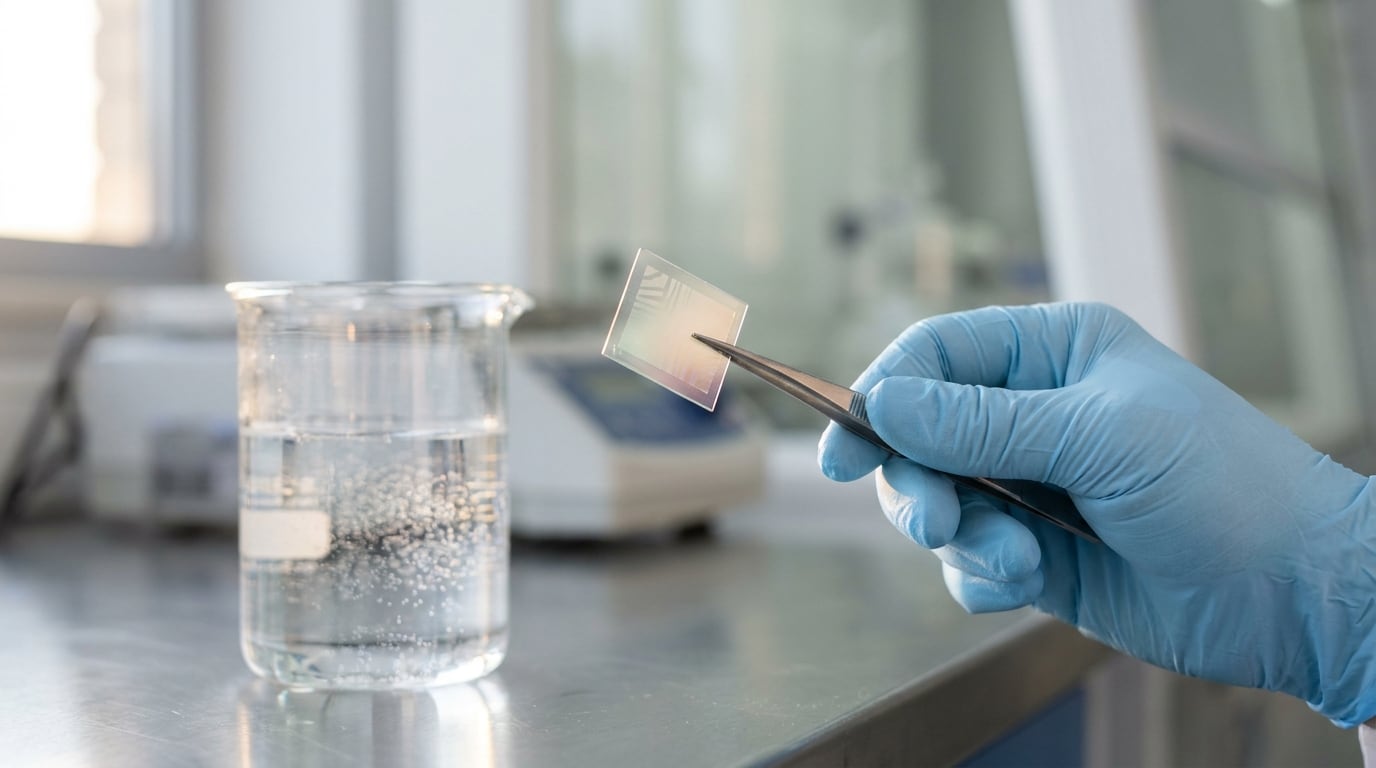
The two molecules were patterned into microdomains by contact printing, after which platinum and iridium-oxide co-catalysts were added. The resulting sheet split water without bias for more than 2 hours, producing hydrogen and oxygen in the expected 2:1 ratio. The stabilized hydrogen rate of 1.3 µmol h⁻¹ cm⁻² corresponds to a solar-to-hydrogen efficiency of about 0.1%.
The study also identifies what limits performance. Shrinking the domains from 1 mm to 100 µm or 10 µm reduced efficiency, because charge extraction is weaker at the boundaries between domains. The authors state that the efficiency is still too low for practical application, but present the work as a design strategy for organic photocatalyst sheets. They point to narrower-bandgap acceptors, better charge-selective molecules and more selective co-catalyst deposition as next steps, and describe a simple spray-deposition route for the patterned underlayer as a possible path to scaling up.
Key facts
- 1.3 µmol h⁻¹ cm⁻²: stabilized hydrogen production rate of the sheet
- About 0.1%: solar-to-hydrogen conversion efficiency
- More than 2 h: unassisted water splitting under simulated sunlight
- 2:1: ratio of hydrogen to oxygen produced
- 1 mm to 100 µm or 10 µm: domain sizes tested, with smaller domains reducing efficiency
Sources
- An organic semiconductor-based photocatalyst sheet for overall solar-driven water splitting — Nature Energy — Nicolas J. Diercks, Jin Su Park, Jun-Ho Yum et al.
- Organic semiconductor sheet enables light-driven water splitting without external voltage — Phys.org (Technology)
Discussion
Technical questions and corrections are welcome. Comments are signed and checked before they appear.
No comments yet.
Sign in to add a typed review comment. Reviews are signed with your name.