What was built
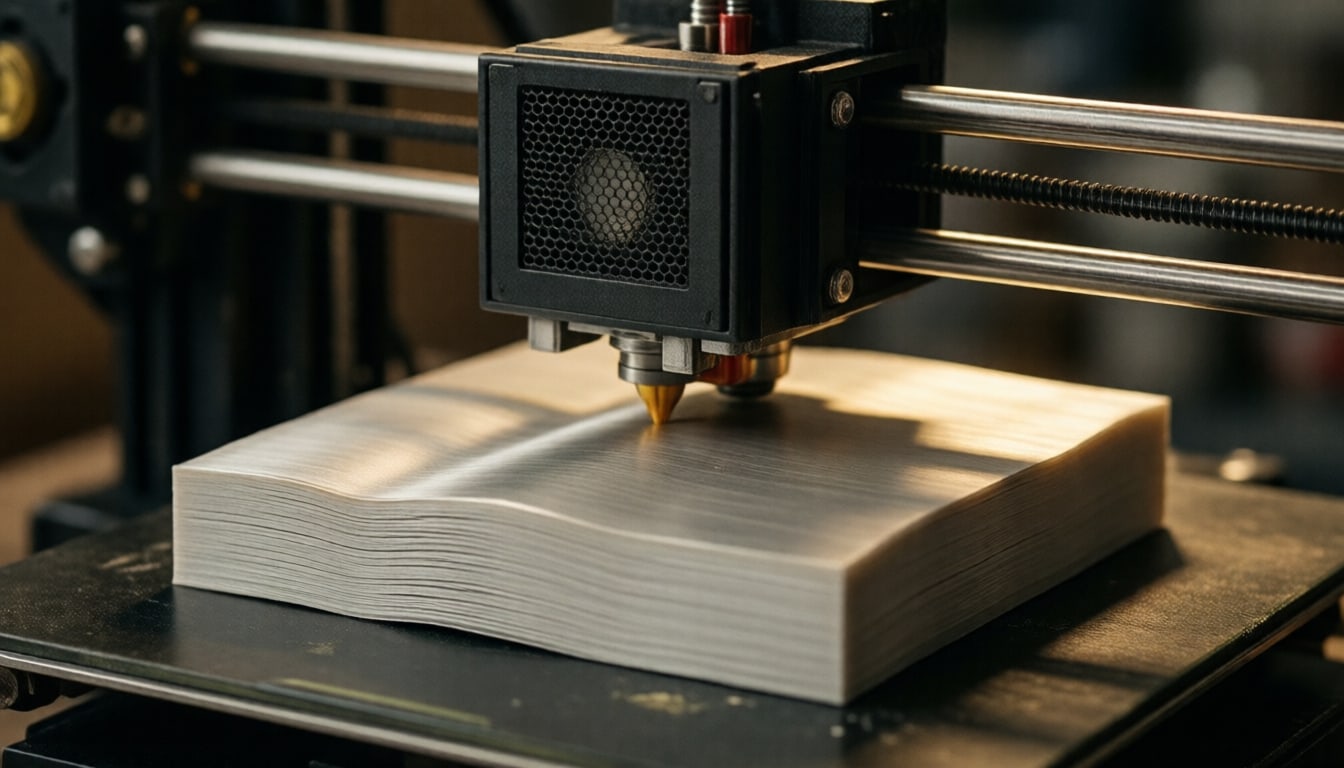
Zimeng Xiong of Alpaca Engineering has developed PancakeSlicer, a non-planar slicer program for 3D printing. According to Hackaday, the tool is designed to work with standard 3-axis printers, and it was used with a Bambu Labs A1 Mini in this case.
The stated aim is to print smooth top surfaces without the stair-step pattern that planar layer stacking produces. Hackaday describes non-planar printing more broadly as promising smoother surfaces, reduced or eliminated support structures in some incarnations, and the possibility of greater strength in others, and identifies the lack of non-planar slicer programs as one of the biggest limits to its adoption.
How it works
Because PancakeSlicer targets 3-axis machines, the non-planar paths it can generate are limited by the print head's clearance on each side of the nozzle. Hackaday reports that on the A1 Mini this clearance could be substantially improved by removing the cooling shroud from the print head and relying instead on a remote static cooling system (RSCS), which blows cooling air in from the sides of the print bed.
The slicer first locates the surfaces over which the top layer should be smoothly overlaid, doing so by tracing rays downward through the part and keeping track of their intersection points. The simplest slicing route generates a planar structure and then overlays a few non-planar layers on the top surface. According to Hackaday, this still left some bleed-through staircase pattern.
A morphed structure eliminated that pattern by continuously varying layer thickness. In narrow regions, however, the layers could become far too thin for the printer to extrude, resulting in under-extrusion. Conformal slicing addresses this by building a planar base, a morphed transition region and several constant-thickness conformal layers on top. Where the print head's clearances prevent a non-planar layer from being printed, the slicer falls back to planar slicing.
How it was tested
The results reported are qualitative descriptions of the printed output, namely that the planar-plus-non-planar overlay approach still left some bleed-through staircase pattern and that the morphed structure eliminated it.
What is not yet proven
Hackaday states that a universal non-planar slicer is still awaited, so PancakeSlicer is not presented as a general solution. The clearance limits of a 3-axis print head constrain which non-planar paths are possible, and the source notes that the A1 Mini's clearance could be substantially improved by removing the cooling shroud and using a remote static cooling system instead.
The thin-layer under-extrusion problem in narrow regions is described as a limitation of the morphed approach that conformal slicing was introduced to solve.
Build sheet
- Slicer: PancakeSlicer, non-planar slicer for 3-axis printers
- Developer: Zimeng Xiong, Alpaca Engineering
- Test printer: Bambu Labs A1 Mini
- Strategy: planar base + morphed transition + constant-thickness conformal top layers
- Fallback: planar slicing where print head clearance is insufficient
- Observed issue: bleed-through staircase pattern with simple planar + non-planar overlay
- Observed issue: under-extrusion where morphed layers become too thin in narrow regions
- Cooling option: remote static cooling system (RSCS) blowing air from the sides of the print bed
Sources
- Printing Smooth Upper Surfaces with a Non-Planar Slicer — Hackaday
Other news outlets are named as sources but not linked.
Discussion
Technical questions and corrections are welcome. Comments are signed and checked before they appear.
No comments yet.
Sign in to add a typed review comment. Reviews are signed with your name.