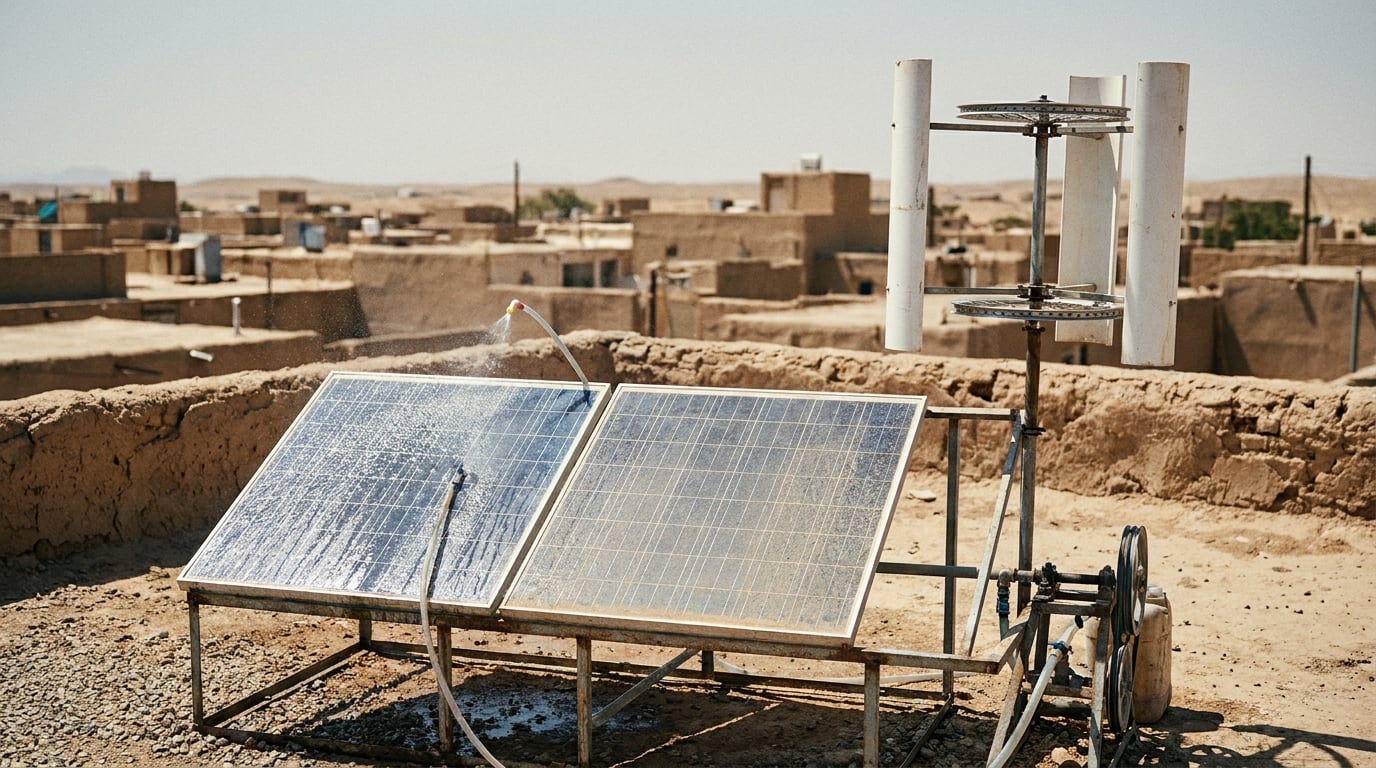
A vertical-axis wind turbine drove a mechanical water pump through a belt, and the pump fed a nozzle that sprayed water onto a photovoltaic module to cool it and wash away dust. Researchers from Shahid Chamran University of Ahvaz and the Technical and Vocational University designed and investigated the system, according to a study published in Results in Engineering.
The design converts wind energy directly into pump operation, the team said, eliminating generators, batteries, inverters and grid connections. According to the researchers, the system therefore operates with zero electrical power consumption and avoids parasitic pumping losses. The turbine was built from two second-hand bicycle rims, a connecting rod and a support frame, with blades cut lengthwise from 110 mm PVC pipes into half-pipe sections 70 cm long and sealed at the ends. The pump began operating at about 1 m/s and could keep running at lower speeds once started.
The researchers report a field test on a rooftop in Farrokhshahr, Iran, using two identical 60 W polycrystalline modules of approximately 70 cm × 70 cm. One module received the spray and the other served as the control. During the May–June campaign, module temperature, voltage and current were monitored between 7 a.m. and 6 p.m., with wind speed and solar irradiance recorded every 10 minutes and ambient temperature and water volume logged hourly.
The results showed a maximum temperature difference of 26.7 °C between the conventional and cooled panels, corresponding to approximately 36–37% reduction during peak radiation hours, the researchers report. The temperature difference fell by more than 76 % in early morning and late afternoon hours because of lower solar radiation. Maximum power increased from 50.1 W to 59.42 W, an 18.6% improvement, and power rose by up to 25% under low-irradiance conditions. Average daily energy efficiency increased from 10.37% to 11.47%, a 10.6% improvement attributed to reduced thermal losses.
An economic analysis reported that initial and maintenance costs rose by less than 2%, while net present value increased by approximately 29%, internal rate of return by 12.6% and levelized cost of energy decreased by 11.4%. The payback period and energy payback time decreased by approximately 10% and 9.9% respectively, according to the study.
Key facts
- Maximum temperature difference of 26.7 °C between cooled and conventional modules
- Maximum power rose from 50.1 W to 59.42 W, an 18.6% improvement
- Average daily energy efficiency rose from 10.37 % to 11.47 %
- Pump began operating at about 1 m/s wind speed
- Initial and maintenance costs rose by less than 2 %
Sources
- Wind-driven spray system cools, cleans solar panels — pv magazine
Other news outlets are named as sources but not linked.
Discussion
Technical questions and corrections are welcome. Comments are signed and checked before they appear.
No comments yet.
Sign in to add a typed review comment. Reviews are signed with your name.